
How to Automate Lead Enrichment Without Building a Pipeline

Most lead enrichment solutions today are basically high-stakes LEGO sets. You spend weeks dragging boxes, drawing arrows, and connecting five different data providers. You pray the whole thing doesn't explode when Apollo changes an API endpoint or ZoomInfo updates their schema. It is exhausting. It is brittle. Quite frankly, it is a massive waste of your engineering team's time.
The promise was simple: "Automate your lead generation." But the reality for most RevOps teams is that you have just traded manual prospecting for manual pipeline maintenance. You are no longer hunting for leads. Instead, you are hunting for why a Zapier step failed at 2:00 AM.
There is a better way to handle AI lead enrichment without the infrastructure debt. It is called agentic automation. It is about to make your "waterfall" workflows look like dial-up internet.
The Maintenance Tax of Lead Enrichment Automation
Let's be real: traditional lead enrichment automation is broken. Most revenue ops teams are stuck in a constant cycle of building complex workflows that require daily babysitting. You export a massive CSV from your CRM, push it through a "waterfall" of three different lead enrichment tools, and then spend your Friday afternoon trying to figure out why 20% of your records failed to match because of a missing LinkedIn URL.
The "Maintenance Tax" of these traditional pipelines scales aggressively. When you first set it up, it feels like magic. But as you add more tools for specific signals, the complexity grows. You add Crunchbase for funding, BuiltWith for tech stacks, and Lusha for phone numbers. Suddenly, you have a 10-step flowchart where a single broken link kills the entire process.
By month six, you are usually spending more time fixing the workflow than actually using the data. As you can see in the chart below, the cumulative hours lost to "plumbing" eventually eats your entire prospecting budget.
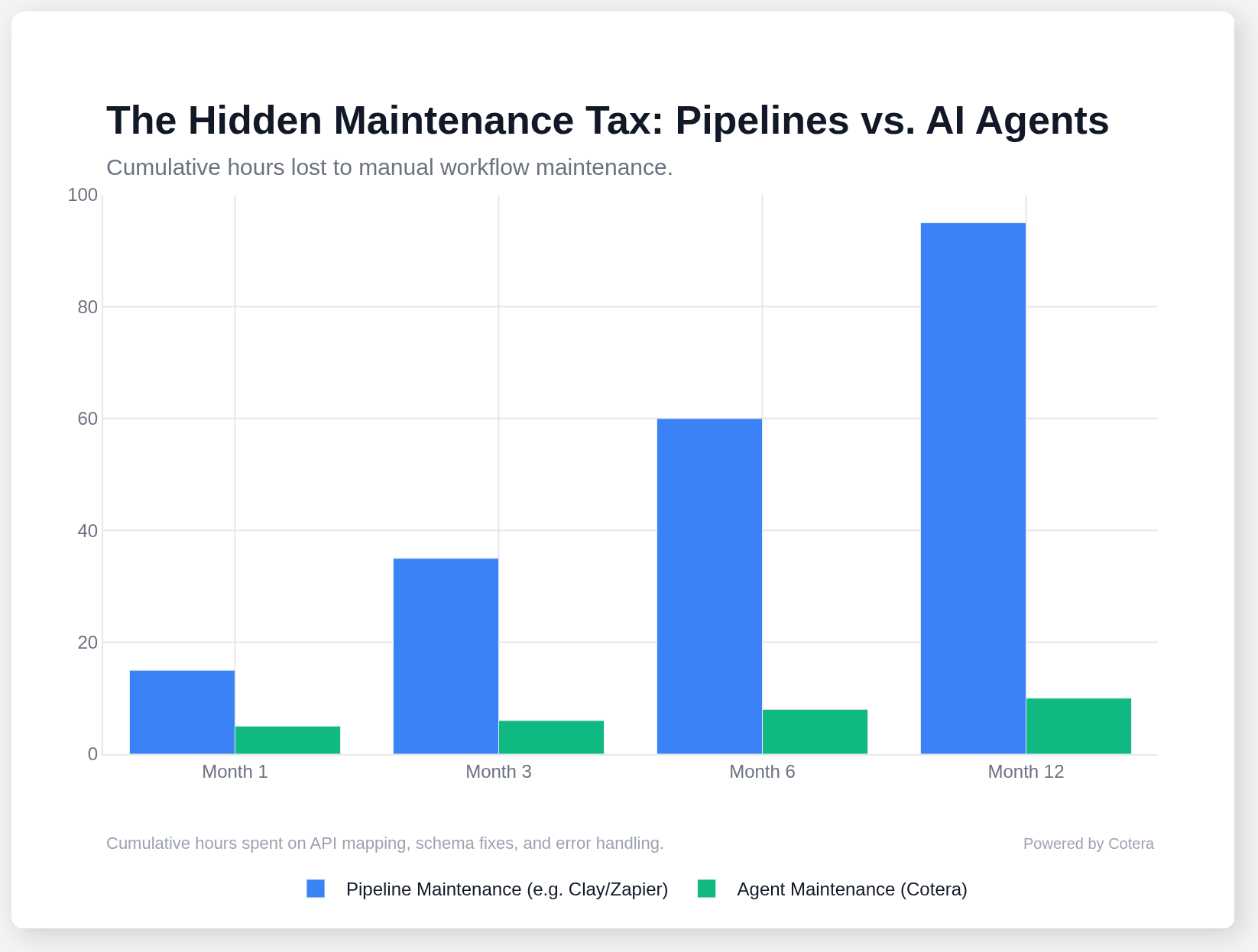
The fundamental problem isn't the data providers themselves. The tools have great data. The problem is the "pipes" connecting them. Traditional workflow tools are "dumb." They cannot think. If a company changed its name from "Twitter" to "X," a standard pipeline simply breaks. You need an agentic layer that can reason through the mess. You need a system that can cross-reference sources and handle the messy data that breaks standard rules.
From Flowcharts to Plain English: AI Agents for Sales
Here is where it gets really interesting. Instead of building a flowchart, what if you could just describe what you want in plain English?
This is the massive shift from "Workflow Automation" to "Agentic Automation." With AI agents for sales, you do not draw arrows between boxes. You write a prompt.
Think about the difference. In a traditional setup, you have to map every single field and handle every "if/then" scenario manually. If the tool finds an email but no phone number, what happens? If the LinkedIn profile is private, does the workflow stop? You have to build the logic for every single edge case.
With an AI agent, you just say:
"Find this lead's LinkedIn. Check if they have posted about AI in the last 30 days. Cross-reference their tech stack with BuiltWith. Finally, score them 1-10 on likelihood to buy our product based on those signals."
The AI agent does not just follow a static path. It figures out which data enrichment tools to use in real-time. It handles the edge cases. It retries when a tool fails. It delivers a structured, qualified result without you ever having to look at an API key or a mapping screen. It is not just automation. It is intelligence.
Real-Time Signals vs. Static Data Enrichment Tools
The biggest issue with the old-school AI lead generation stack is that it relies on static databases. Clearbit and ZoomInfo are great for "who" someone is. However, they are notoriously terrible at answering "why" someone should buy right now.
Static data tells you a person's title is "Director of Ops." That is fine, but it is not enough to win a deal. Dynamic signals tell you that Director of Ops just hired three new SDRs. They mentioned "scalability" in a recent podcast interview. Their company just finished a Series B. That is a real buying signal.
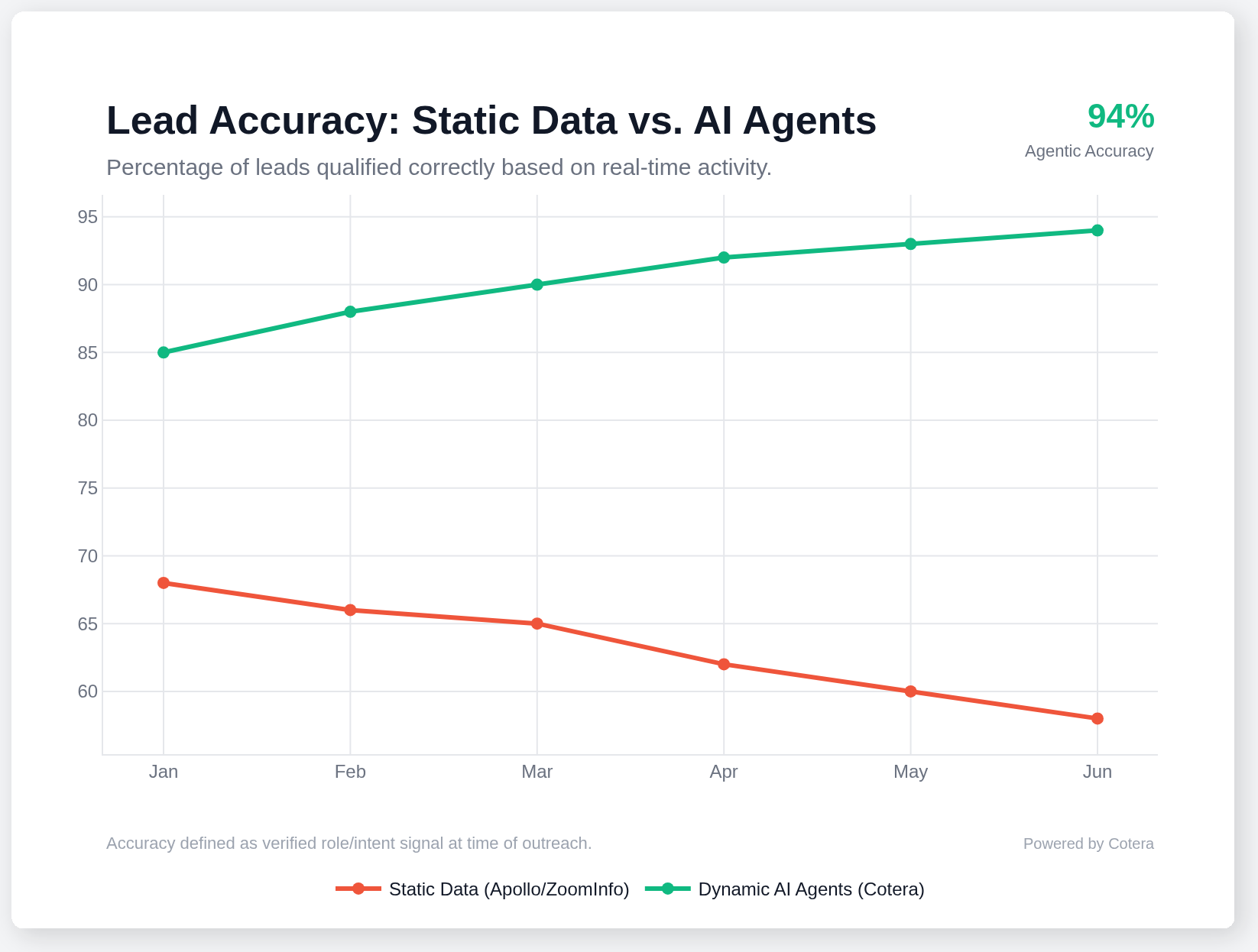
When you use AI agents to hunt for these dynamic signals, your lead accuracy doesn't just improve. It sky-rockets. Standard enrichment is lucky to hit 70% accuracy on intent because the data is often months out of date. Agentic enrichment pushes that past 90% because it is verifying information in real-time across the live web.
The Technical Debt of "No-Code"
We have been sold a lie that "no-code" means "no work." Tools like Zapier or Clay have made it easier to connect apps, but they haven't reduced the complexity of the logic. If anything, they have moved the complexity from the code editor to the drag-and-drop canvas.
Building a 20-step lead enrichment waterfall in a spreadsheet is just programming by another name. You are still writing the logic. You are still debugging the errors. You are still responsible for the architecture.
AI agents represent the death of the architecture phase. You shouldn't have to be a systems architect to find out if a prospect is hiring. You should just be able to ask the question.
Which Strategy Do You Actually Need?
I get asked this a lot: "Ibby, when should I use a standard pipeline and when should I use an agent?"
Use Traditional Pipelines (Clay/Zapier) if:
- You have a dedicated engineer to fix broken workflows every week.
- Your data is simple and never changes.
- You enjoy spending your weekends mapping API fields.
Use AI Agents (Cotera) if:
- You need high-intent leads that actually convert into revenue.
- You want to hunt for complex signals like LinkedIn posts, podcast mentions, or hiring trends.
- You want a system that "just works" without a 15-step flowchart.
The "So What?"
If your sales team is still fighting with broken pipelines, you are losing to the competition. The goal of enrichment is not to fill your CRM with more rows. The goal is to give your reps a valid reason to pick up the phone.
Every minute your RevOps team spends as a "pipeline plumber" is a minute they are not spending on strategy. Every "low intent" lead your SDRs call is a waste of your customer acquisition cost.
My advice is simple: stop building. You do not need a more complex pipeline. You need a smarter agent.
At Cotera, we built the Lead Enricher & Qualifier to do exactly this. We have seen our customers generate massive ROI by moving away from static databases. They are moving toward real-time, agentic signals. No flowcharts. No maintenance. Just the buying signals you actually care about, delivered directly into your stack.
If you're tired of being a full-time pipeline plumber, take a look at how we handle agentic enrichment. It is time to let AI do the heavy lifting so you can get back to closing deals.
The era of the "pipeline" is over. The era of the "prompt" has begun. Are you ready to stop plumbing?
Try These Agents
- Lead Enricher & Qualifier — Enrich and score leads with company data, funding signals, and buying intent
- Apollo Lead Research — Deep research on leads using Apollo data
- Company Growth Analyzer — Track hiring, funding, and expansion signals