
AI SDRs: What They Actually Get Right (And Where They Completely Fall Apart)

I hired my first SDR in 2021 for $55,000 base plus commission. She was great. She was also spending roughly six hours a day not selling — pulling contact data from Apollo, cross-referencing LinkedIn, writing first drafts of emails that I'd then rewrite, logging activities in Salesforce that nobody ever looked at, and building "target account lists" in spreadsheets that went stale the week after she made them. The two hours of actual selling she squeezed in? Those generated all the pipeline. Everything else was theater dressed up as productivity.
When I first heard the term "AI SDR" at a conference last year, I had a physical reaction. Part excitement, part dread. Excitement because I knew that six hours of busy work was begging to be automated. Dread because I'd seen what happens when vendors promise to replace a human role entirely — you get a worse version of the human at a lower price, and then you spend six months cleaning up the mess.
Twelve months later, I have opinions. Strong ones.
What an AI SDR Actually Does Well
Let me be specific, because the marketing pages for these tools are deliberately vague. An AI SDR tool is, at its core, software that handles the repetitive, non-conversational parts of the SDR job. Not the whole job. The parts that don't require a pulse.
Here's where I've seen AI SDRs deliver real results:
- Prospect research at speed. Give it a list of 200 target accounts and it'll pull firmographics, funding rounds, tech stack, recent news, job postings, and leadership changes. An SDR doing that manually takes a week. The agent does it in an afternoon. This is the single biggest win.
- Sequence creation and management. First-draft email sequences based on actual research about the prospect — not "I noticed you're crushing it" template garbage, but references to a specific job posting or a funding round from last month. The rep reviews and tweaks. The AI handles the scaffolding.
- Follow-up cadence. The third email in a sequence. The breakup email. The "just checking in" after a no-show. These are mechanically predictable. Nobody should be typing them from scratch in 2026.
- Data hygiene. Bounced emails flagged, stale contacts removed, CRM fields updated. The silent killer of outbound performance is bad data, and SDRs are notoriously awful at keeping their lists clean because it's boring and unrewarding work.
None of these are glamorous. That's the point. The AI SDR's real value is in the work that humans do badly because it's tedious, not because it's hard.
Where AI SDRs Completely Fall Apart
Now the part nobody puts in the demo reel.
An AI SDR cannot qualify a lead. I don't care what the vendor tells you. Qualification requires understanding context that doesn't exist in any database — is this person a real buyer or a tire kicker? Is their "interest" genuine or are they gathering competitive intel for their current vendor? When they say "we're evaluating options in Q3," does that mean Q3 of this year or Q3 of never?
Experienced SDRs develop a feel for this. They hear something in a prospect's voice on a cold call. They notice the prospect asked about pricing before asking about features, which means they've already decided they need the product and are now checking boxes. They pick up on the fact that the prospect's VP was cc'd on the reply, which means this got escalated internally. An AI SDR reads none of those signals. Zero.
Here's my list of things you should never hand to an AI SDR:
- Live objection handling. "We already use [competitor]" requires a nuanced response that depends on which competitor, what the prospect's actual pain is, and whether they're open to switching or just being polite. The AI gives you a canned rebuttal that sounds like a battle card someone wrote in 2024.
- Qualification calls. BANT, MEDDIC, whatever framework you use — it requires reading a room. The AI can't read a room because there's no room to read. It's text on a screen.
- Relationship building. Remembering that a prospect mentioned their kid's soccer tournament. Referencing a conversation from three months ago. Being a human that another human wants to talk to.
- Knowing when to stop. An aggressive follow-up sequence can damage your brand permanently with an account you might want to sell to in eighteen months. AI SDRs don't have a "this person is getting annoyed" sensor.
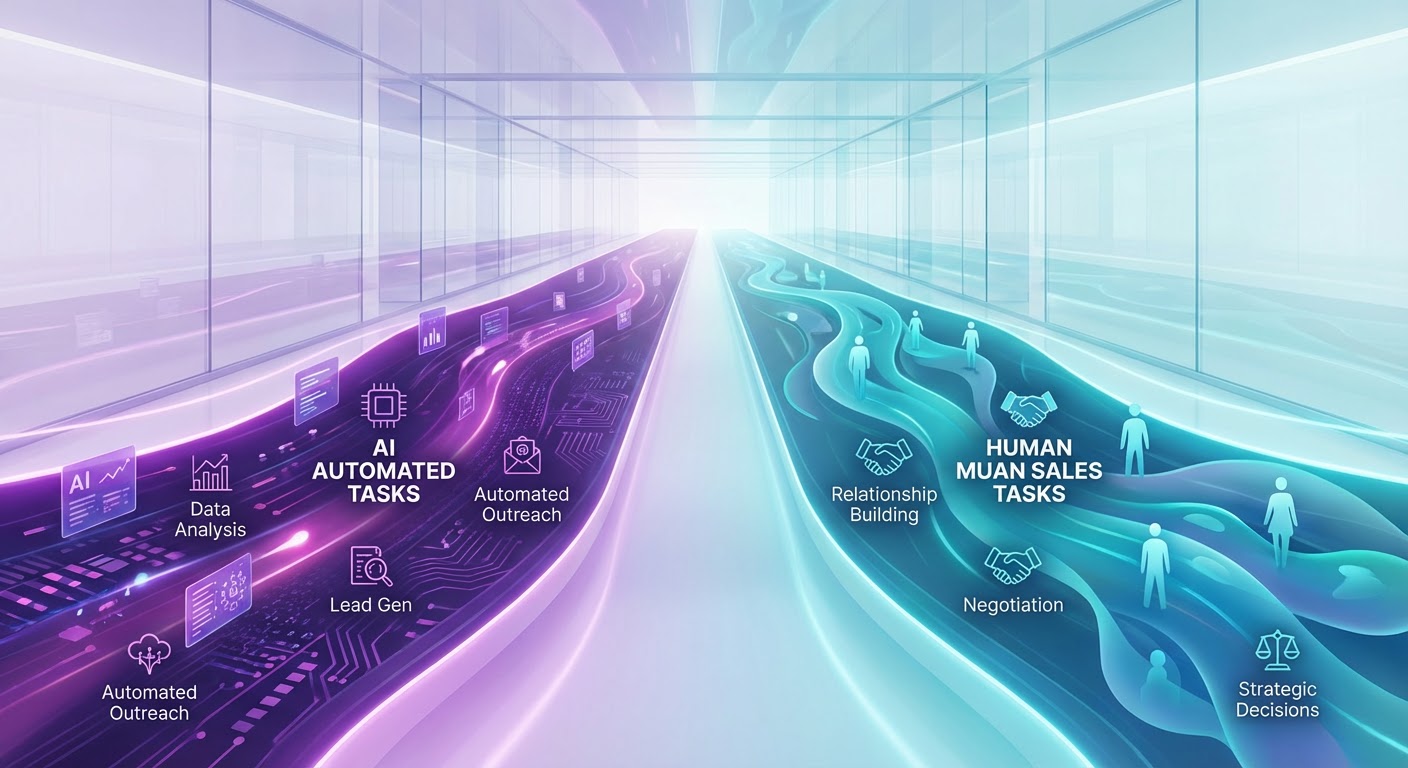
The pattern here is clear: AI handles tasks. Humans handle judgment.
https://pub-ae9c8505c57f401aa194a63cd37cc9bc.r2.dev/article-ai-sdr-mid.png
How to Deploy an AI SDR Without Wrecking Everything
The companies I've seen get this right don't treat the AI SDR as a replacement for the human. They treat it as a layer that sits underneath the rep, handling the foundation so the rep can focus on the stuff that actually closes deals.
Here's the setup that's worked for us:
The AI handles top-of-funnel grunt work. It builds prospect lists from trigger events (new funding, leadership changes, job postings for roles your product serves). It writes first-draft outreach. It manages the follow-up cadence. It keeps the CRM accurate. This is where we run our Instantly + Apollo cold outreach agent — it pulls prospect data from Apollo and drops campaigns directly into Instantly without anyone copy-pasting between tabs.
The human handles everything after first contact. The moment a prospect replies — positive, negative, curious, confused — a human takes over. Every single time. No exceptions. The AI drafts a suggested response, sure. But a person reads it, edits it, and decides whether to send it.
Multi-channel, but coordinated. Email alone is dying. You need LinkedIn, email, and sometimes phone working together in a sequence that doesn't feel like three different robots attacking someone from three angles. Our HeyReach multi-channel prospector coordinates this — email and LinkedIn touches in a single sequence, timed so the prospect gets a LinkedIn connection request the same morning as the first email.
Signals, not spray. The old model was: build a list, blast the list. The AI SDR model that works is: monitor for signals, build a micro-list of 10-15 accounts showing intent this week, and hit those with researched outreach. Our outbound sales automation agent watches for those trigger events and builds sequences around them. The volume is lower. The hit rate is dramatically higher.
Why Use an Agent Instead of Doing This Manually
You could, theoretically, have your reps do all of this themselves. Monitor news, check job boards, cross-reference CRM data, write personalized emails, manage follow-up timing, update Salesforce. Some SDRs even try. They last about two weeks before the research gets sloppy and the follow-ups get missed and the CRM goes stale again.
I tracked one of my reps for a full week last quarter. She had 47 accounts in active outreach. She managed to do meaningful research on about 12 of them. The other 35 got the template treatment — name, company, generic opener, same pitch. Her reply rate on the researched accounts was 11%. On the template accounts it was 0.8%. Same rep, same product, same ICP. The only difference was whether she had time to actually prepare.
An AI SDR gave her that time back for all 47 accounts. Not perfect research — she still tweaked things and caught errors. But a solid starting point for every single prospect, every single day, without her spending five hours assembling it.
The math is not complicated. If your SDR's time costs you $70/hour fully loaded and they spend four hours a day on work an agent can do, that's $280/day you're paying for robot work at human rates. Multiply by your team size. Wince.
The Short Version
An AI SDR is not a sales rep. It's the machinery behind a sales rep. Research, sequencing, follow-ups, data maintenance — the foundation that makes the human conversations better. The vendors selling "autonomous AI SDRs" that replace your team are selling a fantasy that'll cost you pipeline when it underperforms. The practical play is AI doing the groundwork, humans doing the selling, and a clean handoff between the two.
The companies winning with AI SDR tools right now aren't the ones who fired their SDRs. They're the ones whose SDRs suddenly have six hours a day to actually sell.
Try These Agents
- Outbound Sales Automation -- Build signal-driven outbound sequences with automated research and personalization
- Instantly + Apollo Cold Outreach -- Build and launch cold email campaigns with Apollo prospect data piped directly into Instantly
- HeyReach Multi-Channel Prospector -- Run coordinated multi-channel outreach across email and LinkedIn with HeyReach