
How to Build a Competitive Intelligence Brief That People Actually Read
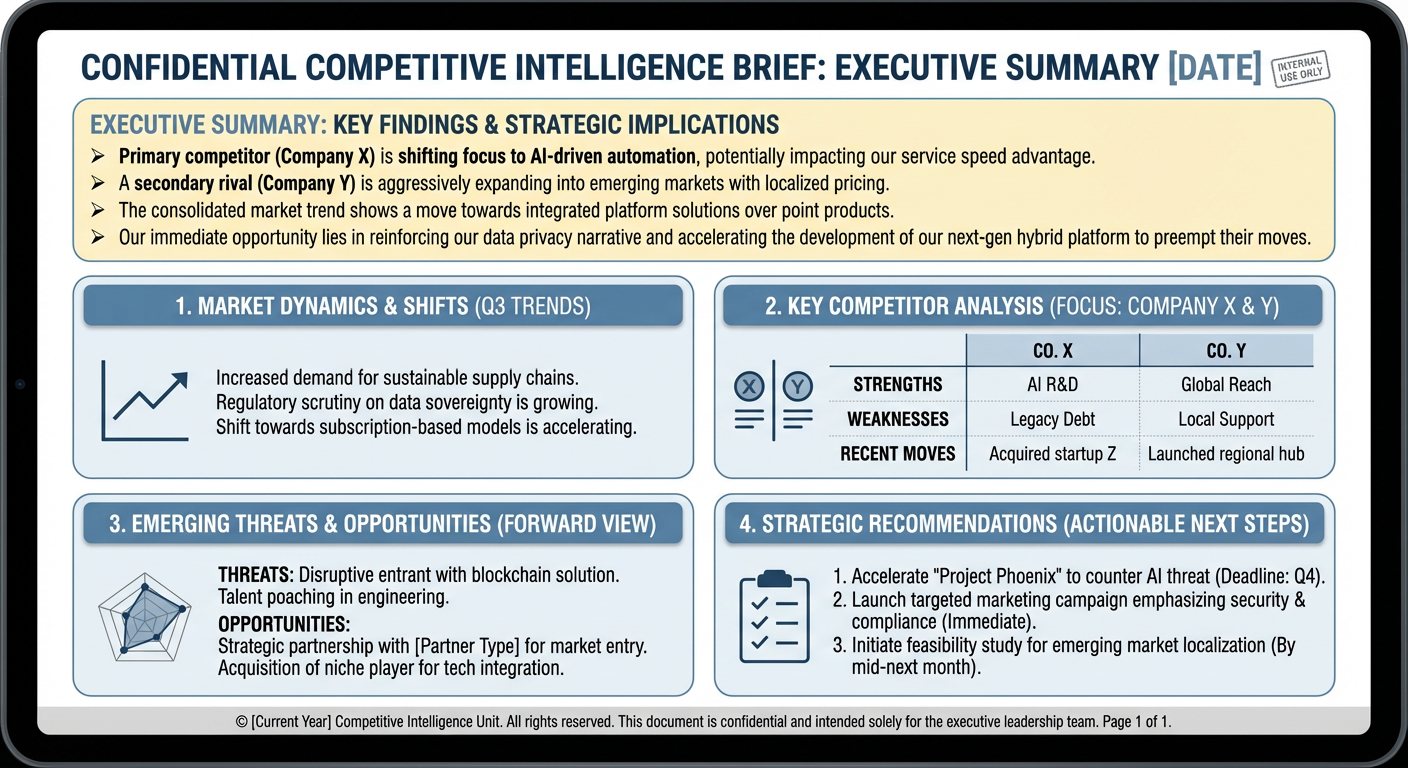
Last year I watched a product marketing manager present a 42-page competitive intelligence deck to the leadership team. She'd spent three weeks on it. Gorgeous charts. Color-coded matrices. A comparison table with seventeen columns. The CEO nodded along for about twelve minutes, then asked one question: "So what should we actually do differently?" The room went quiet. The deck had everything except the answer to the only question that mattered.
Three months later, that same PMM started sending a one-page brief every month. No charts. Bullet points, a few sentences of analysis, and three recommended actions at the bottom. The CEO read it on his phone between meetings. The head of sales forwarded it to her reps. One page replaced forty-two, and it got ten times the engagement.
The dirty secret of competitive intelligence analysis: nobody wants the data. They want someone to tell them what the data means and what to do about it. The brief is the format that delivers that.
What Goes in the Brief
One page. Not two. Not "a few." One. If your brief doesn't fit on a single page, you haven't forced yourself to decide what matters yet. I use four sections and nothing else:
Competitor snapshot — a few sentences per competitor. Current positioning, anything notable this month, whether they're gaining or losing steam. Think status update, not biography. Nobody needs three paragraphs about a competitor's founding story.
Market moves — the three to five most notable things that happened. A pricing change, a new entrant, a feature launch that overlaps with your roadmap. State them plainly. No editorializing yet.
Strategic implications — this is where a brief earns its existence. For each move: what does it mean for us? A competitor staffing up enterprise AEs in Germany isn't just "growth." It means they're about to show up in accounts your team assumed were safe. Write that out loud.
Recommended actions — two or three specific things to do. Not "continue monitoring." Real actions: update the competitive battle card, brief sales on a freshly discovered weakness, accelerate the integration that's blocking pipeline.
Four sections, one page. Kill everything else.
Where to Pull the Data From
People assume competitive intelligence platforms have access to secret data. They don't. Basically everything you need is public. The challenge was never collecting it — it was making sense of all of it at once.
I pull from six places. Job postings on LinkedIn, Indeed, and Greenhouse boards — hiring tells you where a company is investing months before they announce anything. Review sites like G2 and Capterra — cluster the complaints and you've basically got a positioning cheat sheet. Social media, specifically founder LinkedIn posts and Reddit threads where customers talk honestly (Twitter too, though the signal-to-noise ratio is brutal). SEO tools like SimilarWeb and Ahrefs — keyword shifts reveal positioning changes, traffic trends expose whether growth claims hold up. Press and news — funding rounds matter because they tell you how much a competitor can burn over the next year. And ad transparency tools like Meta Ad Library — what messaging they're testing, what landing pages they're building.
You don't need a $30K competitive intelligence software contract for any of this. You need someone (or something) that can look at all six sources and weave them into a story that means something.

Making It Actionable
Most competitive briefs fail at the last mile. They describe what competitors did but stop short of saying what your company should do about it. I've read hundreds of competitive updates that amount to "Competitor X launched Feature Y." Great. And?
The difference between observation and intelligence is the "so what." Every finding in your brief should connect to a decision someone on your team can make.
My test: if a line item in your brief wouldn't make anyone do anything differently, cut it. "Competitor A published 12 blog posts this month" is trivia. "Competitor A published 12 blog posts targeting the exact keyword cluster we're launching into next quarter, and they just hit position 3 for our target term" — that rewrites your content calendar.
A few examples from briefs I've written that actually moved the needle: telling sales that a competitor's G2 reviews consistently complain about implementation speed (instant talk track for deals where time-to-value matters). Flagging for product that a competitor shipped the integration we deprioritized in Q3, and three deals last month cited it as a deciding factor (that got it back on the roadmap within a week). Alerting marketing that a competitor's organic traffic cratered 30% after a botched site migration and naming the five keywords we should attack while they're recovering.
Each finding connects to a team, evidence, and a specific next step. That's what separates a brief people forward from one they archive.
Why Use an Agent
Building a competitive intelligence brief the manual way means spending a full day per competitor per month — opening fifteen tabs, cross-referencing job boards with review sites with traffic data, and trying to hold the pattern in your head long enough to write something coherent. I did this for years. It's miserable, and it's why briefs get skipped or go stale.
A market intelligence agent handles the collection and first-pass synthesis. Point it at a competitor and it pulls hiring data, review sentiment, keyword rankings, traffic trends, and recent news — then connects the dots across those sources into a draft brief with actual takeaways instead of a data dump.
You still validate the analysis, add context only you have (pipeline data, roadmap priorities, what happened in last week's all-hands), and make the call on recommendations. But the grunt work that used to eat a full day now takes maybe thirty minutes of review and editing.
The result: briefs actually get written monthly instead of quarterly. And monthly briefs compound. That competitor whose hiring you barely noticed in January? By March you can see they've added fourteen engineers and a head of AI. That's a pattern. That's intelligence.
The Brief That Gets Read
The format matters more than people think. Same intelligence, delivered as a 40-page deck versus a one-page brief. The deck sits in a shared drive. The brief gets forwarded to the CEO. Choose the format that gets read.
One page. Four sections. Updated monthly. That's a competitive intelligence program that works without expensive market intelligence tools or a dedicated CI team. It requires discipline about what matters, a source for the data, and the willingness to say "so what" after every finding.
Stop building decks. Start writing briefs.
Try These Agents
- Market Intelligence Agent — Full competitor research: hiring, reviews, keywords, traffic, founders, and news in one report
- SEO Competitor Analyzer — Find competitor keywords, content gaps, and SEO opportunities
- Competitor Pricing Analyzer — Track and compare competitor pricing strategies and changes
- Sentiment Analysis — Analyze customer sentiment across reviews, social media, and forums