
How to Do a Competitive Pricing Analysis (Full Framework)
Pricing is the single most important variable in any competitive market. It's also the one that gets the least structured analysis. I know this because I've been in the room when pricing decisions get made, and the "competitive data" is usually someone pulling up two or three competitor websites on a projector and going "looks like they charge about $20 per seat."
That's not analysis. That's vibes.
A couple years ago I worked with a B2B SaaS company that had been losing mid-market deals for months. Win rate dropped from 35% to about 22%. The CEO was convinced they had a product problem. The VP of Sales thought it was messaging. They'd spent $80K on a brand refresh. Nobody had actually built a pricing comparison against their competitors in over a year. When we finally did, the answer was painfully obvious: two competitors had restructured their tiers six months earlier and were offering nearly identical feature sets at the same tier where this company charged 40% more. The product was fine. The price was wrong.
That's the kind of thing a proper competitive pricing analysis catches. Here's the full framework.
Step 1: Gather Competitive Pricing Data
Before you analyze anything, you need data. And the data is messier than you want it to be.
Start with the obvious sources: public pricing pages. Go to each competitor's /pricing URL and document everything. Not just the headline numbers. Everything.
What to capture for each competitor:
- Tier names and count. Three tiers? Five? A hidden enterprise tier behind "Contact Sales"?
- Price points. Monthly and annual, per seat and per account. Normalize everything to a single unit (monthly per-seat is the standard comparison unit in SaaS).
- Feature lists at each tier. Every feature, including the ones in fine print.
- Usage limits. Contacts, API calls, storage, seats, users, whatever they meter.
- Add-ons and overage pricing. These are often where the real cost lives.
- Discounts. Annual billing discount percentage, startup programs, nonprofit pricing.
For competitors without public pricing, get creative. G2 and Capterra reviews mention pricing details. The Wayback Machine archives old pricing pages. Reddit threads surface real quotes. And sometimes you just book a demo and ask.
Step 2: Build a Feature/Tier Matrix
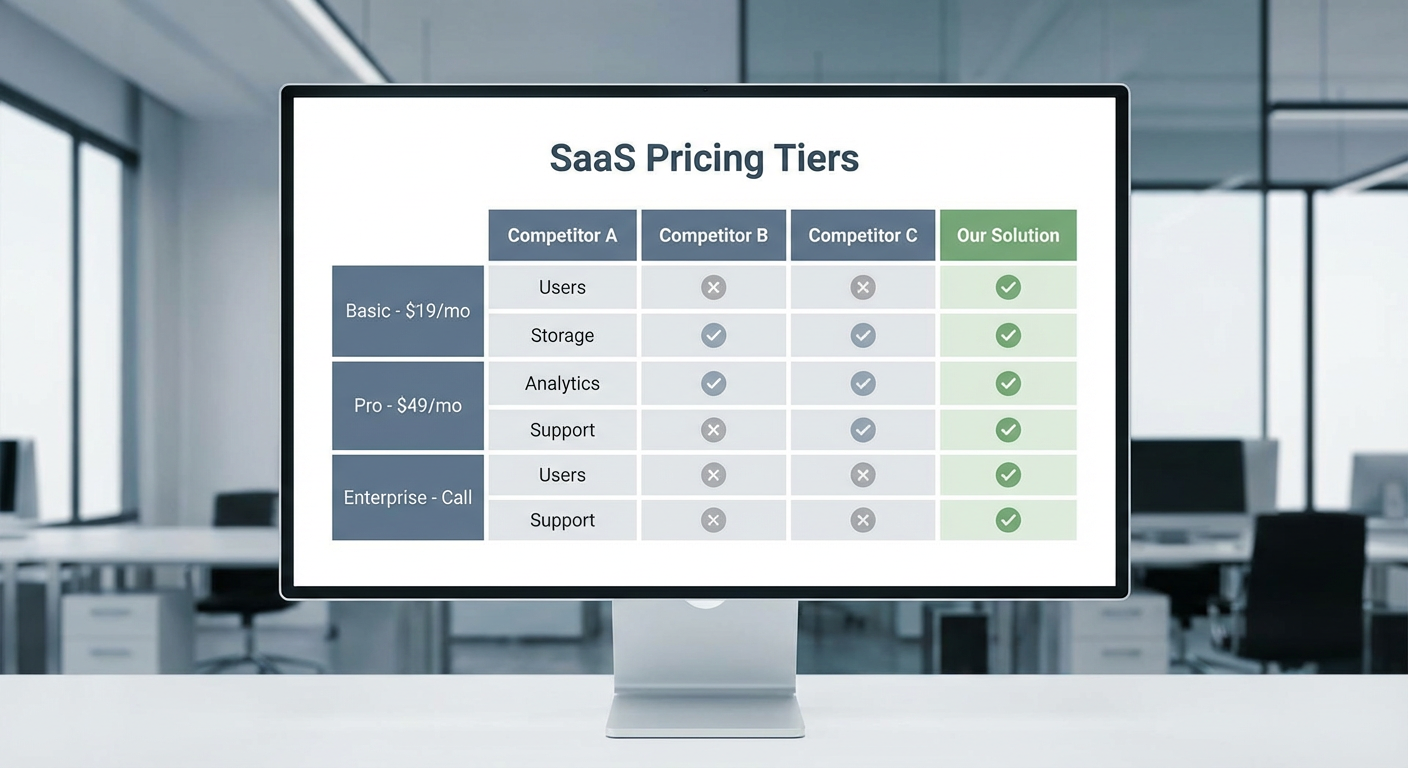
Raw pricing numbers without feature context are meaningless. A price competitor charging $15/seat sounds cheaper until you realize their $15 plan doesn't include the three features your customers care about most.
Build a matrix. Columns are competitors (including you). Rows are every feature that matters in your category. Cells show which tier includes that feature.
This is the single most useful artifact in the entire analysis. Here's why.
It immediately shows where you're overcharging relative to feature access. If every competitor includes reporting in their mid-tier plan and you gate it behind enterprise, you have a packaging problem. It also shows where competitors leave money on the table by giving away features they could charge for.
Include 20-30 features, not 200. The ones that actually influence purchase decisions. If you're not sure which those are, ask your sales team. They'll tell you in ten seconds.
Step 3: Build a Positioning Map
Take the feature/tier matrix and turn it into a visual. The classic positioning map uses two axes: price (low to high) on the X-axis and feature depth (basic to full-featured) on the Y-axis. Plot every competitor.
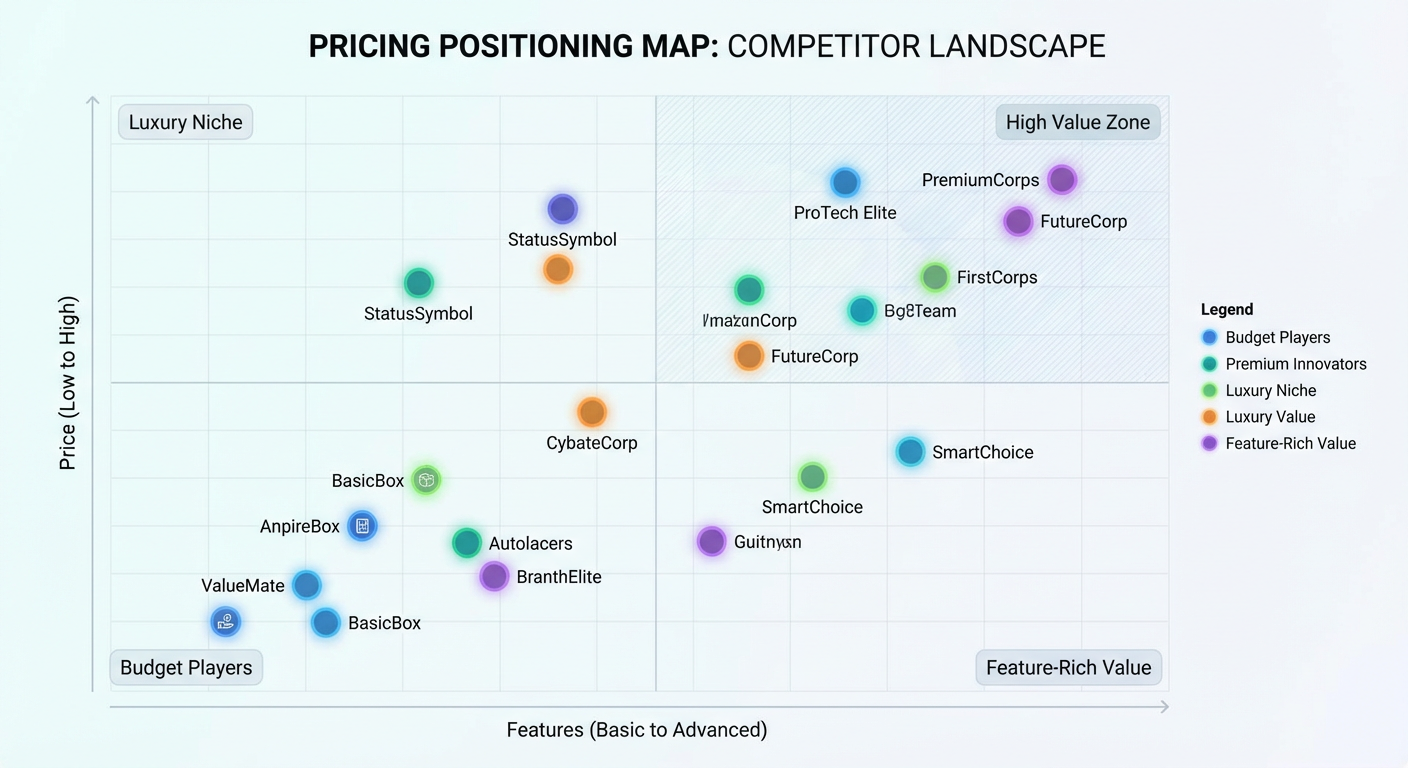
This is where patterns become visible. You'll typically see one of three shapes:
The diagonal line. Competitors are spread from cheap-and-basic to expensive-and-full-featured. Mature market. Your options: find a gap on the line or break the pattern by offering full features at a lower price point.
The cluster. Most competitors bunched in a tight range. Commodity market. Differentiation has to come from something other than features and price — brand, support quality, ecosystem. Or you break out of the cluster entirely.
The scatter. Competitors everywhere. Immature or fragmented market. Pricing isn't standardized and customers are confused about what things should cost. This is the best competitive scenario because you can set expectations rather than follow them.
Your price competition strategy depends entirely on which shape you're looking at. Don't pick a pricing strategy before you know the shape of the market.
Step 4: Identify Market Gaps
The positioning map shows you where competitors are. The gaps show you where they aren't.
Look for empty quadrants or sparse zones. Is there nobody offering a full-featured product at a mid-market price? Is there nobody serving the low end with a credible product? Is every competitor annual-only, leaving an opening for monthly billing?
Not every gap is an opportunity. Some exist because the market already tried and rejected that positioning. Customer research tells you which gaps are real. But I've seen companies double their win rate just by restructuring tiers to serve a segment everyone else was ignoring.
Other gap types to look for:
- Billing model gaps. Everyone charges per seat but nobody offers usage-based pricing.
- Segment gaps. Nobody has a credible plan for teams under 10 or over 500.
- Packaging gaps. Nobody bundles feature X with feature Y even though customers routinely need both.
Step 5: Define Your Price Competition Strategy
With the data, matrix, map, and gap analysis in hand, you can now make a pricing decision grounded in competitive reality instead of gut feeling.
Your options boil down to three strategies:
Price leadership. Be the cheapest. Only works if you have a structural cost advantage or you're willing to accept lower margins for market share. Valid strategy. Dangerous if your cost structure doesn't support it long term.
Value differentiation. Price higher and justify it. This requires your feature/tier matrix to clearly show you offer something at your price point that nobody else does. If the matrix shows you're priced 30% higher with an identical feature set, you don't have a differentiation strategy — you have a pricing problem.
Niche positioning. Target a specific segment that competitors underserve. Maybe you're the only one with a genuine free tier for startups, or the only one with compliance features for healthcare. Niche pricing trades total addressable market for higher win rates in a narrower segment.
Pick one. You can't be the cheapest, the most full-featured, and the most specialized simultaneously.
Why Use an Agent
This entire framework takes days when done manually. Not because any step is hard. Because there are five to eight competitors, each with multiple tiers, each with dozens of features, and organizing it all in a spreadsheet while checking that your data is current is the kind of work that makes smart people want to quit.
A competitor pricing analyzer agent does the mechanical parts: scraping pricing pages, normalizing price points, extracting feature lists, building the competitor pricing comparison matrix, and flagging changes since your last analysis. You focus on interpretation — the positioning map, the gap analysis, the strategic implications. The part that actually requires judgment.
The other advantage is frequency. Manual competitive pricing analysis happens once a year, maybe twice. Agent-assisted analysis can happen quarterly without anyone losing a week to spreadsheet work.
Do the analysis. Update it quarterly. Feed the output to your sales team, your product team, and whoever owns pricing. Competitors restructure tiers, raise prices, kill free trials. If your last analysis is six months old, you're making decisions against a market that no longer exists.
Try These Agents
- Competitor Pricing Analyzer — Build side-by-side pricing and feature comparisons across your competitive set
- Market Intelligence Agent — Full competitor research including pricing, hiring, reviews, and traffic
- SEO Competitor Analyzer — Find competitor positioning and content strategies through keyword and backlink analysis