
Sales Intelligence Platforms: What Actually Matters
I spent $38,000 on a sales intelligence platform last year. Annual contract, enterprise tier, the whole thing. We got access to 200 million contacts, intent data from some mysterious network of B2B publishers, and a dashboard with so many filters it felt like flying a commercial airplane. Six months in, I pulled the usage report. Our team of eight reps had run a combined total of forty-one searches. Forty-one. That's about five searches per rep over six months. We were paying roughly $927 per search.
The contacts were stale. The intent data was vague. And every time a rep actually needed to prep for a call, they just Googled the company and checked LinkedIn like they always did.
That experience changed how I think about sales intelligence. The problem was never access to data. The problem was that nobody could tell me what a "sales intelligence platform" was actually supposed to do.
What Sales Intelligence Actually Is
Strip away the vendor marketing and sales intelligence is just this: data about companies that tells you whether they're likely to buy something, and when.
That's it. It is not magic software that closes deals. It is not a database of phone numbers. It is information about what's happening inside a company right now that might make them a good prospect.
The signals that actually matter:
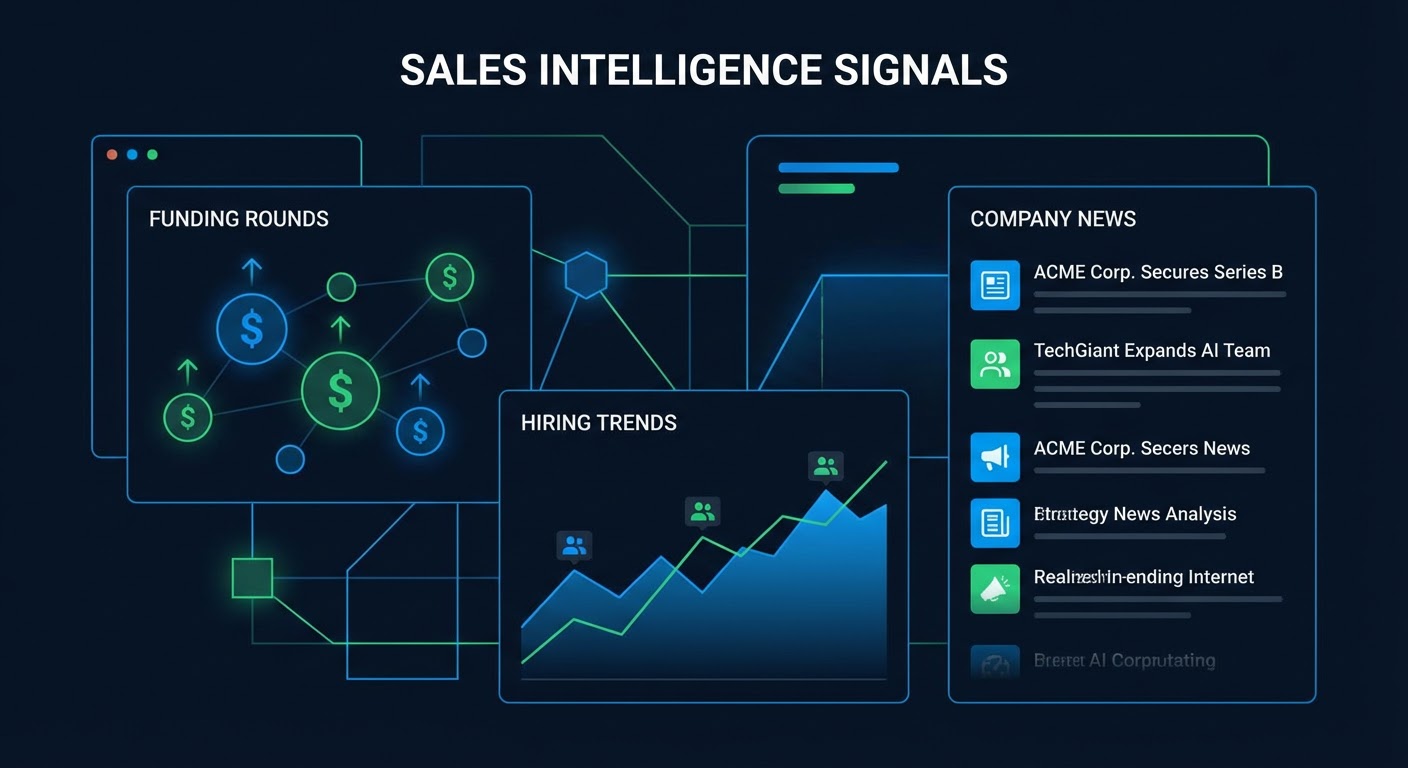
- Funding events. A company that just closed a Series B has money to spend and problems to solve. A company that raised a down round is in cost-cutting mode. Both are useful to know. The signal isn't "they raised money." The signal is what kind of money, how much, and what stage they're at.
- Hiring patterns. If a company posted twelve engineering jobs last month and zero this month, something changed. If they're hiring their first VP of Sales, they're about to build an outbound motion and might need tools for it. Job postings are one of the most reliable predictors of what a company will spend money on in the next quarter.
- Tech stack changes. When a company rips out one CRM and adopts another, that's a buying signal for everyone in the adjacent ecosystem. Tools like BuiltWith and SimilarWeb track these changes. Most reps never look.
- Leadership moves. A new CTO means new vendor evaluations. A new CFO means budget reviews. A new VP of Marketing means the agency roster is about to get reshuffled. Leadership changes trigger purchasing decisions more reliably than almost any other signal.
- Earnings reports. For public companies, the 10-K and 10-Q filings tell you everything. Revenue growth, margins, what they're spending on R&D, where they see risk. The data is public and free. Almost no sales team reads it.
Why Most B2B Sales Intelligence Tools Disappoint
The sales intelligence tools market has a structural problem. Vendors sell access to data, but what reps actually need is interpreted data. Knowing that a company has 500 employees is not intelligence. Knowing that they grew from 200 to 500 employees in eighteen months, just raised $80M, and are hiring aggressively in your product category — that's intelligence.
Most platforms dump raw data into a dashboard and call it a day. Then they wonder why adoption is low.
Here's what I've seen go wrong:
Contact databases masquerading as intelligence. Having someone's email address is not sales intelligence. It's a contact list. A phone-verified email has value, sure, but packaging 200 million contacts as "intelligence" is a stretch. The contact is the delivery mechanism. The intelligence is knowing why you should contact that person right now.
"Intent data" that means nothing. I've been sold intent data from three different vendors. Every time, the explanation of where the data comes from is suspiciously vague. "Our network of B2B media publishers." What publishers? "We can't disclose that." Right. The few times I've been able to validate intent signals against actual pipeline, the correlation was barely better than random. Some intent data is real and useful. A lot of it is noise dressed up with a confidence score.
Dashboards nobody opens. Sales reps do not want another dashboard. They want the answer. "Is this company worth my time?" and "What should I say when I call them?" A platform that requires twenty minutes of clicking to answer those questions will lose to Google every time.

The Signals That Actually Close Deals
I've been tracking which data points my team actually references before meetings and in deal notes. After about a year of paying attention, the pattern is pretty clear.
The signals that show up most in closed-won deal notes:
- The company recently raised funding or hit a revenue milestone. Reps used Crunchbase data or SEC filings to understand the financial position and tailor the pitch to their growth stage.
- The company is hiring for roles that our product supports. If they're hiring data engineers and we sell data tools, that's a direct signal. Job postings beat intent data every single time in our data.
- A new leader joined in the last 90 days. New leaders bring new budgets and new priorities. Our best reps track leadership changes at target accounts and reach out within the first month.
- Something changed publicly. A product launch, a partnership announcement, an acquisition, a bad quarter. Any change is a conversation opener. No change means no urgency, and no urgency means no deal.
None of these signals require a $38,000 platform. They require knowing where to look and looking often enough for the information to be current.
What to Actually Look For in a Sales Intelligence Platform
If you are going to buy a sales intelligence platform, here's what separates the useful ones from the expensive screensavers:
- Signal recency. How fresh is the data? Funding data from six months ago is not intelligence. It's history. The platform should surface events within days, not weeks.
- Signal interpretation. Does it tell you what changed, or just that something changed? "Headcount grew 40% YoY" is more useful than "500 employees."
- Workflow integration. Does the intelligence show up where your reps already work, or does it live in yet another tab they'll forget about?
- Source transparency. Can you see where the data comes from? If not, you can't trust it. Good sales intelligence tools tell you the source — SEC filings, LinkedIn, Crunchbase, job boards. Black-box "intent networks" should make you skeptical.
The best sales intelligence setup I've seen was not a single platform at all. It was a rep who had a system: check Crunchbase for funding, check LinkedIn for headcount, pull the latest 10-Q for public companies, and scan recent news. Took him about twenty minutes per account. He outperformed every rep using the expensive platform by a wide margin.
Why Use an Agent
The rep I just described had great instincts, but his process didn't scale. Twenty minutes per account is fine when you're working ten accounts. When you're working sixty, that's twenty hours a week just on research. Nobody has twenty hours a week for research.
That's where agents come in. A Crunchbase account research agent pulls funding data, key contacts, and recent news for any account in under a minute. It does the same research that took my best rep twenty minutes, at the same quality, without the context-switching.
For companies that are hiring aggressively or showing growth signals, the company growth analyzer checks traffic trends, headcount changes, and competitive positioning across SimilarWeb and LinkedIn data. It gives you the "is this company worth my time" answer in seconds instead of requiring you to assemble it yourself from four different tabs.
And for public companies, the SEC financial research agent pulls revenue, margins, and growth rates straight from 10-K and 10-Q filings and organizes it into a spreadsheet. No more copying numbers out of EDGAR by hand. This is the data that tells you whether a company can afford what you're selling and whether their trajectory suggests they'll need it.
The point isn't to replace judgment. It's to make the research so fast that reps actually do it. A sales intelligence platform that requires twenty minutes of manual work per account is a platform that reps won't use. An agent that does the same work in sixty seconds is one they will.
The Short Version
Sales intelligence is not a platform. It is a practice. The companies that do it well are tracking funding events, hiring patterns, leadership changes, tech stack shifts, and financial performance — and they're doing it often enough that the information is still fresh when they pick up the phone.
The platform doesn't matter. The signals matter. Pick the data sources that predict buying behavior for your specific market, monitor them consistently, and act on changes fast. Whether you do that with a $38,000 annual contract or an agent that pulls the same data in a fraction of the time is up to you. But I know which one my reps actually use.
Try These Agents
- Crunchbase Account Research — Pull funding data, key contacts, and conversation hooks for any account before a sales call
- Company Growth Analyzer — Check if a company is growing, find their competitors, and see who's winning in their space
- SEC Financial Research — Extract quarterly financials from SEC filings and build a clean spreadsheet automatically