
AI B2B Lead Generation: What Works and What's Just Noise
I sat through a demo last month where the vendor promised their AI lead generation tool could "find 10,000 qualified leads per month." I asked what "qualified" meant. They said the leads matched our ICP filters. Industry, company size, geography. I said we already had those leads in Apollo. What we didn't have was any idea which of them would actually pick up the phone.
That interaction pretty much sums up where AI B2B lead generation is right now. Everyone's generating leads. Very few are generating qualified ones. The difference between "matches your ICP" and "might actually buy" is the whole ballgame, and most AI lead generation tools don't play it.
Here's what I've figured out after a year of testing this stuff with real pipeline on the line.
The Volume Trap
The first thing every B2B team does when they get an AI lead generation tool is crank up the volume. Makes sense intuitively. If we used to find 200 leads a month manually, and now we can find 2,000, our pipeline should 10x, right?
Wrong. What 10x'd was the number of contacts sitting in our CRM that nobody called. We went from 200 leads with maybe 40 good ones to 2,000 leads with the same 40 good ones buried somewhere in the pile. Our SDRs spent more time sorting through junk than they saved on prospecting. Net result: slightly worse than before, plus a $3,000/month software bill.
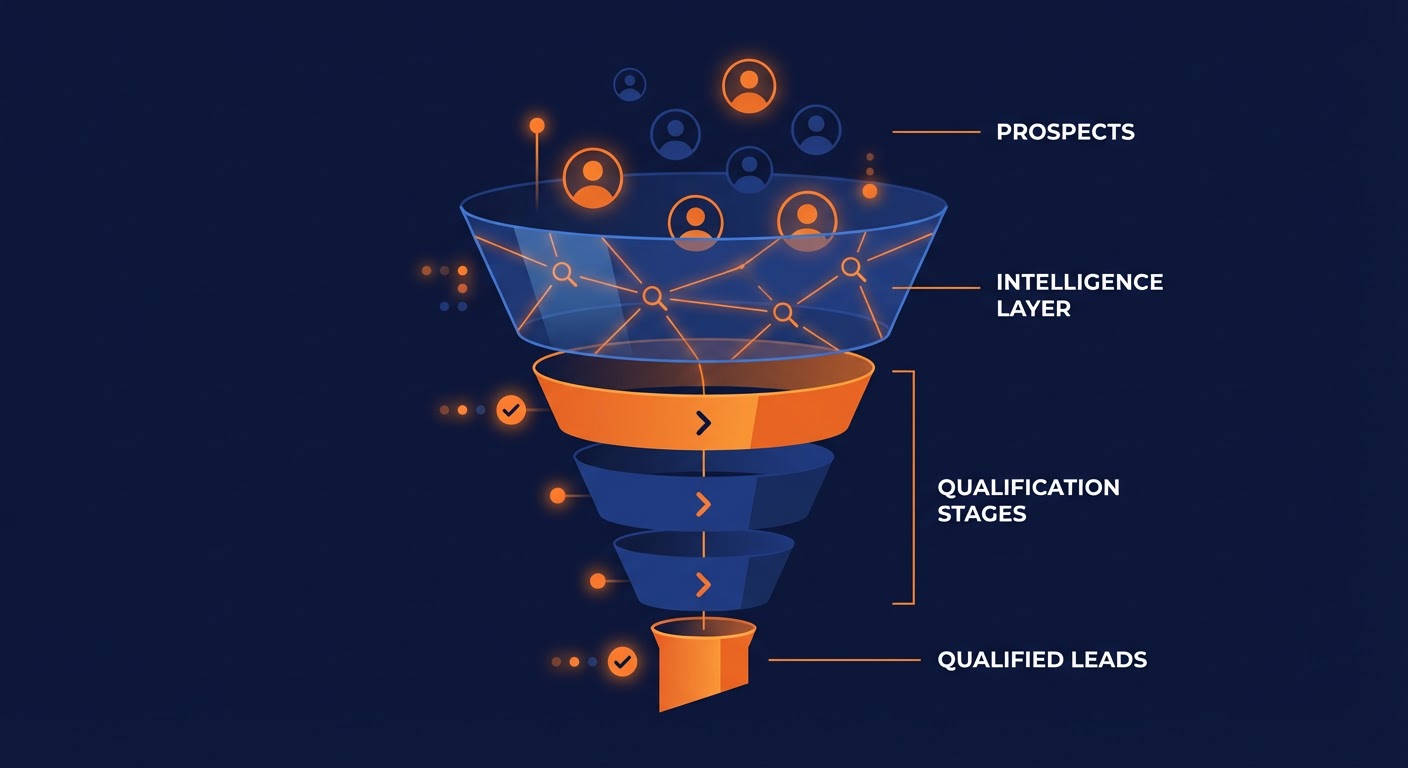
The volume trap happens because AI is really good at finding companies that match firmographic criteria. That's a simple pattern-matching problem. It's bad at knowing which of those companies have a buying trigger right now. And that second question is the only one that matters for pipeline.
What AI Lead Generation Actually Does Well
Let me be specific about what's working for B2B teams because there's a version of this that genuinely changes the math.
Signal detection across scattered sources. A human SDR can check LinkedIn, company news, job boards, and G2 reviews for maybe 10-15 companies per day before their brain melts. An AI agent can scan all four sources for 500 companies in the same time. The output isn't "here's a list of companies." It's "here are 23 companies where something changed this week that suggests they might need what you sell." That's a fundamentally different deliverable.
Research synthesis per lead. This is where AI lead generation tools earn their money. Pull Crunchbase data, recent news mentions, LinkedIn activity for the decision maker, hiring trends, and tech stack info — then condense it into a two-paragraph brief. Our reps read these before every call. First conversations improved because reps walked in knowing something instead of fishing.
Lead scoring that uses real signals. Traditional lead scoring is a points system that marketing sets up and nobody trusts. AI-powered lead scoring looks at actual behavior and contextual signals. Did this company just post a job for a role your product replaces? That's worth more than "visited the pricing page" and both of us know it.
Deduplication and hygiene. This is boring and nobody writes blog posts about it. But B2B databases are messy. Duplicate contacts, outdated titles, wrong email addresses, companies that got acquired six months ago. Running leads through an AI layer that catches these before they hit your CRM saves hours of cleanup later. I found 340 duplicate contacts in our HubSpot last quarter. Three hundred and forty. Some of them had been emailed by multiple reps.
What AI Lead Generation Does Badly
I need to be honest about this because the hype is out of control.
Writing cold emails. AI-generated outbound reads like it was written by a very enthusiastic intern who has never sent a cold email. It's technically correct, occasionally clever, and immediately recognizable as not-human. Every prospect I've talked to about this says the same thing: they can spot an AI email within the first sentence. Use AI for research. Write your own emails.
Replacing ICP judgment. Your AI lead generation tool is only as good as the ICP definition you give it. If your ICP is fuzzy ("mid-market companies that need better data"), the AI will return thousands of technically-matching companies that your reps waste time on. The garbage-in-garbage-out principle didn't go away because we added machine learning.
Predicting timing with firmographic data alone. Company size and industry don't tell you when someone is ready to buy. Behavioral signals do. A 500-person fintech that raised Series C two weeks ago is a completely different prospect than a 500-person fintech that raised Series C two years ago. Same firmographics. Wildly different timing. Tools that rely on static data for lead gen miss this entirely.
Building an AI Lead Gen System That Doesn't Suck
Here's what we actually run. It's not complicated, but the order matters.
Step 1: Define "qualified" before you touch any tool. Not ICP criteria. Qualification criteria. What has to be true about a company RIGHT NOW for your reps to want to call them? For us, it's: recent funding round, new hire in our buyer persona role, or public mention of a problem we solve. If none of those three signals exist, the company goes in a nurture bucket, not the active pipeline.
Step 2: Use AI for signal scanning, not list building. The tool should monitor your target account list for buying signals and surface the ones that triggered. This week, 14 of your 300 target accounts showed activity worth acting on. Here they are, here's what happened, here's the decision maker's contact info. That's AI lead generation done right.
Step 3: Enrich before routing. Every lead that passes the signal filter gets an automatic research brief. Company context, decision maker background, recent activity, competitive landscape. This brief lives in your CRM so the rep sees it before their first touchpoint.
Step 4: Route and track. Leads go to the right rep based on territory, segment, or round-robin. Performance tracking ties back to the signal that triggered the lead, so over time you learn which buying signals actually convert and which ones are noise.
Why Use an Agent for This
I tried building this system with three separate tools stitched together with Zapier. It worked for about two weeks before an API change broke the whole flow and we lost three days of leads. That experience convinced me to consolidate into an agent-based approach.
An AI prospecting agent handles the entire flow. It searches Apollo for companies matching your ICP, scans for buying signals, enriches the contacts that pass the filter, checks your CRM for duplicates, and creates the records. One prompt, full pipeline. The prospect list builder does the same thing but exports to Google Sheets if your team prefers to review there before pushing to CRM.
For the qualification step specifically, the lead enricher and qualifier pulls data from multiple sources and applies your scoring criteria automatically. It's the difference between "here are 500 leads" and "here are 500 leads, 47 of which are worth calling this week and here's why."
The math comes down to conversion rate. Our old approach: 2,000 AI-generated leads per month, 2% conversion to meeting, 40 meetings. Our current approach: 300 signal-qualified leads per month, 14% conversion to meeting, 42 meetings. Similar output. One-sixth the volume. Way less time wasted on dead leads.
Generate Fewer Leads, Better Leads
AI B2B lead generation isn't a volume play. If you want volume, export Apollo's entire database and start dialing. The actual value of AI in lead gen is intelligence — knowing which companies to call and why, right now, this week. Build your system around signals instead of firmographics and the pipeline quality changes immediately. More isn't better. Relevant is better.
Try These Agents
- AI Sales Prospecting — Signal-based prospect research that finds companies worth calling right now
- Apollo Prospect List Builder — Build filtered prospect lists from Apollo and export to Google Sheets
- Lead Enricher Qualifier — Enrich and score leads against your qualification criteria automatically
- Crunchbase Lead Prospector — Find companies by funding activity, growth signals, and market position