
AI Sales Agents in 2026: What They Actually Do and Where They Fall Short
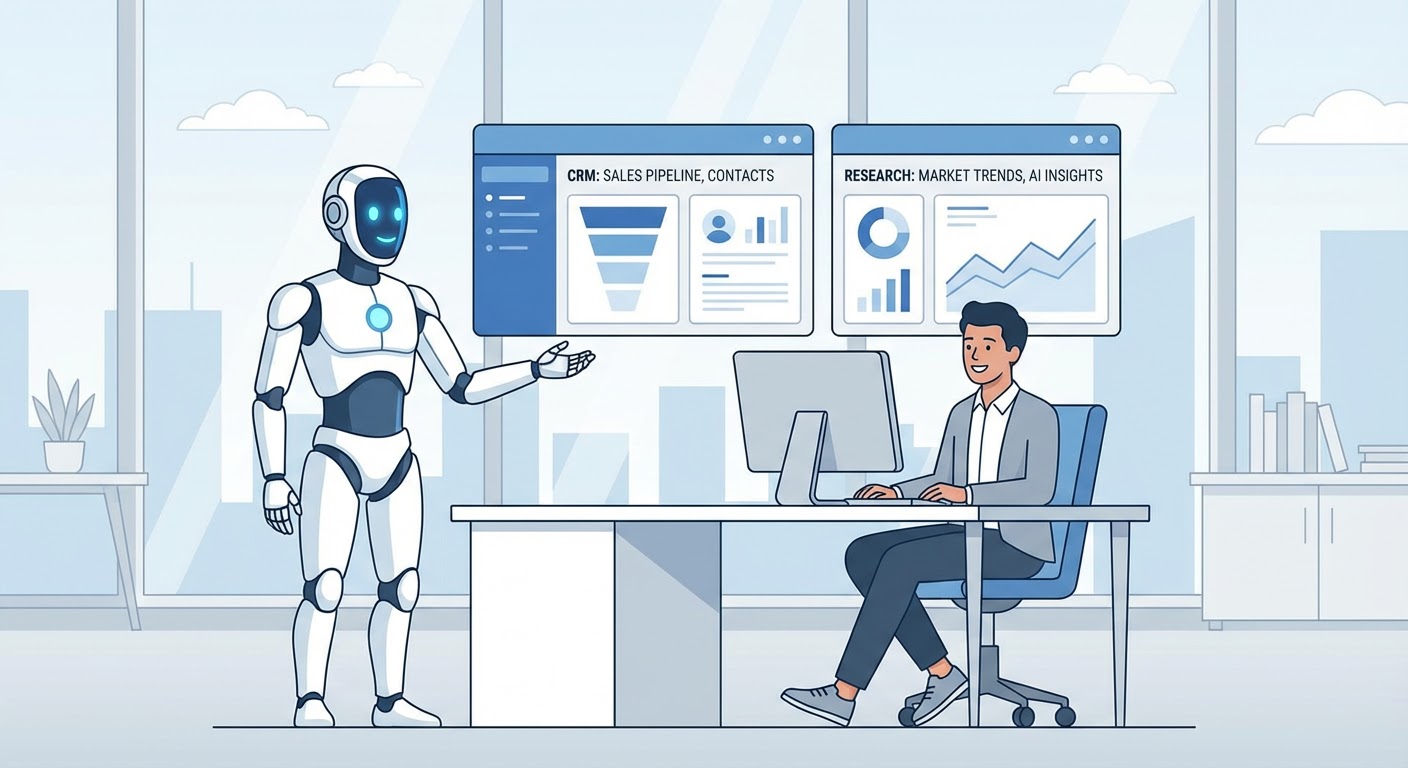
Marcus, an AE at a mid-stage fintech company in Austin, told me something last month that stuck with me. He said he'd started treating his AI sales agent the way he treats his junior analyst: give it the boring stuff, check its work, and never let it talk to customers unsupervised. "The minute I stopped expecting it to be a closer and started using it as a research machine, everything clicked."
Marcus closes about $1.4M per quarter. He's not some early-adopter tech bro who automates everything for sport. He's a guy who got tired of spending his mornings copy-pasting LinkedIn profiles into a Google Doc before discovery calls. He started feeding accounts into an AI agent that pulls firmographics, recent funding data, open job reqs, and competitive intel. The agent spits back a one-pager. Takes about ninety seconds. His prep time per call dropped from twenty-two minutes to three.
That's the boring truth about AI sales agents in 2026. The boring truth doesn't get keynotes.
What an AI Sales Agent Actually Does (Right Now)
Forget the conference demos for a second. Those always show the same thing: an AI agent that autonomously prospects a company, writes a perfectly tailored cold email, handles the reply, overcomes an objection, and books a meeting. Audience claps. Investor writes a check. Nobody mentions that the demo was run against a single warm account with pristine data and a prospect who was basically told to say yes.
In practice, the stuff that AI sales agents reliably handle falls into a few categories, and none of them are glamorous.
Prospect research is the clearest win. A rep gives the agent a company name or a list of accounts, and it comes back with org charts, tech stack info, hiring patterns, funding history, recent press, and sometimes even customer reviews pulled from G2 or Trustpilot. This used to take an SDR forty-five minutes per account. Now it takes less time than making coffee. Cotera's AI Sales Agent does exactly this -- you hand it a target account and get back a structured brief with everything a rep needs before picking up the phone.
CRM hygiene is the second big one. I talked to a RevOps leader named Priya at a Series C company in Chicago who told me her team's Salesforce data accuracy went from "roughly directional" to 94% within six weeks of deploying an agent to handle deal stage updates, activity logging, and contact enrichment. Gone are those Monday pipeline reviews where half the team sheepishly admits their data is two weeks stale. The agent just... watches everything — email threads, call recordings, calendar — and updates the CRM on its own. She said, and I'm quoting here, "It's like having an intern who actually does the data entry instead of saying they'll do it tomorrow."
Call prep and follow-up is third. Before a meeting, the agent compiles a dossier on the prospect. After the meeting, it generates a summary, drafts a follow-up email referencing things that were actually discussed, and creates tasks for any commitments the rep made. Pre-Meeting Research is our version of this -- feed it a prospect's name and company and it returns a brief you can scan in thirty seconds while you're waiting for the Zoom to connect.
List building and lead gen rounds it out. Give an agent your ICP criteria -- say, VP-level and above at SaaS companies with 200-1000 employees that recently raised a Series B -- and it'll build a prospect list with contact info, company details, and a relevance score. AI Lead Generation is how we handle this at Cotera, and honestly it's one of the agents I see teams adopt fastest because the ROI is so immediate. An SDR who used to spend three hours Monday morning building a weekly list now has it ready before they've finished their first cup of coffee.
None of this is sexy. All of it saves hours per rep per day.
Where AI Sales Agents Actually Fall Short
Here's where I'll probably annoy some vendors. The failure modes of AI sales agents are predictable, consistent, and almost entirely ignored in the marketing materials.
Autonomous outreach is still bad. Not "needs some polish" bad. Fundamentally bad. I've reviewed thousands of AI-generated cold emails at this point, and they share a distinctive quality that I can only describe as "technically personalized but emotionally vacant." The agent will reference a prospect's recent job change or a funding round, but it does so in a way that feels like a lookup table rather than a human who actually cares. Recipients can tell. Response rates on fully autonomous AI outreach consistently run 40-60% lower than outreach where a human wrote the message using AI-gathered research. The research is the valuable part, not the writing.
Objection handling is a disaster. When a prospect pushes back on pricing, an experienced rep reads the room. Are they negotiating because they have budget constraints, or are they testing whether you'll fold? Is this a real objection or a polite brush-off? AI agents handle every objection the same way — grab a pre-written response off the shelf and hope it sticks. Ever watched someone play chess who memorized the first ten moves but panics in the midgame? Same energy. I've seen agents respond to "we're happy with our current vendor" by listing feature comparisons -- technically a valid response, completely wrong for the moment.
Context windows are a real limitation. Here's one that doesn't get talked about enough: an AI agent can research a company just fine, but ask it to hold the full context of a six-month sales cycle? Forget it. That deal you've been nurturing since October, where the champion moved to a new role and you had to re-engage the new stakeholder while preserving the relationship with the old one? Good luck getting an AI agent to navigate that. The long-memory, multi-threaded complexity of enterprise sales cycles is still well beyond what any agent handles well.
Data quality is the silent killer. An AI sales agent is only as good as the data it can access. If your CRM is messy, your contact data is stale, and your enrichment sources are patchy, the agent will confidently produce garbage. I watched a team deploy an AI agent that pulled prospect data from a source with 30% outdated email addresses. The agent dutifully crafted and "sent" emails to dead inboxes. Nobody noticed for two weeks because the agent reported them as sent. Activity metrics looked great. Pipeline didn't move.
Full-Auto vs. Copilot: Two Very Different Philosophies
There's a spectrum here that's worth understanding, because "AI sales agent" gets used to describe two radically different approaches.
On one end you have full-auto agents. These try to replace the rep for portions of the workflow. They prospect autonomously, write and send emails without human review, respond to replies, and book meetings. The pitch is compelling: a tireless SDR that works 24/7 at the cost of a software subscription. The reality, as I described above, is that the quality of autonomous outreach isn't there yet. Teams that go full-auto? Volume goes through the roof. Conversion falls off a cliff.
On the other end you have copilot agents. These handle the research, data entry, and prep work, then hand the results to a human who makes the judgment calls and does the actual selling. The human stays in the loop for anything customer-facing. The agent does everything around the selling. This is the model that Marcus uses. It's the model we built Cotera's agents around. And frankly, it's the model that actually produces revenue in 2026.
The distinction matters because the full-auto vendors and the copilot vendors get lumped together under "AI sales agent," and they produce very different outcomes. A team that buys a full-auto agent expecting a copilot -- or vice versa -- ends up disappointed. Know which one you're buying.
Most of the teams I talk to that are getting real results landed on the copilot approach almost by accident. They tried full-auto, watched their reply rates tank, and dialed it back to "let the AI do the research, let the human do the talking." The ones who figured this out early saved themselves a quarter of wasted pipeline.
How Teams Are Actually Integrating These Things
The implementation patterns I see working look nothing like the clean workflows in vendor pitch decks. They're messy, practical, and stitched together with the tools teams already use.
Rachel runs sales at a 60-person cybersecurity company. Her setup: an AI agent runs research on every inbound lead within five minutes of form submission. By the time her BDR picks up the phone, they have a one-pager on the prospect's company, tech stack, recent security incidents in their industry, and which competitors they might be evaluating. The BDR doesn't use an AI to make the call. They use the AI's research to make a better call. Her connect-to-meeting rate went from 12% to 31% in one quarter. Not because the AI called anyone. Because the AI made sure the human wasn't flying blind.
Another team I know -- a SaaS company selling to retail brands -- uses an AI agent to monitor their target account list for trigger events. New CMO hired? Competitor raises a round? A target company posts three Salesforce admin job listings in one week? The agent flags it, adds context about why it matters, and drops it into a Slack channel. Reps pick the ones that seem most promising. The agent doesn't decide which signals matter most. The reps do. But the agent surfaces signals that reps would have missed entirely because nobody has time to manually check 400 accounts for job postings every week.
The common thread: the AI handles the information gathering, and the human handles the judgment. Every team that's tried to flip that ratio -- letting the AI make judgment calls while humans supervise the information gathering -- has regretted it.
The Honest Math
A friend of mine who runs RevOps at a vertical SaaS company did a time study across his twelve-person sales team before and after deploying AI agents. Here's roughly what he found.
Before agents, reps spent about 35% of their day on research, data entry, and CRM updates. Another 20% on email drafting and follow-up admin. About 15% on call prep. That left 30% of the day for actual selling -- conversations, demos, negotiations.
After agents, the research and data entry dropped to about 8% of the day (mostly reviewing what the agent produced). Email admin dropped to 10%. Call prep dropped to 5%. That freed up roughly 47% of each rep's day for selling activities -- basically a 60% increase in selling time.
He didn't hire more reps. He raised quotas. Pipeline per rep went up 40% in the first full quarter. Not because the AI sold anything. Because the humans finally had time to sell.
That's the real ROI of an AI sales agent. Not replacing reps. Giving them back the hours they've been wasting on work that doesn't require a human.
What Happens Next
I'll be honest -- I don't think fully autonomous AI sales agents that replace human reps are coming anytime soon. Maybe ever. The part of selling that requires reading a room, building trust, and exercising judgment under ambiguity is the part that humans are genuinely better at, and it's also the part that determines whether deals close. Everything else is support work. AI is already excellent at support work. That's not a consolation prize. That's a massive efficiency gain hiding in plain sight.
The teams winning right now aren't the ones who automated the most. They're the ones who automated the right things and kept humans where humans matter. If you take one thing from this, let it be that. The AI sales agent isn't your closer. It's the best research assistant your closers have ever had.
Try These Agents
- AI Sales Agent -- Research accounts, find prospects, and draft personalized outreach in one prompt
- AI Lead Generation -- Build qualified prospect lists with scoring and enrichment
- Pre-Meeting Research -- Research any prospect in seconds before your next call
- LinkedIn Outreach Builder -- Generate personalized LinkedIn messages based on profile data