
Best Sales Intelligence Platforms: A Buyer's Guide That Won't Waste Your Time
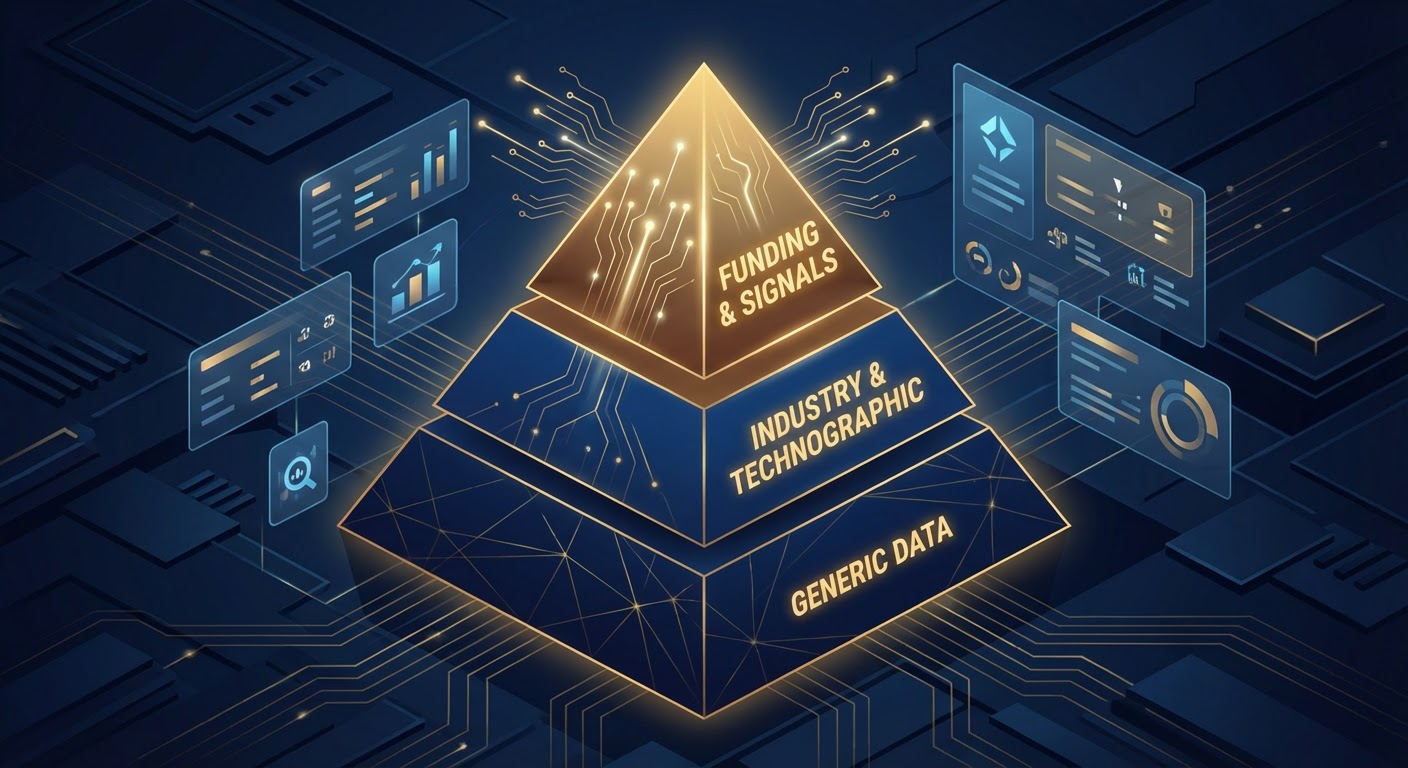
Last fall I sat through back-to-back demos from three sales intelligence platforms in the same week. On Monday, a rep from Platform A walked me through 300 million contacts and told me accuracy was "industry-leading." On Wednesday, Platform B showed off real-time intent signals from something they called a "demand graph." On Friday, Platform C pitched me a prospect research tool powered by AI that would "do the Googling for you." All three claimed to be the best sales intelligence platform on the market. All three had G2 badges proving it. And honestly? They were solving three completely different problems.
That is the part nobody tells you when you search "best sales intelligence platforms." The category doesn't mean one thing. It means three or four things, and picking the wrong type for your team is worse than picking no tool at all. I've watched companies buy a data provider when they needed research automation, or buy an enrichment platform when they really just needed cleaner contact records. Forty grand and a year later, they rip it out.
So forget the ranked list. Let me walk you through the actual market, broken into the three approaches that exist today, and help you figure out which one fits how your team sells.
Approach 1: Data Providers
These are the platforms that sell you access to a database. ZoomInfo, Apollo, Cognism, Lusha — the bread and butter of the sales intelligence platforms market. You pay for contact records (emails, direct dials, job titles) and company firmographics (headcount, revenue, industry, tech stack). Some bundle in basic intent signals. Most charge by the number of credits or records you export.
Where they work well:
- High-volume outbound teams. If your reps send 200+ emails a week and need fresh contact data at scale, a data provider is the foundation. You need accurate emails and phone numbers before anything else matters.
- SDR-heavy orgs building lists. When your motion is "generate lists, run sequences, book meetings," the data provider is the engine. Speed to list matters.
- Companies with a defined ICP. If you know your ideal customer profile down to the industry, headcount band, and tech stack, filtering a database is the fastest path to a target list.
Where they fall apart:
- Signal timing. A database tells you who might be a fit. It does not tell you who is a fit right now. The contact existed yesterday and will exist tomorrow. There is no urgency signal built in.
- Research depth. Knowing someone's title and email doesn't prepare you for a conversation. The best reps do 15-20 minutes of research before picking up the phone. A data provider gives you about 30 seconds of that.
- Freshness decay. Contact data rots. People change jobs. Emails bounce. The platform says 95% accuracy. Your inbox says 78%. This gap widens the longer you hold onto exported records without refreshing them.
Data providers are table stakes. They are not intelligence. If your team already has decent contact data and your problem is conversion rate rather than pipeline volume, buying a bigger database won't fix it.
Approach 2: Enrichment and Signal Platforms
These tools sit a layer above raw data. Crunchbase, Clearbit (now Breeze), 6sense, Bombora, SimilarWeb, BuiltWith — they give you context about what is happening at a company, not just who works there. Funding rounds, hiring velocity, technology adoption, intent topics, web traffic trends.
Where they work well:
- Account-based teams. If your reps work 30-60 named accounts and need depth over breadth, enrichment platforms give them something to actually talk about. A funding announcement is a conversation opener. A tech stack change is a wedge.
- Teams prioritizing timing. Hiring surges, leadership changes, funding events — these are the signals that correlate with purchasing decisions. Enrichment platforms surface them.
- Marketing and sales alignment. When marketing needs to score and route leads based on company-level signals, enrichment data feeds the scoring model. Without it, you are scoring on form fills alone, and form fills lie.
Where they fall apart:
- Intent data opacity. Some of these platforms sell "intent signals" from unnamed publisher networks. I've tested intent data from multiple vendors against our actual pipeline. The correlation was barely above random. If the vendor won't tell you exactly where the signal comes from, be skeptical.
- Assembly required. Enrichment data is ingredients, not a meal. Knowing a company raised a Series B, hired a new VP of Engineering, and added Snowflake to their tech stack is valuable — if someone connects those dots. Most reps don't. The data sits in a dashboard nobody checks.
- Cost stacking. You rarely get everything from one vendor. Crunchbase for funding, Bombora for intent, SimilarWeb for traffic, BuiltWith for tech stack. Suddenly you're paying four subscriptions and nobody has built the workflow to use them together.
https://pub-ae9c8505c57f401aa194a63cd37cc9bc.r2.dev/article-best-sales-intel-mid.png
Approach 3: Agent-Based Intelligence
This is the newest category and honestly the one I'm most interested in. Instead of giving reps a database to search or a dashboard to check, you give them an agent that does the research for them. Feed it a company name and it pulls funding data, identifies key contacts, scans recent news, checks hiring patterns, and assembles a brief. The output isn't a row in a spreadsheet. It's an answer: "Here is what you need to know about this company and why they might buy from you right now."
Where this approach works well:
- Teams where research quality matters but time doesn't exist. Your reps know that deep research wins deals. They just don't have 20 minutes per account to do it. An agent that compresses that into 60 seconds changes the math entirely.
- Mid-market and enterprise motions. When deal sizes justify real preparation, but your team is stretched thin, agents let you do enterprise-quality research at mid-market speed.
- Teams already drowning in tools. Instead of adding another dashboard, an agent pulls data from the sources you already trust — Crunchbase, Apollo, SEC filings, news APIs — and synthesizes the output. One query, one answer.
Where it falls apart:
- Pure volume plays. If your motion is "blast 1,000 prospects a day," an agent that does deep research per-account is overkill. You need a list, not a brief.
- Data quality dependency. Agents are only as good as the sources they pull from. If the underlying data is stale or wrong, the brief is stale or wrong. Garbage in, garbage out still applies.
Matching Approach to Team
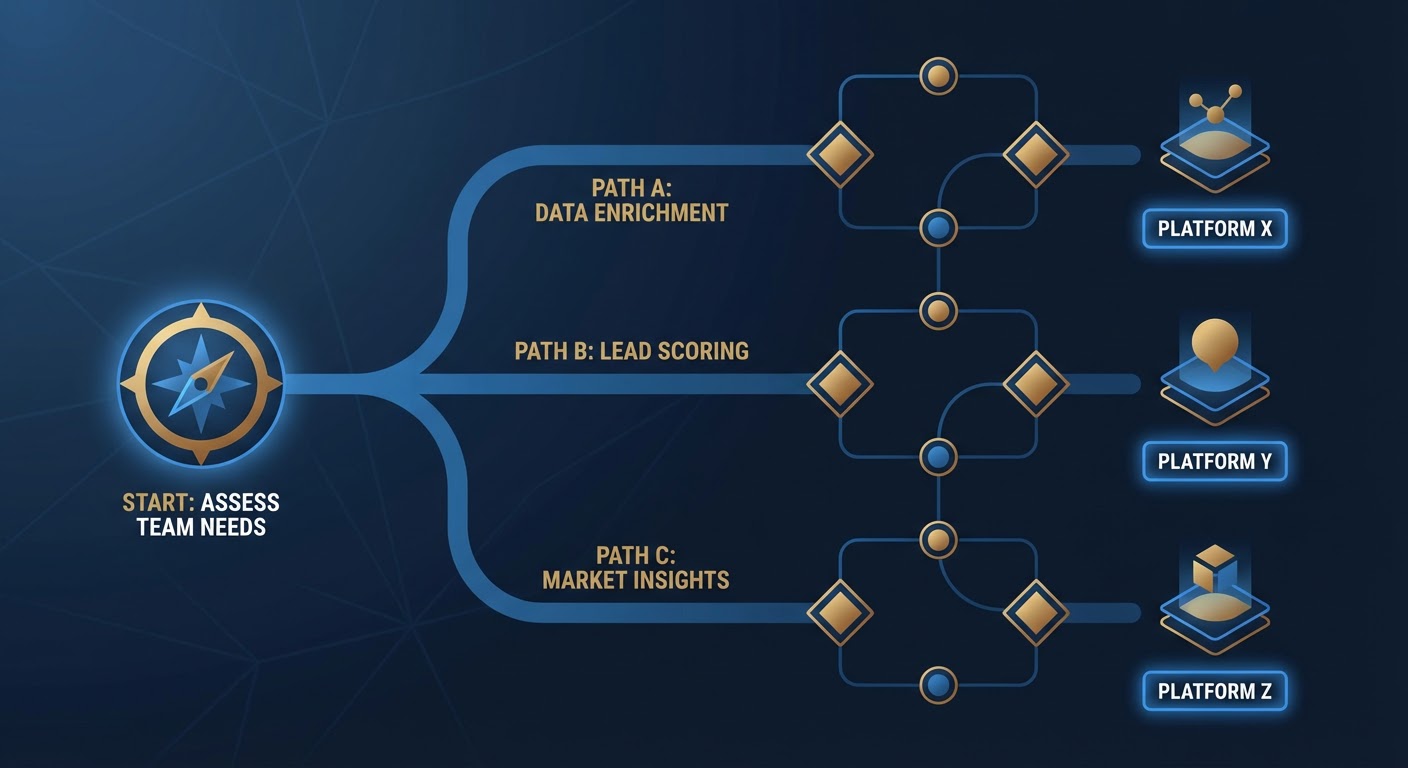
Here is the shortcut I wish someone had given me before I sat through those three demos:
- "We need more prospects to contact." You want a data provider. Start with Apollo or ZoomInfo. Get clean contact data at the volume you need.
- "We have enough prospects but we're not converting." You want enrichment and signals. Crunchbase for funding, job boards for hiring patterns, news monitoring for trigger events. Your problem is timing and relevance, not volume.
- "Our reps know what research to do, they just don't have time." You want agents. Automate the research workflow your best rep already does manually. Give everyone access to that quality of preparation without the time cost.
Most teams, if they're being honest, need a combination. A data provider for the contact foundation, plus an agent or enrichment layer to actually make sense of the data before someone picks up the phone.
Why Use an Agent
The pattern I keep seeing is this: sales teams buy a data provider, find that the data alone doesn't improve conversion, then layer on enrichment tools, find that nobody checks the dashboards, and end up right back where they started — with their best rep doing manual research that works but doesn't scale.
Agents break that cycle. A Crunchbase account research agent pulls funding data, key contacts, and conversation hooks for any account before a call. The same research your best rep does in 20 minutes, done in under a minute. The Apollo lead research agent does deep-dive prospect research using Apollo's enrichment data, building full profiles instead of just returning an email address. And for figuring out whether a company is even worth pursuing, the company growth analyzer checks growth signals, identifies competitors, and tells you who is winning in their space.
The sales intelligence platform you actually need might not be a platform at all. It might be an agent that pulls from the right sources and gives your reps the answer instead of another dashboard to ignore.
The Short Version
The best sales intelligence platforms aren't ranked on a list from one to ten. They fall into three categories — data providers, enrichment platforms, and agent-based intelligence — and each one solves a different problem. Data providers give you contacts. Enrichment platforms give you context. Agents give you answers. Figure out which problem your team actually has before you start booking demos. And if your top rep already does great research manually but just can't do it for every account? Skip the database upgrade. Automate what already works.
Try These Agents
- Crunchbase Account Research — Pull funding data, key contacts, and conversation hooks for any account before a sales call
- Apollo Lead Research — Deep-dive research on any lead using Apollo data enrichment
- Company Growth Analyzer — Check if a company is growing, find their competitors, and see who's winning in their space