
Competitor Monitoring Tools: What's Worth the Money
I have a graveyard of competitor monitoring tools in my purchase history. Crayon, Klue, Kompyte, a half-dozen point tools for specific types of monitoring. Some of them were excellent products that I cancelled because we couldn't keep up with the output. Some were mediocre products with great sales teams. One charged us for three months after I thought I'd cancelled because I'd only cancelled the auto-renewal on one of two subscriptions. Fun.
After two years of buying, testing, and mostly canceling, I have opinions. Not all of them are popular with the vendors.
The Dirty Secret of Competitor Monitoring Tools
Most companies buy a competitor monitoring tool, get excited during onboarding, configure their competitor list, receive the first flood of alerts, and then slowly stop checking the dashboard. By month three, the tool is a line item nobody questions because canceling feels like admitting defeat. By month six, the person who championed the purchase has either moved on or forgotten the login.
I've talked to probably 30 marketing leaders about their competitive intelligence setup. More than half admitted their CI tool is underused. The tool isn't the problem. The workflow is. You can have the best monitoring platform in the world, but if nobody has a process for turning alerts into actions, you're paying for a notification service that nobody reads.
Before buying any tool, answer this: who will review the alerts, how often, and what will they do with the information? If you can't answer all three, don't buy the tool yet. Build the process first, run it manually for a month, then automate it.
What These Tools Actually Do
Competitor monitoring tools fall into a spectrum from narrow to broad.
On the narrow end: point tools that watch one thing. Visualping watches web pages for changes. Google Alerts watches for brand mentions in news. Owler sends email digests about company news. These are cheap or free, do one thing, and do it adequately.
In the middle: competitive intelligence platforms like Crayon, Klue, and Kompyte. These aggregate multiple data sources — website changes, news, social media, job postings, reviews, product updates — into a unified dashboard. They cost real money ($500-2,000+/month) and require setup time. The value proposition is "one place for everything competitive" instead of cobbling together ten point tools.
On the broad end: AI agents that chain research workflows together. Instead of dashboards you check, these agents proactively research competitors, synthesize findings, and surface what changed. This category is newer and less established, but it's where the market is heading.
Where the Expensive Platforms Fall Short
I used Crayon for eight months. The product itself was good. The problem was organizational, not technical.
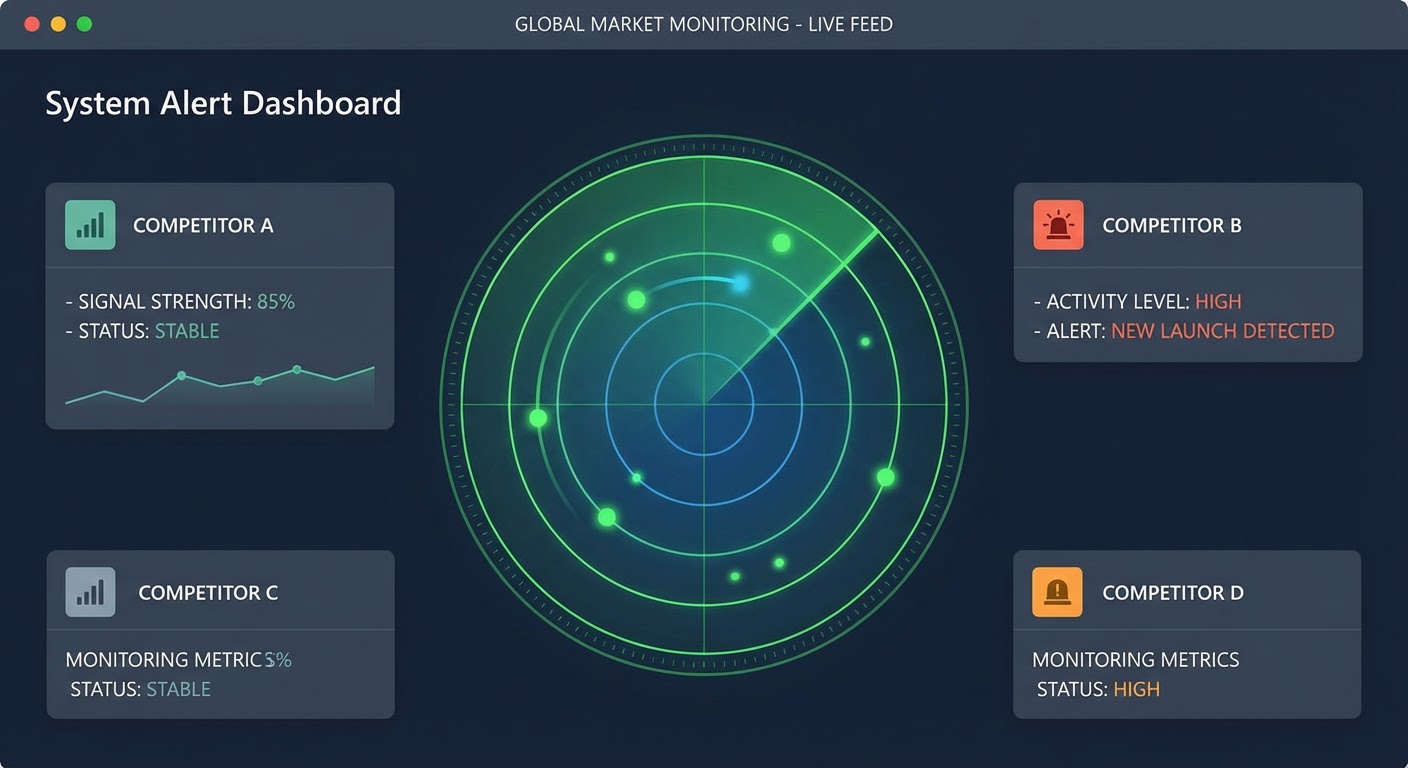
Alert fatigue killed us. Crayon was diligent. Every web page change, every news mention, every social post, every job listing — all captured, all categorized, all delivered. We got 40-60 alerts per day across five competitors. Reading them all would have been a full-time job. Nobody has a full-time competitive intelligence person at a Series B startup, so the alerts piled up unread.
Signal-to-noise was our real issue. Of those 40-60 daily alerts, maybe 2-3 per week were actually actionable. A pricing change. A major product announcement. A new hire that signaled a strategic shift. The rest was noise: minor website copy tweaks, random news mentions, social posts that didn't indicate anything strategic. Finding those 2-3 signals in a sea of noise was like panning for gold in a river of mud.
The dashboard became a guilt trip. I'd log in, see 200 unread alerts, feel overwhelmed, skim five of them, and log out. The tool was technically doing its job. I just couldn't keep up with the volume, and there was no way to tell the tool "only show me things that actually matter."
What Actually Works (My Current Setup)
After the Crayon experiment, I went back to basics. Here's what I use now, and it costs about $0/month in dedicated competitor monitoring tools.
Google Alerts for brand mentions. Free. Set up alerts for each competitor's name, CEO name, and product name. These filter to a dedicated Gmail label that I check twice a week. Most alerts are irrelevant. The ones that matter — funding announcements, executive changes, major product launches — are worth the 10 minutes of skimming.
RSS feeds for competitor blogs. Free. Every competitor has a blog or newsroom. Most still support RSS. I use Feedly to aggregate them. When a competitor publishes something, I see the title and make a snap decision: read it or skip it. Takes 5 minutes per day.
Monthly manual check. Once a month, I spend an hour checking each competitor's website for changes, reviewing their latest content, scanning their job postings, and reading a handful of their G2 reviews. This catches the things that automated monitoring misses — subtle positioning changes, visual redesigns, new case studies.
Win/loss data from CRM. The most underrated competitor monitoring tool is your own sales data. Which competitors show up in deals? Which ones do you beat? Which ones beat you? This data is more actionable than any external monitoring tool because it directly connects to revenue.
Total cost: $0/month in monitoring tools. Total time: about 3 hours/month. Total value: I catch every significant competitive move within a few days and I have the context to understand why it matters.
When a Paid Tool Makes Sense
I'm not anti-tool. Paid competitor monitoring makes sense in specific situations.
When you have a dedicated competitive intelligence person. If someone's full-time job includes competitive intelligence, a platform like Klue or Crayon gives them the raw material to work with. The alert volume that overwhelmed me as a side responsibility is manageable as a primary responsibility.
When you're in a fast-moving market. If competitors are launching products weekly, changing pricing monthly, and making announcements constantly, manual monitoring can't keep up. Enterprise software markets that move slowly don't need heavy monitoring. Consumer tech, fintech, and adtech move fast enough to justify the investment.
When you have a formal battlecard program. If your sales team relies on competitive battlecards that need updating whenever a competitor makes a move, the monitoring tool feeds the battlecard workflow. Without battlecards, the monitoring data has no output channel and will go unused.
Why Use an Agent for This
After trying expensive platforms and reverting to free tools, the gap I kept running into was synthesis. Google Alerts tells me a competitor got mentioned in TechCrunch. RSS tells me they published a blog post. Job postings tell me they're hiring. But connecting those dots — "they just got press coverage for an AI feature, their blog pivoted to AI content, and they're hiring ML engineers, so they're making a major AI investment" — that synthesis was always manual.
The market intelligence agent handles the synthesis layer. It monitors across sources and connects signals instead of presenting them as isolated alerts. A name change on a pricing tier plus a blog post about moving upmarket plus three new enterprise AE job postings gets reported as "Competitor X appears to be shifting upmarket" rather than three separate alerts you'd need to connect yourself.
The brand monitoring agent watches for mentions across news, social, and forums, filtering by relevance instead of dumping everything into your inbox. When a competitor gets mentioned in a context that matters to your business, you hear about it. When someone just name-drops them in an unrelated tweet, you don't.
The social listening alerts focus specifically on real-time conversations — complaints about competitors on Twitter, Reddit threads comparing products, LinkedIn posts from competitor employees. This is the type of intelligence that's impossible to get from traditional monitoring tools and often the most actionable for sales teams.
Try These Agents
- Market Intelligence Agent — Synthesized competitive monitoring across multiple data sources
- Brand Monitoring — Filtered brand mentions from news, social, and forums
- Social Listening Alerts — Real-time competitive conversations on social platforms
- Competitor Traffic Analysis — Traffic trends and distribution data for competitors