
How AI Sales Agents Actually Work (Behind the Marketing Hype)
Every vendor at SaaStr this year had "AI agent" plastered on their booth. I asked fourteen of them the same thing: "What does this do that a Zapier flow with a ChatGPT step doesn't?" Twelve pivoted to talking about their roadmap. One admitted it was "basically that, but nicer." The fourteenth just stared at me.
I'm not anti-agent. We run them every day and they've genuinely changed how our team works. But the marketing around AI sales agents has gotten so detached from reality that I feel obligated to write down what's actually happening inside these things.
What "Agent" Means (and What It Doesn't)
The word "agent" gets thrown around like confetti. Here's the actual definition: an agent takes a goal, figures out the steps to get there, runs those steps using tools it has access to, and changes course when something unexpected happens.
That last part matters. A Zapier workflow is not an agent. It runs the same steps every time: search Apollo, filter, export, push to HubSpot. Step 3 fails? Everything stops. There's no plan B built in.
A real AI sales agent handles ambiguity. You tell it "find me 20 qualified fintech prospects" and it starts searching Apollo. Results are thin? It tries Crunchbase. One company's website is dead? Probably acquired — skip it, move on. It's making micro-decisions throughout the process instead of blindly following a script.
Most of what's being sold as an "AI sales agent" is really a workflow with a language model jammed in to write emails or summarize profiles. The flow itself is still rigid. Zero Apollo results? It doesn't pivot to another data source. It just returns an empty spreadsheet. That's a workflow with a chatbot stapled on, not an agent.
The Four Pieces Under the Hood
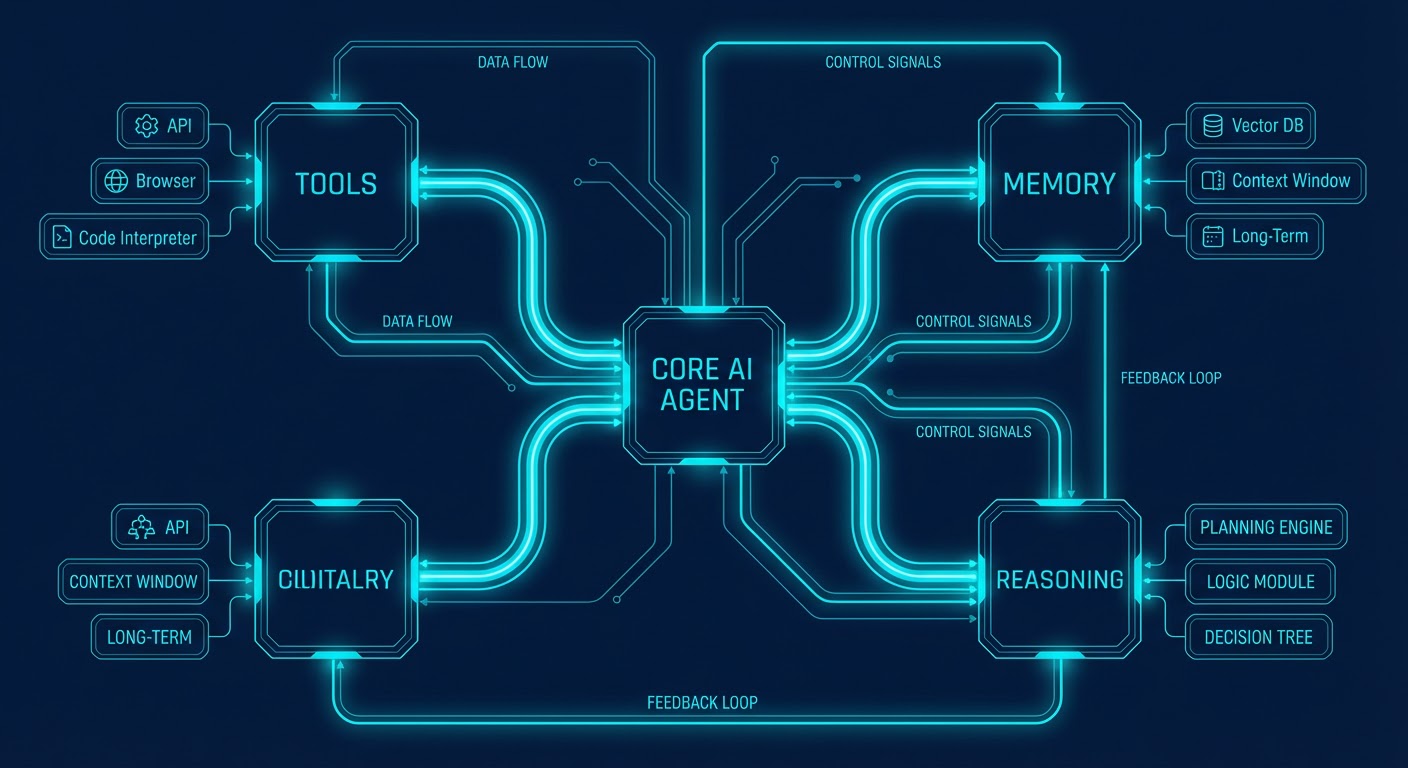
A real AI sales agent has four moving parts. No jargon, just what each piece does for your team.
The brain (LLM). This is the language model — GPT-4, Claude, whatever the vendor is using. It handles reasoning, writes text, and makes judgment calls. When the agent decides "this prospect's LinkedIn shows they just changed jobs, so the usual outreach angle won't work — try the new-in-role approach instead," that's the LLM reasoning.
The tools. These are the APIs and databases the agent can access. Apollo for contact data. LinkedIn for profile info. Your CRM for existing records. A news API for recent company mentions. Email verification services. The agent can't do anything its tools don't let it do. An agent without tools is just a chatbot. An agent with the right tools can run your entire prospecting workflow.
The memory. What does the agent remember between tasks? If it researched a company yesterday, does it know that today? Some agents have short-term memory only (each task starts fresh) and some maintain a longer history. For sales, memory matters because you don't want to re-research accounts your team already knows about. You want the agent to build on previous work.
The planning layer. This is the piece that breaks "find me qualified prospects" into individual steps and decides the order. Good planning means the agent enriches before deduplicating (so it has data to match on). Bad planning means it pushes to CRM before checking for duplicates (so you get 50 duplicate records).
What AI Sales Agents Can Do Right Now
Some vendor told me last month their agent "closes deals autonomously." I laughed. Then I realized they weren't joking and I felt bad. Here's what actually works today, without the hallucinated roadmap.
Deep prospect research. Funding history, recent press, open job postings, tech stack, G2 reviews, decision-maker LinkedIn activity — pulled together into a readable brief. A human SDR doing this manually needs 30-45 minutes and six browser tabs. The agent finishes in two minutes and doesn't get bored on prospect number 15.
Assembling data from scattered sources. Your prospect list needs Apollo contacts, Crunchbase company info, LinkedIn signals, and CRM history. Doing that by hand means four tools and a lot of copy-paste. The agent chains the lookups and gives you one clean output. I used to spend my mornings doing exactly this. It was the worst part of my job.
CRM cleanup. Deduplication, field updates, enrichment, flagging dead contacts. Nobody wants to do this work. That's why nobody does it, and that's why your CRM has 340 duplicate contacts (I found that many in ours). An agent grinds through the whole database and fixes records without complaint. Ops teams I've worked with save 10+ hours a week on this alone.
Pre-call briefs. Before every meeting, the agent pulls what it can about the prospect and their company and drops a summary into Notion or Slack. My reps read these in the elevator on the way to the meeting room. Way better than their old habit of skimming a LinkedIn profile 30 seconds before the call started.
What They Can't Do (Despite the Sales Pitches)
Write cold emails anyone believes. I've tested this extensively. AI-written outbound has a smoothness to it — an uncanny valley of too-perfect structure — that prospects flag within the first sentence. The hook-pain-solution-CTA format is identical every time. Your prospects have seen it a hundred times this month. Let the agent do research. You write the email.
Tell you whether to pursue a deal. A company raised $50M? Cool. Will they spend any of that on your product, or do they have twelve other fires to put out first? That judgment call requires context an agent doesn't have. Market intuition, relationship history, reading between the lines of a vague email response. Humans only.
Have real conversations. Chatbot-style agents that talk to prospects in real time collapse the moment someone goes off-script, cracks a joke, or asks a question the training data didn't cover. Sales conversations aren't linear. They loop, they stall, they get emotional. AI doesn't handle any of that well.
Remember that your prospect's daughter just got into UCLA. People buy from people. An agent can tell you what to say but it can't build the kind of trust that makes someone take your call when they're ignoring the other eight vendors in their inbox.
Four Questions to Ask Before You Buy
Next time a vendor demos their AI sales agent, try these:
- "What happens when Apollo returns zero results?" If the answer is "it errors out," it's a workflow, not an agent. A real agent tries a different data source.
- "Find me companies similar to our best customers." Don't give it filters. If it can't infer what "similar" means from your CRM data, the intelligence layer is thin.
- "What if Apollo says someone is VP of Sales but LinkedIn says they left?" Conflicting data is everywhere in B2B. Does it flag the conflict or just push the stale record into your CRM?
- "I told you last week that lead was terrible. Did anything change?" If the agent doesn't learn from your feedback, it's going to keep surfacing the same bad fits forever.
Why Use an Agent for This
The case for an AI sales agent comes down to one thing: it does the hours of prep work that reps skip because they don't have time. Every rep knows they should research before calling. Most reps research the first few prospects and then start winging it because they have 30 more to get through.
An agent does the research on all 30. Same depth on the last prospect as the first. No fatigue, no shortcuts, no "I'll just check their LinkedIn real quick" when they should be reading the company's earnings call transcript.
For meeting prep, the pre-meeting research agent runs before every call on our team. Company context, stakeholder background, what's changed recently, competitive landscape — all dumped into a Notion doc. My reps told me their first conversations with prospects improved almost immediately. Turns out knowing something about the person you're calling makes you sound less like a telemarketer. Who knew.
On the pipeline side, the outbound automation agent handles the research → enrichment → sequence building flow. Not autonomously closing deals. Nobody's doing that. But autonomously doing the three hours of data work that sits between "I have a target list" and "I'm ready to start selling."
The Bottom Line on AI Sales Agents
They're real, they work, and they're wildly oversold. The actual value is in research automation, data assembly, and CRM hygiene. The fake value is in "autonomous selling" and "AI that closes deals." Buy the technology for what it does today — save your reps from data work — and ignore the promises about what it'll do tomorrow.
Try These Agents
- AI Sales Prospecting — Research, enrich, and build prospect lists with AI-powered data assembly
- Pre-Meeting Research to Notion — Automated meeting prep briefs delivered to Notion before every call
- Outbound Sales Automation — Chain research and enrichment into outbound campaign building
- Call Insights Analyzer — Analyze sales call recordings for patterns and coaching opportunities