
How to Check Your Competitor's Ad Spend (Spoiler: Every Number Is Wrong)

Early in my career, my VP asked me to figure out what a competitor was spending on Google Ads. I spent two weeks on it. Cross-referenced SpyFu with SEMrush, cornered a former employee of theirs at a conference, built this absurdly detailed spreadsheet triangulating estimates. The number I presented with supreme confidence? Off by roughly 3x.
But the directional read — that they were pouring money into branded defense and barely touching prospecting keywords — turned out to be dead accurate. That insight shaped our entire Q4 campaign. The exact dollar figure? Didn't matter once.
That's the whole game with competitor ad spend. You'll never get the real number. You can absolutely get close enough to make smarter decisions.
Why the Numbers Are Always Wrong (and That's Fine)
Every tool that estimates competitor ad spend works the same basic way. They sample clickstream data from browser extensions and panel participants, which represents maybe 1-3% of internet users. Then they estimate cost-per-click based on scraped keyword data. Then they multiply those two guesses together.
A guess times a guess. That's what SpyFu, SEMrush, and SimilarWeb are all selling you.
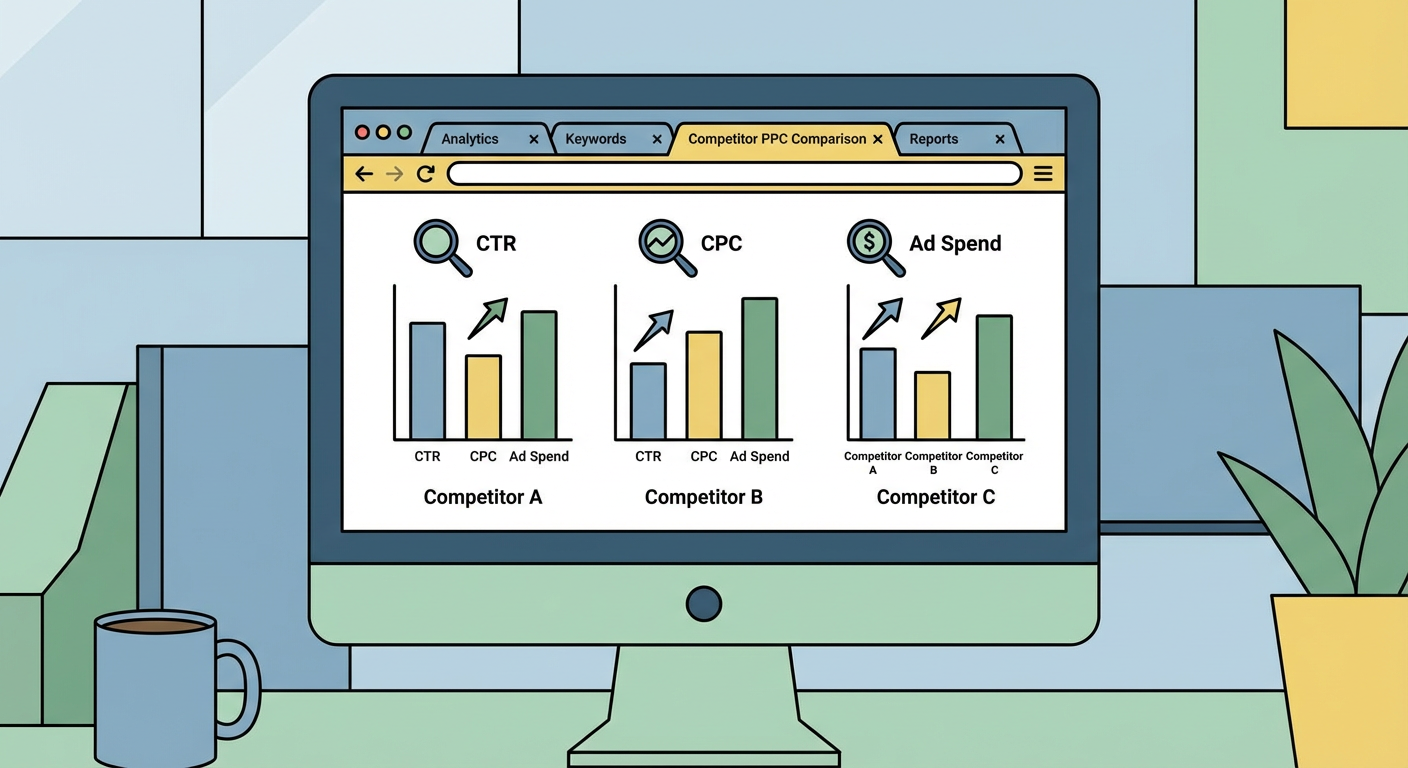
The saving grace: relative comparisons hold up even when absolute numbers don't. If SpyFu says Competitor A spends 5x what Competitor B does, that ratio is probably close to reality. And when SEMrush shows a competitor's estimated spend jumping 60% between quarters, something genuinely happened. They didn't just randomly appear in more browser panels.
Think of it like election polls. Useful for tracking movement and comparing candidates. Terrible at predicting exact vote counts. Same deal here.
Free Tools That Get You Most of the Way
SpyFu is where I always start. Type in a domain and you get an estimated monthly Google Ads budget, keyword count, and top paid terms. The free version limits depth but the headline numbers are right there, no credit card required. Interface is dead simple, which I appreciate after years of tools that make you click through seventeen menus.
SEMrush gives you ten free lookups a day. Their "Advertising Research" tab shows estimated paid traffic, estimated cost, and the keywords driving both. In my experience SEMrush runs higher than SpyFu on spend estimates. I usually split the difference between the two and call that my working number.
Google Ads Auction Insights is the only source of actual data in this entire exercise — but you only get it if you're running ads yourself. It shows which competitors appear alongside you, how often (impression share), and whether they outrank you. No dollar amounts, but impression share is a real proxy for budget. A competitor holding 85% impression share on your core keywords is consistently outbidding you. That's not a guess.
Meta Ad Library at facebook.com/ads/library won't tell you spend, but it shows volume. You can see every active ad a competitor runs on Facebook and Instagram. Someone with 150 active variations is testing aggressively, which means real budget. Someone with six stale ads is either scraping by or their media buyer quit in March. Ad volume correlates with spend more reliably than most people realize.
What You Can Figure Out Without Any Tool
Honestly, some of the best competitor ad spend intelligence is just... observation.
If they sit in position 1-2 for expensive keywords week after week, they're paying for it. Google Ads doesn't hand out top spots for free. Persistent high placement on terms like "CRM software" at $30+ per click means real budget.
Count their creatives. Someone running 40+ Meta ad variations monthly has a dedicated media buyer and testing budget. Someone recycling the same three ads since last summer is either disciplined or broke (and it's usually the second one).
Check keyword breadth through SpyFu. A competitor suddenly bidding on 200 keywords they weren't touching last quarter just got a budget bump. That expansion pattern reveals where they're investing before results become visible.
Watch for platform expansion too. Google-only competitor suddenly showing up on Meta with 30 active ads? They raised money, hit a revenue target, or brought on a new marketing lead. Money moved.
And look at landing pages. Companies spending serious ad dollars don't send clicks to their homepage. They build dedicated pages for different campaigns and audiences. If a competitor has unique landing pages per ad variation, the spend justifies that investment.
Why an Agent Makes This Less Painful
The manual version of competitor ad spend analysis involves five separate tabs — SpyFu, SEMrush, Meta Ad Library, Google Ads Transparency, your own Auction Insights — each with its own interface, its own data format, and its own opinion about what things cost. Then you reconcile numbers that never agree.
A PPC competitor analysis agent does that consolidation for you. Estimated spend ranges, keyword overlap, creative counts, platform presence — synthesized into something you can actually compare instead of a stack of screenshots.
The real payoff is doing this monthly instead of once. Competitor ad spend intelligence only matters in context over time. One snapshot tells you what they're doing today. Monthly tracking reveals where they're betting next. An agent makes the repetition trivial instead of the kind of task that lives on your to-do list for three months before you finally do it.
Chase the patterns, not the precision. A competitor that doubled their estimated spend and expanded to two new platforms this quarter is telling you something regardless of whether the dollar figure is $30K or $90K.
Try These Agents
- PPC Competitor Analysis — Pull competitor ad data across Google, Meta, TikTok, LinkedIn, and Reddit in one pass
- SEO Competitor Analyzer — Find what keywords competitors rank for and identify content gaps
- Market Intelligence Agent — Full competitor research across hiring, reviews, keywords, and news