
How to Check Your Competitor's Domain Authority (and Why the Number Lies to You)

A prospect once told me on a call that he'd Googled us, Googled our main competitor, and compared domain authority scores. "Their DA is 72. Yours is 34." He said it like he'd caught us red-handed at something. Picked them. Six months later he churned off their platform and came back. Turns out the company with better content and an actual product solved his problem better than the one with the fancier link profile. Shocking.
That experience cemented something I already suspected: domain authority is the most looked-at, least understood number in SEO. Everybody checks it. Very few people know what it's actually measuring.
What DA Measures (Spoiler: Not What You Think)
Domain Authority is a metric Moz invented. Not Google. Moz. Google has never said they use anything like it in their algorithm. I'll repeat that because it matters: the thing everyone treats as a ranking score was made up by a third-party company.
What Moz actually calculates is a prediction based on backlinks — how many sites link to you, and how authoritative those sites are. Higher-quality links, higher DA. It attempts to forecast how well a domain might rank. It doesn't measure how well it does rank.
Ahrefs built their own version and called it Domain Rating. SEMrush went with Authority Score. All three measure related-but-different things, so the numbers rarely agree. I checked one of our client's sites last month: Moz said 45, Ahrefs said 62, SEMrush said 38. Same website. Same day.
What these scores are actually good for:
- Rough comparison between two sites when you use the same tool for both
- Tracking your own progress over time (DA 25 to DA 40 in a year means your link building worked)
- Quickly filtering out garbage sites when you're prospecting for backlinks
What they're bad at: predicting who ranks #1 for any specific keyword, telling you anything about content quality, reflecting changes that happened recently. DA updates lag by weeks, sometimes months.
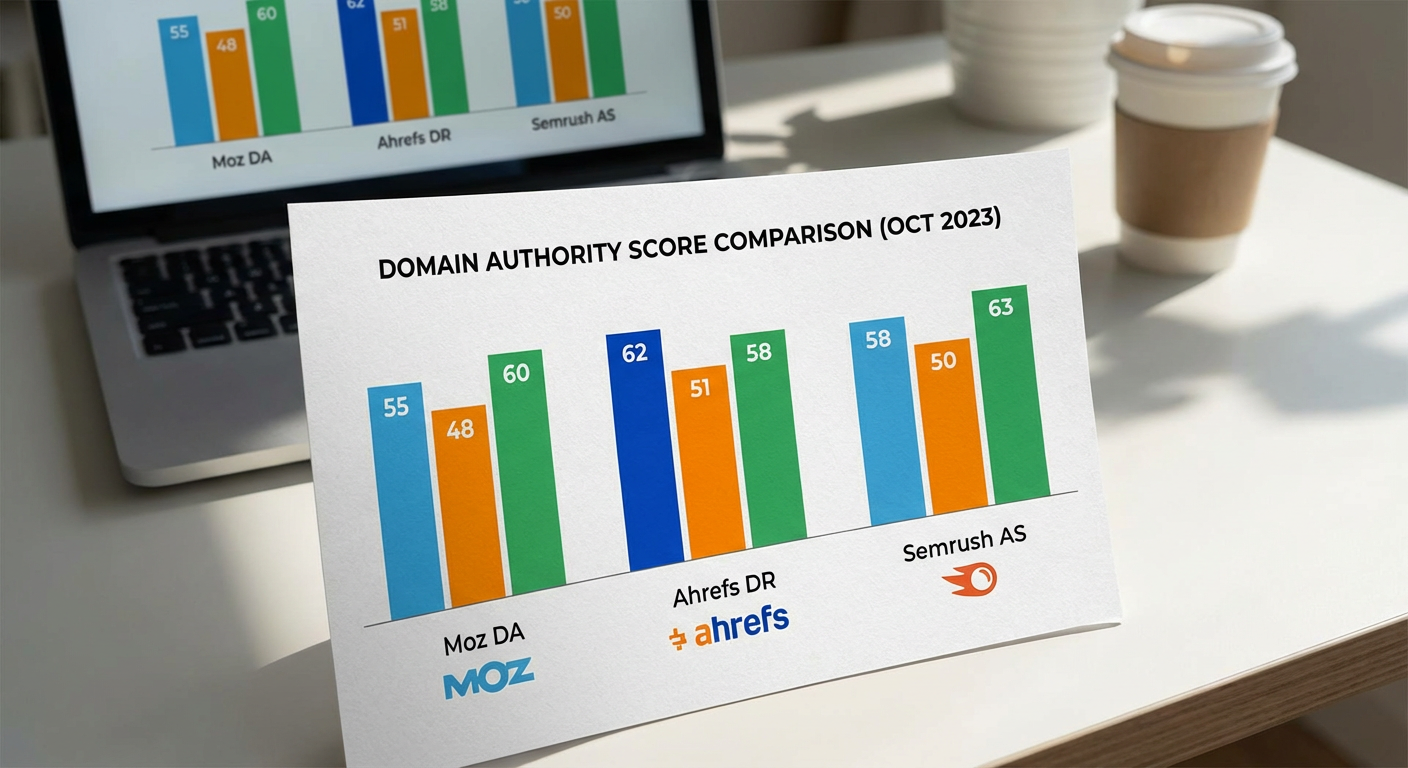
Free Tools for Checking It
Every major SEO platform gives DA away for free because they want you hooked on the rest of their product. Honestly, fair play to them.
Moz Link Explorer at moz.com/link-explorer is the original. Ten free searches per month, no account needed. You get DA, linking domain count, and top pages. Since Moz created the metric, this is the number people default to when they say "domain authority."
Ahrefs Free Backlink Checker at ahrefs.com/backlink-checker shows you Domain Rating plus the top 100 backlinks. I used their free tools exclusively for about a year before paying for anything. The DR number weighs links a bit differently than Moz, but for competitive comparison it works the same way.
SEMrush gives you a few free Authority Score lookups per day. Their version blends backlink data with traffic estimates and spam detection, so it's trying to capture a broader picture in one number. Whether that makes it more or less useful depends on what you care about.
MozBar browser extension changed the way I search Google. Install it and every search result shows DA inline. You're googling your target keyword and the authority score of every competing page just... sits there next to the title. I can't browse without it now.
One rule: pick a tool and stay with it. Comparing your Moz DA against a competitor's Ahrefs DR makes zero sense. Apples to apples, always.
When DA 40 Beats DA 70 (It Happens All the Time)
If domain authority actually predicted rankings, the highest-DA site would own position one for every keyword. Obviously that doesn't happen. I have pages on our blog that consistently outrank sites with double our DA. Not because we gamed anything — because we wrote something more specific, more recently updated, and more aligned with what the person searching actually wanted.
Topical depth crushes link counts. A site with DA 40 that's published 200 focused pieces about email marketing will outrank a DA 75 generalist blog for email marketing terms. Google can recognize when a site genuinely goes deep on a topic. Publishing widely on one subject sends a signal that no amount of backlinks from unrelated domains can replicate.
Individual page strength matters more than domain strength. One well-linked page with dead-on search intent will beat a page on a DA 90 domain that has two backlinks and generic content. Rankings happen page by page, not domain by domain. DA is a domain-level average. Your page doesn't care about the average.
Freshness isn't captured by DA at all. A stale article from 2022 on a high-DA site will lose to an updated, accurate, better-structured piece from a smaller site. I've watched this play out on our own content over and over. We update, we climb. We neglect, we drop. DA stays the same throughout.
So when you see a competitor's DA and it's double yours, don't fold. Check whether they've actually built content depth on the keywords you want. Often they haven't.
Why an Agent Changes the Math
Looking up one competitor's DA takes thirty seconds. Actually understanding the competitive picture — DA plus backlinks plus keyword rankings plus content gaps plus traffic trends across five or ten competitors — takes a different kind of effort. That's a morning gone to tab-switching and spreadsheet building.
An SEO competitor analyzer agent collapses all of that into one pass. Authority scores, backlink comparison, content gap identification, and ranking data, laid out so you can see where competitors are fortified and where they're exposed. It doesn't fixate on DA the way humans tend to because it weighs everything together.
Pair it with competitor keyword research and you'll find the specific keywords where a competitor's high DA hasn't translated into good content. That's your opening — where a tighter, better page from a lower-authority domain wins.
DA is worth knowing. It's not worth worshipping. One data point in a bigger picture.
Try These Agents
- SEO Competitor Analyzer — Uncover what keywords competitors rank for and where the content gaps live
- Competitor Keyword Research — Find keyword gaps and steal ranking opportunities from competitors
- Website Traffic Checker — Estimate competitor website traffic and break down their channel mix