
How to Do a Competitor SEO Analysis (Step by Step)
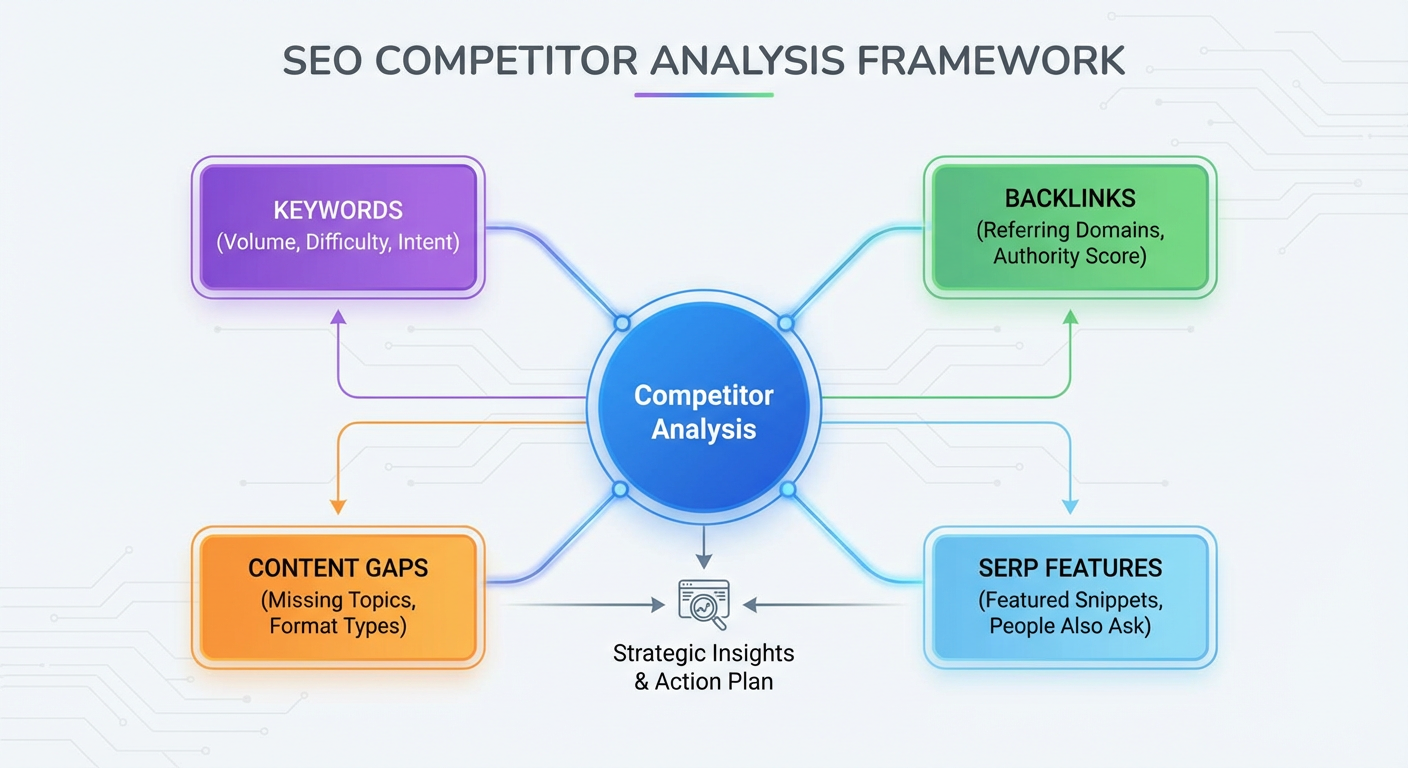
I've watched more SEO competitor analyses die in spreadsheets than I can count. Someone on the team exports a keyword gap report, dumps it into a Google Sheet, emails it around, and nothing happens. Two months later someone asks "whatever happened with that competitive research?" and the answer is always a long pause followed by "we should pick that back up."
The data was never the problem. Every SEO tool on the market will happily vomit thousands of rows of competitor keyword data at you. The problem is that nobody taught anyone what to actually do with it. So here's the step-by-step process I use — the one that produces a plan, not a spreadsheet.
Step 1: Identify Your Real SEO Competitors
This is where most people go wrong before they even start. They type in their three known business competitors and call it a day. But your SEO competitors and your business competitors are often completely different companies.
Your business competitors sell the same product. Your SEO competitors rank for the same keywords. Sometimes those overlap. Often they don't.
I learned this the hard way at a previous startup. We were obsessed with what our two direct competitors were doing in search. Meanwhile, a media company with a blog and zero competing product was eating 40% of the organic traffic for our most valuable keywords. They weren't even in our competitive set. They weren't selling anything remotely like what we sold. But they owned the SERPs.
Here's how to find your actual SEO competitors:
- Take your top 15-20 target keywords and search each one in Google
- Track which domains show up repeatedly on page one
- Rank those domains by how often they appear
The sites showing up for five or more of your keywords are your real SEO competitors. Some will be direct competitors. Some will be media sites, review platforms, or companies in adjacent categories. All of them matter because they're the ones standing between you and organic traffic.
Step 2: Run a Keyword Gap Analysis
Now you know who you're up against. Next question: where are they getting traffic that you're not?
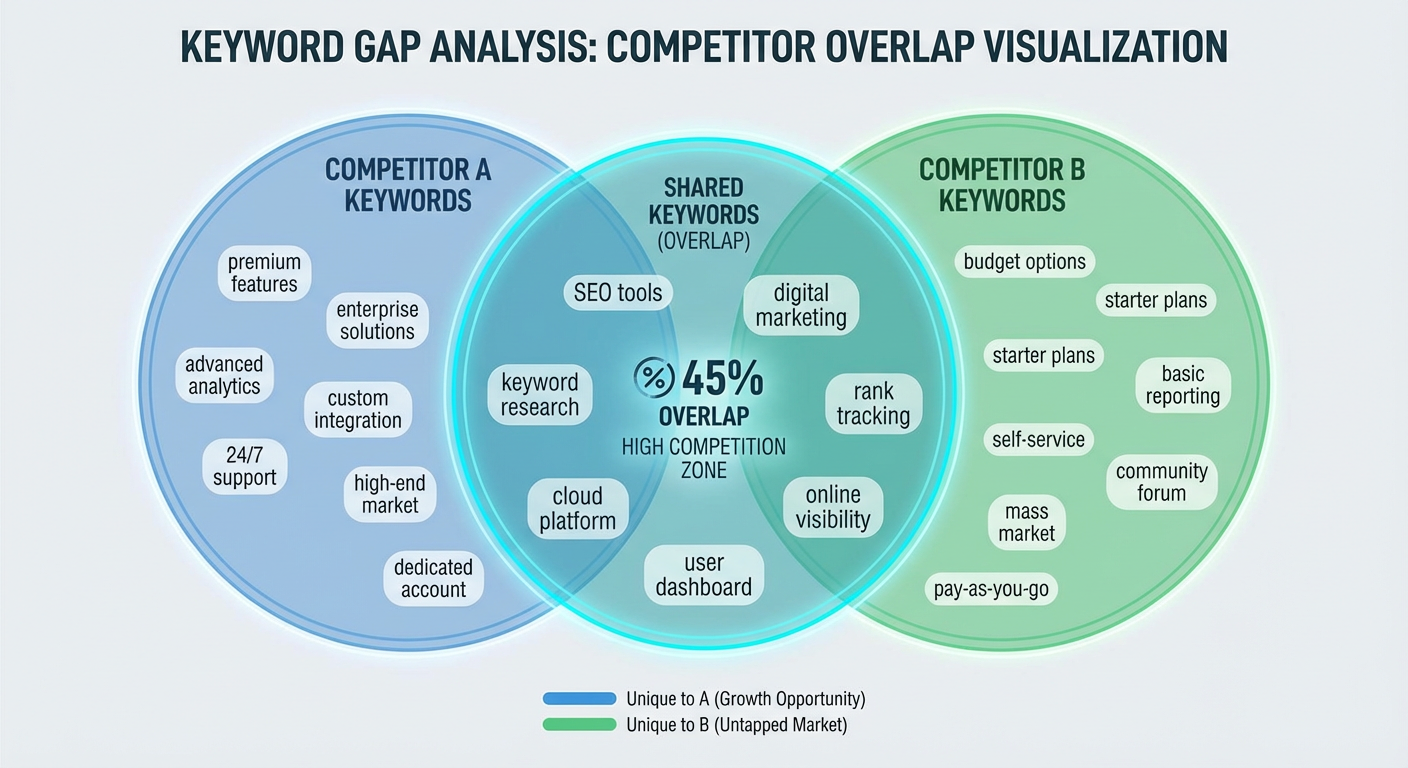
Ahrefs, SEMrush, and Moz all have keyword gap tools. Plug in your domain and two or three competitors, and out comes a list of keywords where they rank and you're invisible. Fair warning: the raw output will be thousands of rows. Don't panic. Most of it is noise.
Filter ruthlessly. I ignore anything under 200 monthly searches (not worth a dedicated page), anything with keyword difficulty over 50 (unless your DA is 70+, you're not cracking those soon), and anything with purely informational intent. "What is SEO" gets searches. "Best SEO audit tool" gets buyers. I care about the second one.
After filtering, group what survives by topic. You'll spot clusters — maybe a competitor ranks for fifteen variations around "email marketing automation." That's not fifteen separate opportunities. That's one content bet they made. You either go all-in on that cluster or skip it. Writing one half-hearted post about email automation when a competitor has fifteen pages on it is a waste of your time.
Step 3: Compare Backlink Profiles
Keywords tell you what your competitors are targeting. Backlinks tell you why they're winning.
A competitor ranking above you for the same keyword with similar content almost always has a stronger backlink profile. That's the part of SEO competitor research that people skip because it's less fun than keyword hunting. But it's where the real competitive picture lives.
Pull backlink data for your top five competitors and compare:
- Total referring domains (not total backlinks — one site linking to you 500 times is still one domain)
- Domain authority distribution. A hundred links from DA 10 sites mean less than five links from DA 70+ publications.
- Link velocity. Are they gaining links faster than you? Flat link growth against a competitor with accelerating links means the gap is widening.
The most useful thing backlink analysis tells you is where your competitors get links that you could also get. If three competitors all have links from the same industry publication, that publication clearly accepts content from companies in your space. Go get a link from them too.
Step 4: Analyze Their Top Content
This is my favorite step because it's where strategy actually emerges from the data.
Pull your competitors' top pages by organic traffic. Most SEO tools rank pages by estimated monthly visits. Look at their top 20. What topics come up? What format are those pages — long guides, comparison posts, tool roundups, templates?
When you study a competitor's top pages, you're reverse-engineering the content bets that paid off. Not everything a competitor publishes works. Their blog probably has plenty of posts that rank for nothing. But the top 20 pages? Those are the ones where topic selection, content quality, and SEO execution all lined up.
What I pay attention to during competitor website analysis: content length (if every page-one result for your keyword is 3,000+ words, your 800-word post isn't going to cut it), freshness (a competitor's article from 2022 that hasn't been touched is an invitation), gaps in their coverage (read their top pages carefully — what questions do they leave hanging?), and internal linking. Competitors who've built content hubs with strong interlinking rank better. If they haven't bothered, better site architecture alone can give you an edge.
Step 5: Technical SEO Quick Comparison
I'll keep this brief because people massively overthink this step. You're not auditing anyone's site. You're looking for obvious gaps.
Throw your site and your competitors into Google PageSpeed Insights. Look at Core Web Vitals — LCP, INP, CLS. If their site loads in 1.2 seconds and yours takes 4.5, that's working against you no matter how brilliant your content is. I've seen this exact scenario tank a client's rankings for months until we fixed their image optimization.
Beyond speed: schema markup, mobile-responsiveness, clean URL structure. Table stakes, all of it. Not differentiators. But if you're failing at basics while your competitors have them sorted, fix that before spending a dime on content.
Step 6: SERP Feature Analysis
Google stopped showing ten blue links a long time ago. Featured snippets, People Also Ask boxes, video carousels, image packs — these things eat clicks before anyone reaches the traditional results. Your keyword competitor analysis has to account for them or you're working with an incomplete map.
For your priority keywords, check what SERP features show up and who owns them. A competitor holding the featured snippet for your target keyword means you need to specifically structure content to steal it — clear definitions, numbered steps, comparison tables. The kind of formatting Google loves to pull into position zero.
People Also Ask boxes are underrated. Each PAA question is essentially a sub-keyword that Google considers related to the main query. Answer those questions in your content and you're covering the topic more thoroughly than competitors who ignore them. I've seen pages jump from position 8 to position 3 just by adding PAA-aligned sections.
Why Use an Agent for SEO Competitor Analysis
Honest math: doing all six steps manually takes eight to fifteen hours per competitor set. Different tool for each step, different export, different tab, different format. It's not intellectually hard. It's just mind-numbing enough that it slides off everyone's priority list into the "we should really do this sometime" graveyard.
An SEO competitor analyzer agent compresses the mechanical parts into minutes. Feed it your domain and your competitor list, and it runs keyword gaps, backlink comparisons, content analysis, and SERP feature checks in one shot. You still decide what to pursue and how to differentiate. The agent handles the part where you'd normally have twelve browser tabs open and a spreadsheet that's slowly destroying your will to live.
I've watched teams go from doing this analysis once a year (producing a deck that nobody reads) to doing it quarterly because the agent made it painless. That frequency is the real advantage. SEO moves. Competitors publish new content, earn new links, lose rankings. Quarterly analysis catches the shifts while they're still actionable.
Do the analysis. Build the plan. Publish the content. Repeat quarterly. That's it.
Try These Agents
- SEO Competitor Analyzer — Run a full competitor SEO audit covering keywords, content gaps, and backlink profiles
- Competitor Keyword Research — Discover keyword gaps and ranking opportunities across your competitive set
- Website Traffic Checker — Compare competitor traffic trends, top pages, and engagement metrics
- Market Intelligence Agent — Full-spectrum competitor research including hiring signals, reviews, and market data