
How to Find Your Competitor's Tech Stack (and Why You Should Care)

I can tell you more about a competitor's business from their tech stack than from their pitch deck. A company running Salesforce Enterprise, Marketo, and a $50k/year data warehouse is not the same animal as a company on HubSpot free tier with a shared Google Sheet as their "CRM." The tools tell you the budget. The budget tells you the strategy. The strategy tells you how to compete.
And here's the fun part: almost all of this information is public.
BuiltWith: Point, Click, Know Everything
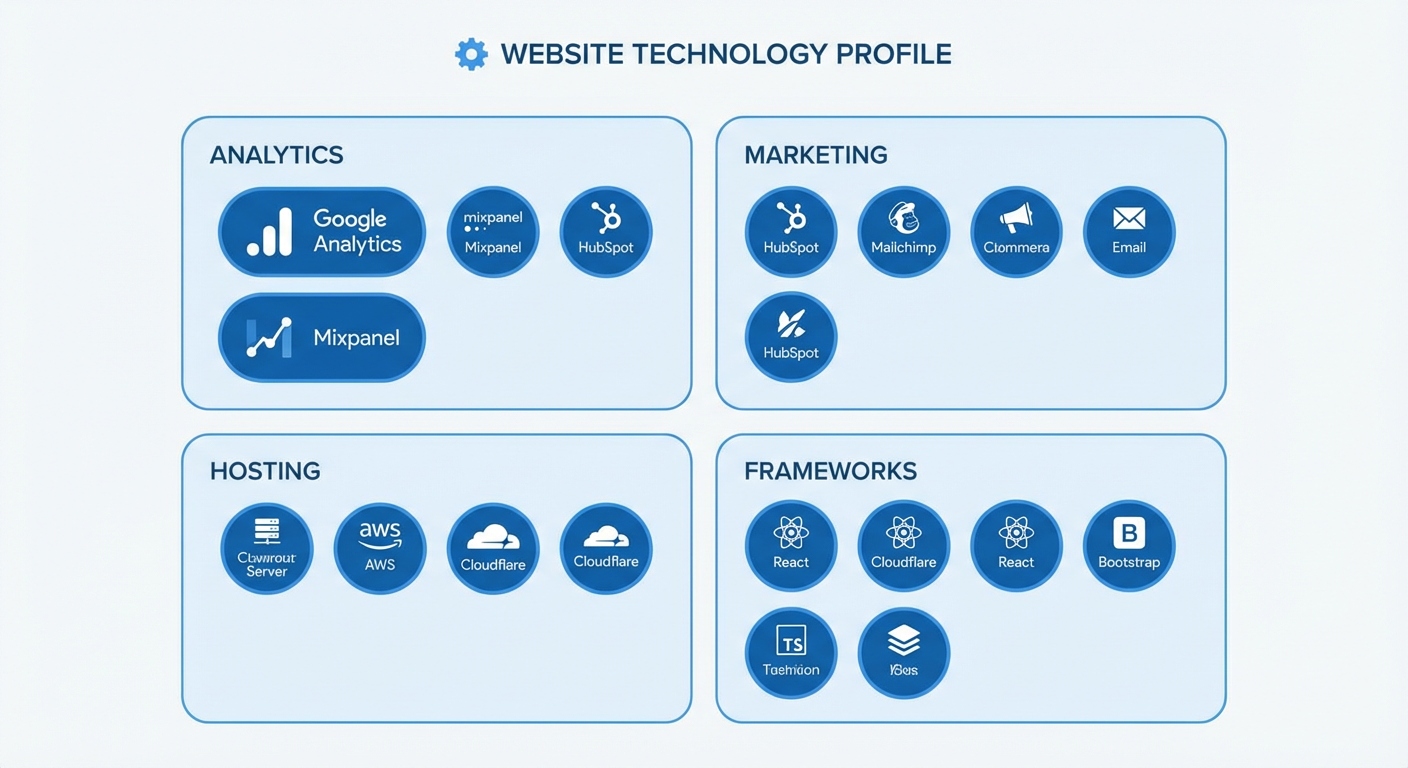
BuiltWith is the fastest way to x-ray a competitor's website. Free lookup, no account needed. Type in their domain and it returns every piece of technology running on that site. The CMS, the analytics tools, the payment processors, the ad trackers, the CDN, the chat widget. Everything.
I once checked a "bootstrapped" competitor on BuiltWith and found they were running Marketo (minimum $1k/month), Optimizely (enterprise AB testing), and Segment (data infrastructure). That's not a bootstrapped stack. That's a company with venture money they haven't announced yet. Called it three weeks before their funding round hit TechCrunch.
The paid version of BuiltWith shows historical data, so you can see what they added or dropped over time. A competitor that just added Amplitude probably started caring about product analytics. One that dropped their AB testing tool might have cut their CRO budget.
Wappalyzer does the same thing as a browser extension. I keep it installed and glance at it whenever I'm poking around a competitor's site.
Job Postings: The Accidentally-Public Architecture Diagram
This one is criminally underused. Job postings spell out the tech stack in plain English because they have to. "Senior Backend Engineer (Python, FastAPI, PostgreSQL)" just told you their backend stack. "Experience with Kubernetes and Terraform" means they're on cloud infrastructure. "Salesforce Admin" means... well, you can figure that one out.
Check their careers page, LinkedIn jobs, and whatever ATS they use (Greenhouse and Lever pages are usually public). Even filled positions often stay indexed on Google for months.
But here's what makes job postings really interesting: they reveal future direction. A competitor with no data team that suddenly posts three data engineering roles is building something. A competitor hiring five SDRs after years of product-led growth just decided inbound isn't enough. The hiring plan IS the strategy, published in the open.
GitHub Recon
If a competitor has public repos (plenty do, especially if they have an API or open source components), you're looking at actual code. Languages, frameworks, architectural patterns, dependency choices. It's all there in the package files and Dockerfiles.
Even companies without public repos leak information through their engineers' personal profiles. Search for employees on GitHub. Their public activity, starred repos, and contributions paint a picture of what they work with day to day.
Reading Between the Lines
Tech choices are build-vs-buy decisions, and every decision is a tell.
Running all best-of-breed tools (Segment plus Amplitude plus Braze plus Snowflake) means they optimize each layer separately and can afford the integration overhead. That's expensive. Usually signals a well-funded company with strong engineering.
All-in-one platform (HubSpot for everything, or deep in the Salesforce ecosystem) means they've chosen simplicity over optimization. Smaller team, or they've decided the integration headaches aren't worth it. Easier to compete against because they probably have less sophisticated tooling in any individual area.
Heavy custom tooling (internal tools, proprietary analytics, custom ETL) means they think off-the-shelf stuff doesn't cut it. Could be a real advantage, could be a massive maintenance burden. Either way, they're spending engineering time on infrastructure instead of product.
Why Use an Agent for This
Manually running BuiltWith checks, scanning job boards, and searching GitHub for three competitors eats an afternoon. And by the time you're done, the information is already aging.
A market intelligence agent monitors all of these signals continuously. It catches tech stack changes, new job postings that signal infrastructure investments, and strategic shifts you'd miss checking once a quarter. Pair it with a website traffic checker and you get the full picture: what technology they run, how much traffic they pull, and where it comes from.
A competitor's tech stack is an autobiography they didn't mean to publish. Go read it.
Try These Agents
- Market Intelligence Agent — Full-spectrum competitor research covering hiring, reviews, keywords, and news
- Website Traffic Checker — Estimate competitor website traffic and break down their channel mix
- SEO Competitor Analyzer — Uncover what keywords competitors rank for and where the content gaps live
- Landing Page Teardown — Rip apart competitor landing pages for conversion and messaging patterns