
How to Find Competitors You Don't Know About

Last year we lost a deal to a company I'd literally never heard of. The prospect mentioned them casually during a call — "oh yeah, we're also looking at [company name]" — and I had to mute myself so they wouldn't hear me frantically typing the name into Google. They had a real product. Real customers. A decent website. They'd been operating in our space for two years and somehow never crossed my radar.
That stung. Not because we lost the deal, but because I'd been doing "competitive intelligence" for months and completely missed an actual competitor. My competitor search was broken. I was only tracking the companies I already knew about, which is the most common mistake in competitive research. You build a list of five or six known rivals, obsess over their every move, and meanwhile some company you've never heard of is quietly eating your lunch from a direction you weren't watching.
Here's how to find the ones you're missing.
The SERP Overlap Method
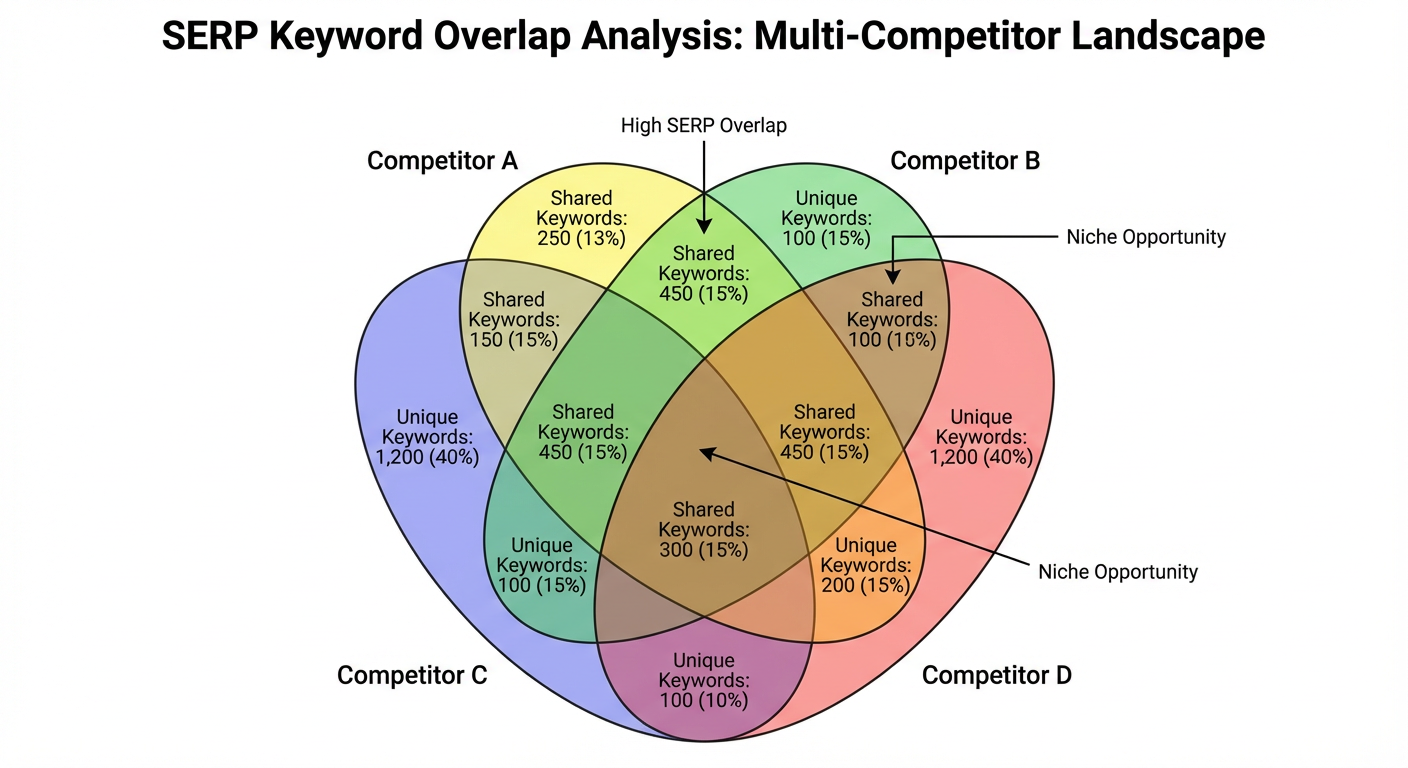
This is the simplest way to find website competitors and it takes about 20 minutes. Search for your top 10 keywords — the ones that actually drive revenue, not vanity terms — and write down every domain that appears on page one.
Do this across all 10 searches. Some domains will show up once. Ignore those. The ones that show up for four, five, six of your keywords? Those are competitors. They're targeting the same audience with similar content. Some of them you'll recognize. Others you won't.
When I did this for the first time at a previous company, I found three businesses I'd never heard of ranking for terms I thought we owned. One of them was a bootstrapped startup with maybe 10 employees. They had no social media presence, no PR, no conference talks. But they had solid SEO content ranking for our best keywords, and they were pulling traffic we should have been getting.
A few things to watch for:
- Domains that rank for your branded terms. If someone ranks for "[your company] alternatives," they know about you even if you don't know about them.
- New entrants. A domain that didn't show up last quarter but now appears for three of your keywords is a company moving into your space.
- Content-heavy sites that aren't direct products. Sometimes a media site or comparison platform is funneling traffic away from you. That's still competition for attention.
Keyword Bidding Overlap
Organic SERPs tell you who's investing in content. Paid ads tell you who's investing money, which is a different signal and sometimes more telling.
Search your core keywords and look at the ads. Who's bidding? Google's Ads Transparency Center lets you check competitors' ad history without any paid tools. Type in a competitor's domain and see what they're running. But more importantly, search your own keywords and note the advertisers you don't recognize.
The Facebook Ad Library and LinkedIn Ad Library work the same way. Search for keywords related to your product category and see which companies are spending money to reach your audience.
I found one of our most aggressive competitors through Google Ads. They were bidding on our brand name — running ads that said "Looking for [our product]? Try [their product] instead." That's how I learned they existed. They'd been running the campaign for months.
Companies that bid on the same terms as you have made a conscious decision that your audience is their audience. That's a competitor, even if their product looks different from yours on the surface.
G2, Capterra, and Review Site Categories
Review sites are the most underrated competitor website finder available. Here's why: G2, Capterra, and TrustRadius organize products into categories. When a company creates a listing, they choose which categories to appear in. Those categories are their self-declared competitive set.
Go to G2. Find your product's category page. Every product listed there considers themselves your competitor. Sort by number of reviews, by satisfaction rating, by company size served. You'll find companies you've never encountered because they don't show up in your usual channels — they don't blog, they don't run ads, they don't speak at conferences. But they're on G2 with 200 reviews and a 4.5-star rating, and buyers are finding them during evaluation.
The category structure itself is revealing. Sometimes your product appears in a G2 category you didn't expect. That means buyers think of you differently than you think of yourself, and the other products in that unexpected category are competitors you probably weren't tracking.
Also check competitors' G2 comparison pages. G2 auto-generates "vs" pages for every product pair. If G2 has a comparison page between a company you've never heard of and one of your known competitors, that unknown company is almost certainly relevant to you too.
Customer Interviews
This one requires actual conversations, which is why most teams skip it. Ask your customers — especially new ones — a simple question: "Who else did you evaluate before choosing us?"
The answers will surprise you. I've done this dozens of times and every single round produces at least one name I don't recognize. Buyers find tools through different channels than you monitor. They ask in Slack communities. They search Reddit threads. They get recommendations from friends at other companies. Their discovery path doesn't match yours.
A few variations that pull out even more intel:
- "If we didn't exist, what would you use?" This surfaces alternatives you might not think of as direct competitors but that buyers would use instead of you.
- "Who came up in your last renewal discussion?" During renewal, procurement often checks the market again. They'll mention newer entrants.
- "What do your peers at other companies use?" This one is gold because it extends beyond the individual buyer's experience into their network.
Lost-deal interviews are even more valuable. Someone who chose a competitor over you can tell you exactly who beat you and why. That competitor might be a company you haven't even been tracking. Sales teams sometimes capture the competitor name in the CRM. Sometimes they don't. Formalizing this — making "competitor name" a required field on closed-lost deals — is one of the highest-ROI things you can do for competitive intelligence.
Why Use an Agent
Doing a thorough competitor search manually means searching 10+ keywords in Google, checking the ad results, browsing three review sites, reading category pages, and conducting customer interviews. It's a full day of work, and the results go stale within a month as new companies enter your market and existing ones shift strategy.
A market intelligence agent automates the parts that don't require human conversation. It runs SERP overlap analysis across your keyword set, flags new domains appearing for your terms, pulls review site category data, monitors ad libraries, and synthesizes everything into a list of competitors ranked by overlap with your market position. It catches the company that just started bidding on your keywords last Tuesday. It notices the startup that published 15 blog posts targeting your core terms over the past month.
You still need to do the customer interviews yourself. No agent replaces a direct conversation with a buyer. But the agent handles the 80% that's pure research, so your time goes toward the conversations that actually produce unique insight.
The competitors you don't know about are the ones that hurt you most. They win deals you never even knew were competitive. Start looking.
Try These Agents
- Market Intelligence Agent — Full-spectrum competitor research covering hiring, reviews, keywords, and news
- SEO Competitor Analyzer — Uncover what keywords competitors rank for and where the content gaps live
- Competitor Keyword Research — Find keyword gaps and opportunities your competitors are ranking for