
How to Spot Indirect Competitors Before They Eat Your Lunch
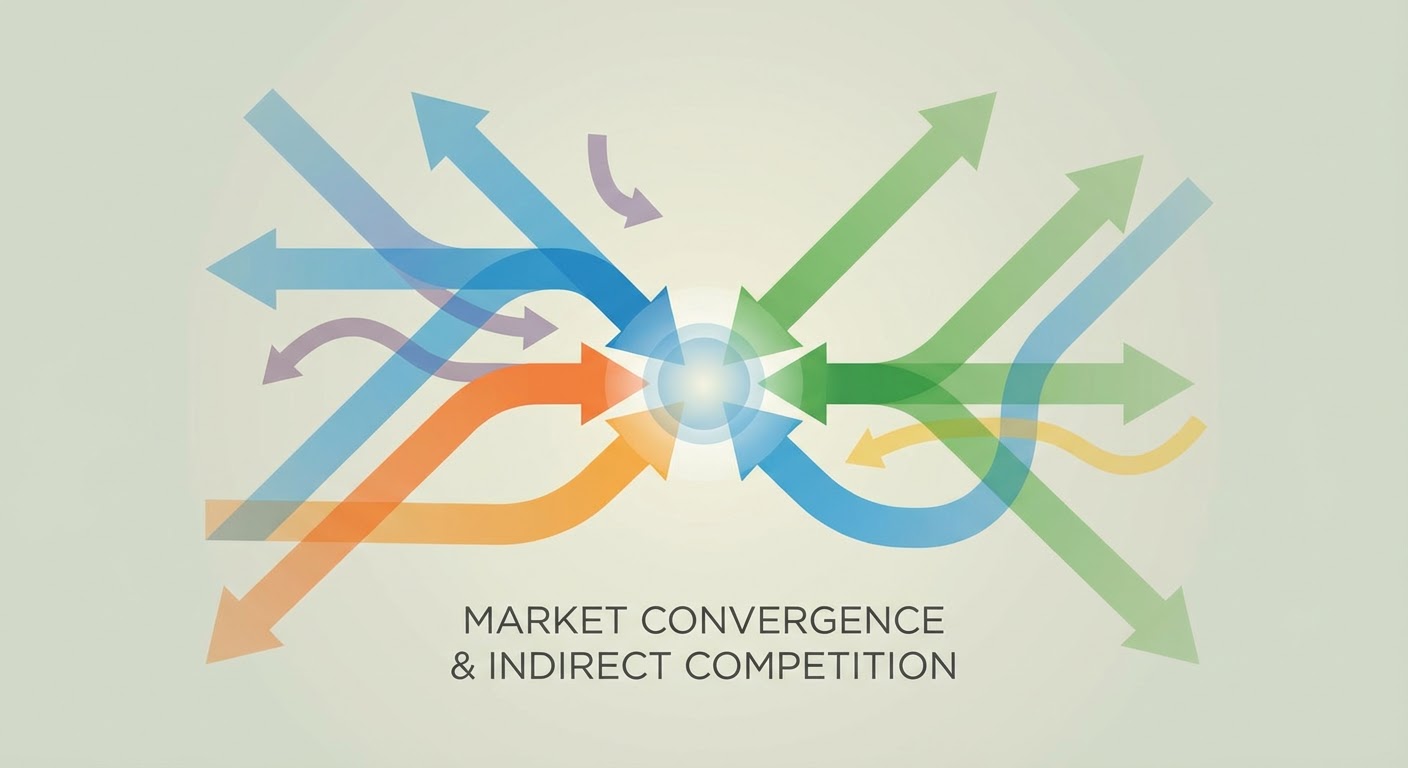
Slack didn't set out to kill email. Zoom wasn't trying to replace business travel. Figma didn't pitch itself as the InVision killer. But look at what happened. The competitors that cause the most damage rarely announce themselves as competitors. They come from adjacent spaces, solve a related problem, and gradually absorb the use case you thought was yours.
In B2B, this pattern repeats constantly. The CRM that adds analytics. The analytics platform that adds CRM. The project management tool that adds time tracking, which used to be a separate $50M market with dedicated vendors. If you're only watching direct competitors — companies that do exactly what you do — you're watching the wrong direction.
What Makes a Competitor "Indirect"
Direct competitors sell a similar product to similar buyers. You know who they are because you fight them in deals. Indirect competitors are harder to spot because they don't look like you. They fall into three categories, and each one requires a different approach to identify.
Category substitutes solve the same problem differently. If you sell sales engagement software, a freelance VA service is an indirect competitor. Different product, same buyer need. These substitutes are everywhere and mostly aren't worth worrying about. But occasionally one gains enough traction to matter.
Adjacent expanders are the dangerous ones. These are companies in a neighboring category that could add your functionality as a feature. Your entire product might become a tab in their product. The way to identify them: look at companies serving your same customer but solving a different problem. If adding your capability makes their product more complete, they're a potential indirect competitor.
Platform consolidators are the largest companies that absorb categories. Salesforce, Microsoft, HubSpot, Google. They don't compete with anyone specifically. They compete with everyone gradually. If your product's functionality could reasonably exist as a module inside a major platform, that platform is your indirect competitor whether or not they've built it yet.
Finding Them Through Traffic Overlap
The most reliable early signal of indirect competition is audience overlap. When your website visitors also visit a company you've never considered a competitor, that overlap means buyers are evaluating both of you. Even if the products seem unrelated today.
A SimilarWeb lookalike prospector identifies companies with visitor profiles similar to your known competitors. Some will be direct competitors you missed. Others will be adjacent companies attracting the same audience. Those adjacent companies are your indirect competitive threats.
Check the keywords too. If a company in a different category starts ranking for keywords in your space, they're positioning for a move. A project management tool that starts publishing content about "team analytics" and "productivity metrics" is telling you something. Their blog reveals their product roadmap six to twelve months before the actual feature launch.
Competitor traffic analysis makes this visible. Run it on companies in adjacent categories and look for keyword overlap with your own traffic. High overlap means the audiences are converging. When audiences converge, products follow.
Finding Them Through Hiring Signals
Job postings are the most underrated competitive intelligence source. When a company in an adjacent space posts job descriptions that sound like they're building your product, believe them.
Look for three signals. Domain-specific job titles (a collaboration tool hiring "competitive intelligence engineers" is entering the CI space). Technical requirements that match your product's architecture. And customer success roles targeting your customer profile.
LinkedIn job alerts work for tracking individual companies. But for broader landscape scanning, a Crunchbase market mapper can identify companies in adjacent markets that are scaling teams in your direction. It's less about any single job posting and more about patterns across hiring activity.
I missed a competitor once because I wasn't watching hiring signals. A data integration company hired four people with marketing analytics backgrounds in a single quarter. Three months later, they launched a marketing analytics module that directly competed with our product. The hiring was the signal. I just wasn't looking for it.
Finding Them Through Your Customers
Your existing customers will tell you about indirect competitors before any tool catches them. You just have to listen for specific phrases.
"We're also evaluating..." followed by a company name you don't recognize. That's your signal. When three different prospects mention the same unfamiliar company, it's not a coincidence.
"We might just build this in-house." That's the internal competition signal. If multiple prospects say this, your product might be more commoditized than you think. The "build it ourselves" competitor is indirect but real.
"We're thinking about consolidating onto [Platform X]." If prospects are considering replacing your specialized tool with a feature inside a larger platform, that platform is your indirect competitor. It doesn't matter that their version is worse. The consolidation argument ("one less vendor, one less login, one less contract") is strong.
Train your sales and customer success teams to flag these mentions. Not formally — nobody fills out a "competitive mention form." Just encourage them to drop a note in Slack when they hear an unexpected company name. Over time, the pattern becomes obvious.
What to Do When You Spot One
Not every indirect competitor deserves a response. Most adjacent companies that could enter your market won't. They have their own priorities and their own roadmap, and building your feature isn't necessarily on it.
Watch them, but don't panic. Add them to your competitive landscape map in a "watch" tier. Check quarterly for signals of movement: product announcements, content shifts, hiring patterns. If the signals accelerate, upgrade them to your active competitive tracking.
When an indirect competitor does make a real move into your space, you usually have six to twelve months before they're a serious threat. Their v1 will be immature. Their sales team won't know how to sell it. Their customers won't know it exists yet. Use that window to sharpen your positioning on what makes a dedicated solution better than a bolted-on feature.
Why Use an Agent for This
The SimilarWeb lookalike prospector systematically identifies audience overlap that manual research can't. You can't visit every company's website and check if their visitors overlap with yours. The agent does it automatically and surfaces the unexpected matches that point to indirect competitive threats.
The Crunchbase market mapper scans adjacent markets in a structured way. Instead of guessing which industries might converge with yours, it maps companies by category, funding, and growth signals. The ones growing fast in a direction that points toward your market go on your watch list.
The competitor traffic analysis agent turns content strategy into competitive intelligence. When adjacent companies start targeting your keywords, you see it in the data. That keyword encroachment is often the first public signal that a company is expanding into your space.
The competitor you should fear most is the one you haven't heard of yet. Go find them before they find your customers.
Try These Agents
- SimilarWeb Lookalike Prospector — Find companies with overlapping audiences
- Crunchbase Market Mapper — Map adjacent markets for indirect competitive threats
- Competitor Traffic Analysis — Identify keyword and content convergence
- Market Intelligence Agent — Ongoing landscape monitoring for emerging threats