
Competitive Benchmarking: Skip the Theory, Do the Work
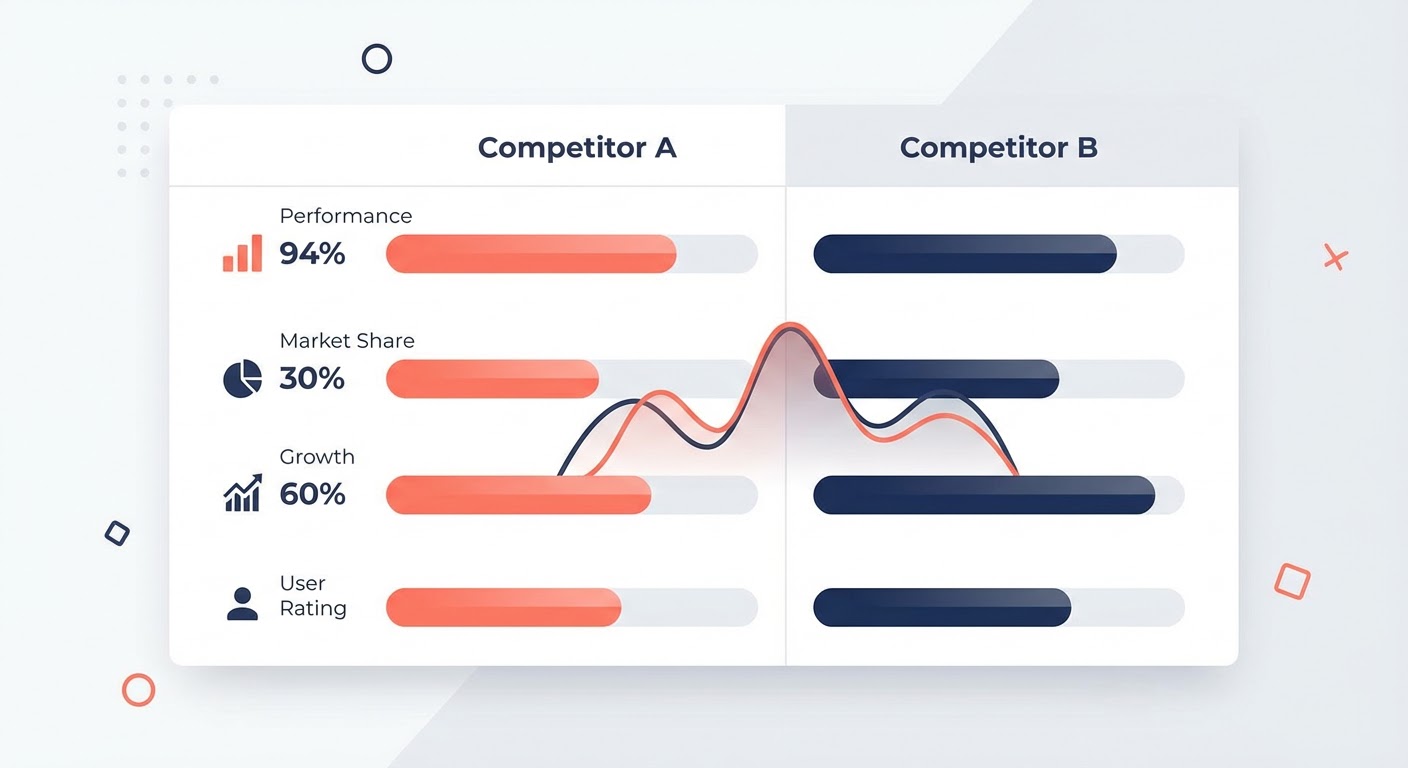
A marketing director showed me her "competitive benchmarking report" last quarter. It was 47 slides. She'd spent three weeks building it. There were quadrant charts, spider diagrams, and a lovely color-coded matrix that mapped twelve competitors across eight dimensions.
I asked her what the team had actually done with the report. She paused. "We presented it at the QBR." And then? "Well... it was really informative."
Three weeks of work for a slide deck that informed people and changed nothing. That's what competitive benchmarking looks like at most companies. A research project that impresses stakeholders and collects digital dust in a Google Drive folder.
Here's my rule: if a competitive benchmark doesn't lead to a specific decision within two weeks, it was a waste of time. You benchmarked yourself against competitors so you could... know things? No. You benchmark so you can act. Change your pricing. Adjust your positioning. Invest in a feature. Drop a losing channel. The benchmark is the input, not the output.
What to Actually Benchmark (And What to Skip)
The biggest mistake in competitive benchmarking is measuring too much. Twelve competitors across eight dimensions is 96 data points. Nobody makes decisions with 96 data points. They make decisions with 3-5.
Here's what's worth benchmarking, based on what actually changes behavior:
Pricing and packaging. How are you priced relative to competitors? Not just the sticker price — the packaging. What's in the free tier? Where does the next tier start? What do they charge for add-ons? This directly affects your pricing strategy and win rates. If you're 40% more expensive with the same features, that's actionable intelligence.
Traffic and channel mix. Where do your competitors get their users? Organic search, paid ads, social, direct? If a competitor is getting 50% of traffic from organic search and you're getting 8%, that's a signal that SEO investment could pay off. If they're spending heavily on Google Ads and their traffic is growing, that channel is probably working for them.
Product positioning. How do competitors describe themselves? What problem do they lead with? Who do they say they're for? If three of your five competitors are positioning around "enterprise security" and you're the only one talking about "ease of use," you've either found a gap or you're missing what the market actually wants. Both are worth knowing.
Customer sentiment. What do their customers love and hate? G2 reviews, Trustpilot, Reddit threads, Twitter complaints. The features their customers complain about most are your sales angles. The things they praise are your competitive threats.
Content and thought leadership. What are they publishing? What topics are they ranking for? Where are they investing in content? If a competitor suddenly starts publishing 10 articles about "AI sales automation" after publishing nothing about it for years, they're about to launch something in that space.
What to skip: employee count, office locations, founding year, mission statements, org charts, board composition (unless you're doing enterprise deal intel). These fill slides but don't change decisions.
Running a Competitive Benchmark That Doesn't Take Three Weeks
I've gotten the competitive benchmarking process down to about half a day for five competitors. Here's how.
Hour 1: Pricing scan. Visit each competitor's pricing page. Screenshot it. Note the tiers, the featured price, and what's gated behind enterprise/contact-us. If their pricing isn't public, check G2 reviews where users sometimes mention what they pay. Organize this in a simple spreadsheet, not a 47-slide deck.
Hour 2: Traffic and SEO. Pull traffic estimates and top keywords for each competitor. You're looking for patterns, not exact numbers. Who's growing? Who's declining? Which keywords are they winning that you're not? Which channels are driving their growth?
Hour 3: Positioning and messaging. Read their homepage, their about page, and their top three blog posts. How do they describe their product? What words do they use? Who do they say it's for? Write a one-sentence summary of each competitor's positioning. If you can't tell them apart, the market can't either — and that's information too.
Hour 4: Customer sentiment. Read their last 20 G2 reviews. Read their Trustpilot page. Search Reddit for their brand name. You're looking for patterns in complaints and praise. If nine out of twenty reviews mention bad customer support, that's a sales angle for your reps. If everyone praises their onboarding, that's something you should probably study.
Four hours. Five competitors. Not three weeks. The output is a one-page summary per competitor with pricing, traffic trends, positioning, and customer sentiment. Your team can read it in 15 minutes and make actual decisions with it.
Keeping Benchmarks Current
A competitive benchmark from six months ago is fiction. Companies change pricing. They launch features. They rebrand. They get acquired. A static benchmark report is wrong the moment you finish writing it.
The teams that do competitive benchmarking well treat it as a living process, not a one-time project. Monthly check-ins on pricing pages and positioning. Quarterly traffic analysis. Ongoing monitoring of review sites. It sounds like a lot of work, but each monthly update takes about an hour if you've done the initial benchmark properly. You're just checking what changed.
The teams that don't do this well produce one big report per year, present it at the annual strategy meeting, and then operate on outdated information for the next eleven months. Their sales team quotes competitor pricing from 2024 because nobody told them it changed.
Why Use an Agent for This
The monitoring part of competitive benchmarking is exactly the kind of work that an agent handles better than a human. Not the strategic analysis — you still need a person to say "this pricing change means we should adjust our mid-tier offering." But the data collection part? Checking five competitors' pricing pages every month, scanning their blogs for new content, pulling traffic estimates, monitoring their reviews? That's pure research labor.
A competitive traffic analysis agent automates the traffic and channel benchmarking. Monthly traffic estimates, source breakdown, trending keywords. Instead of manually pulling reports from three different SEO tools, you get a dashboard-style output that shows exactly where each competitor stands.
For pricing specifically, the competitor pricing analyzer tracks pricing page changes over time. When a competitor raises their mid-tier price by 20%, you know within days instead of finding out during a sales call when the prospect tells you.
The G2 competitive battlecard generator turns the review analysis into sales-ready ammunition. Instead of your reps reading G2 reviews themselves, they get a battlecard that says "Competitor X: customers complain about API limits and slow support. Our angle: unlimited API calls, 4-hour response SLA." That goes directly into sales conversations.
For the ongoing monitoring, a Google Sheets competitor traffic report keeps a running log that updates automatically. Your marketing team doesn't have to remember to pull the data every month. It just appears in the spreadsheet.
Benchmark to Decide, Not to Know
If your last competitive benchmark didn't lead to a specific change in strategy, pricing, messaging, or investment, it wasn't benchmarking. It was trivia. Real competitive benchmarking is short (half a day, not three weeks), focused (5 metrics, not 50), and actionable (leads to a decision within two weeks). Everything else is strategy theater.
Try These Agents
- Competitor Traffic Analysis — Track competitor traffic sources, volume, and trends automatically
- Competitor Pricing Analyzer — Monitor competitor pricing changes and packaging evolution
- G2 Competitive Battlecard Generator — Turn G2 review analysis into sales-ready competitive battlecards
- Google Sheets Competitor Traffic Report — Automated competitor traffic reporting in Google Sheets