
Competitor Mapping: A Guide That Won't Put You to Sleep
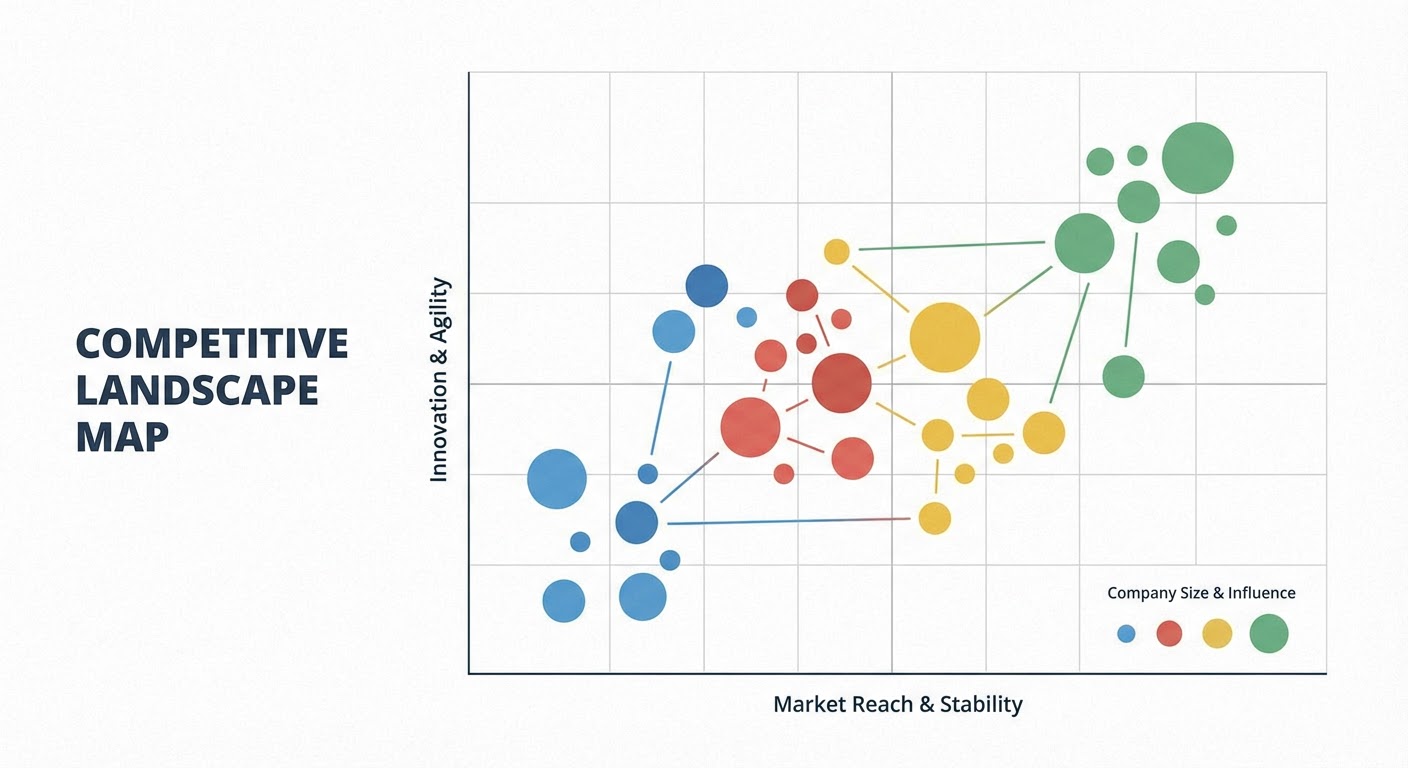
Every strategy consultant I've ever met loves a good 2x2 matrix. Put "price" on one axis, "features" on the other, plot your competitors as dots, and call it a competitive landscape map. I've made at least a dozen of these. They look great in board decks. They're also mostly useless for day-to-day decision making.
The problem isn't the concept — understanding where competitors sit relative to you is genuinely useful. The problem is that most competitor mapping exercises produce a pretty picture and stop there. Nobody goes back to update it. Nobody uses it to make actual decisions. It gets screenshot'd into a slide, presented once, and forgotten.
I want to talk about competitor mapping that people actually use. The kind that changes how you sell, how you position, what you build next. It starts with being honest about which competitors actually matter.
Not All Competitors Are Equal
The first mistake in competitor mapping is listing everyone. I once watched a team spend two weeks mapping 47 competitors. Forty-seven. They plotted each one on a positioning map with four quadrants. The resulting chart looked like someone sneezed on a scatter plot.
Here's a better approach: name the companies you've lost deals to in the last six months. Not the ones you worry about. Not the ones your CEO read about in TechCrunch. The ones that actually took money out of your pocket.
For most B2B companies, that list is three to five names. Maybe seven if you're in a crowded space. Those are your real competitors. Everyone else goes into a "watch" list that you check quarterly and mostly ignore.
Split your map into three tiers:
Tier 1 competitors show up in more than 20% of your competitive deals. You need battlecards, detailed positioning, and weekly monitoring for these. You probably have two or three.
Tier 2 competitors appear occasionally — maybe 5-15% of competitive deals. You need basic positioning and monthly check-ins. Usually three to five of these.
Tier 3 is everyone else. Check quarterly. Don't lose sleep.
The Positioning Map That's Actually Useful
Forget the generic price vs. features grid. Instead, map competitors on the two dimensions your buyers actually care about.
In our market, those dimensions turned out to be "time to value" (how fast can a team get results) and "depth of customization" (how much can you bend the tool to fit your workflow). Your dimensions will be different. The way you find them: read your last 20 deal win/loss notes and look for the two factors that get mentioned most. That's your map.
Once you have the right axes, the map becomes useful because it mirrors how buyers think. When a prospect says "we need something quick to deploy," you can immediately show them where you sit versus Competitor B on the time-to-value axis. The map becomes a sales tool, not a strategy decoration.
Update it when something changes. A competitor launches a self-serve product? They just moved on your time-to-value axis. A competitor adds an API and custom workflows? They shifted on customization. These moves happen maybe two or three times a year, so the map doesn't need constant attention. But when it shifts, the positioning conversation shifts too.
Where to Get the Data
Competitor mapping requires information from five sources, and most of it is free.
Your CRM is the most reliable source. Filter closed-lost deals by competitor mentioned. That tells you who you actually compete against and how often. Most teams skip this because their CRM data is messy — reps don't consistently log competitor names. Fix that first. Add a required field. You'll thank yourself in three months.
Buyer conversations tell you how customers position you relative to competitors. Not how you think you compare — how they think you compare. Those are different. One discovery call where a prospect says "we think of you as the easier version of Competitor A" is worth more than a week of website analysis.
Public financial data works for publicly traded competitors. Crunchbase profiles reveal funding, employee counts, and strategic priorities. A competitor that just raised $50M is making different moves than one that's bootstrapped and profitable.
Review sites (G2, Capterra, TrustRadius) show you how customers rate competitors across specific criteria. The "compared to" section in G2 reviews is gold — it tells you exactly which alternatives buyers considered.
A competitor traffic analysis reveals where competitors get their traffic, which content performs, and where they're investing in audience. A competitor getting 40% of their traffic from "enterprise security compliance" keywords is telling you their positioning through their actions.
The Indirect Competitor Problem
Most competitor maps only include direct competitors — companies selling a similar product to similar buyers. The competitors that blindside you are the indirect ones. The spreadsheet. The intern. The "do nothing" option.
In B2B, your biggest competitor is often inertia. The prospect's current process, even if it's bad, is familiar. Mapping this means acknowledging it on your competitive landscape and having positioning for the "why change at all?" conversation, not just the "why us over them?" conversation.
Then there are adjacent competitors — companies that don't compete with you today but could tomorrow. The CRM that adds your feature as a module. The platform that moves from SMB to enterprise. A market mapper tool can help spot these by tracking companies in adjacent spaces that show signs of entering your market — new job postings, patent filings, product announcements in your category.
Keeping the Map Alive
A competitor map that doesn't get updated is worse than no map at all. It gives you false confidence. You make decisions based on where competitors were six months ago, not where they are now.
The maintenance is simpler than the initial build. Monthly, spend 20 minutes checking your Tier 1 competitors for positioning changes. Did their homepage messaging change? Did they launch or sunset a product? Did their pricing shift? Update the map.
Quarterly, review the full map including Tier 2 and Tier 3. Promote or demote competitors based on deal data. A Tier 2 competitor showing up in more deals gets promoted. A Tier 1 competitor you haven't seen in a quarter gets demoted. The tiers aren't permanent — they reflect reality, and reality changes.
Have a market intelligence agent run a competitive scan monthly and flag anything that would move a competitor's position on your map. Most months, nothing changes. When something does change, you'll know about it within days instead of discovering it mid-deal.
Why Use an Agent for This
Building the initial competitor map takes research. The Crunchbase competitor tracker pulls funding data, employee counts, and company details in minutes instead of hours of manual research. Point it at your competitor list and you get the factual foundation of your map without the tab-switching.
The competitor traffic analysis answers the positioning questions that websites alone can't. Where a competitor invests their marketing dollars tells you more about their strategy than their "About Us" page ever will.
For ongoing maintenance, the market intelligence agent watches for the signals that should trigger a map update: pricing changes, product launches, positioning shifts, major hires. It turns map maintenance from a calendar reminder you ignore into an alert you can't miss.
Map your competitors. Keep the map simple. Update it when the market moves. Use it to sell.
Try These Agents
- Market Intelligence Agent — Competitive monitoring that catches positioning shifts
- Crunchbase Competitor Tracker — Company data for your competitor map
- Competitor Traffic Analysis — SEO and traffic positioning data
- Crunchbase Market Mapper — Identify adjacent and indirect competitors