
How to Do a Competitor SWOT Analysis (Without the Usual BS)
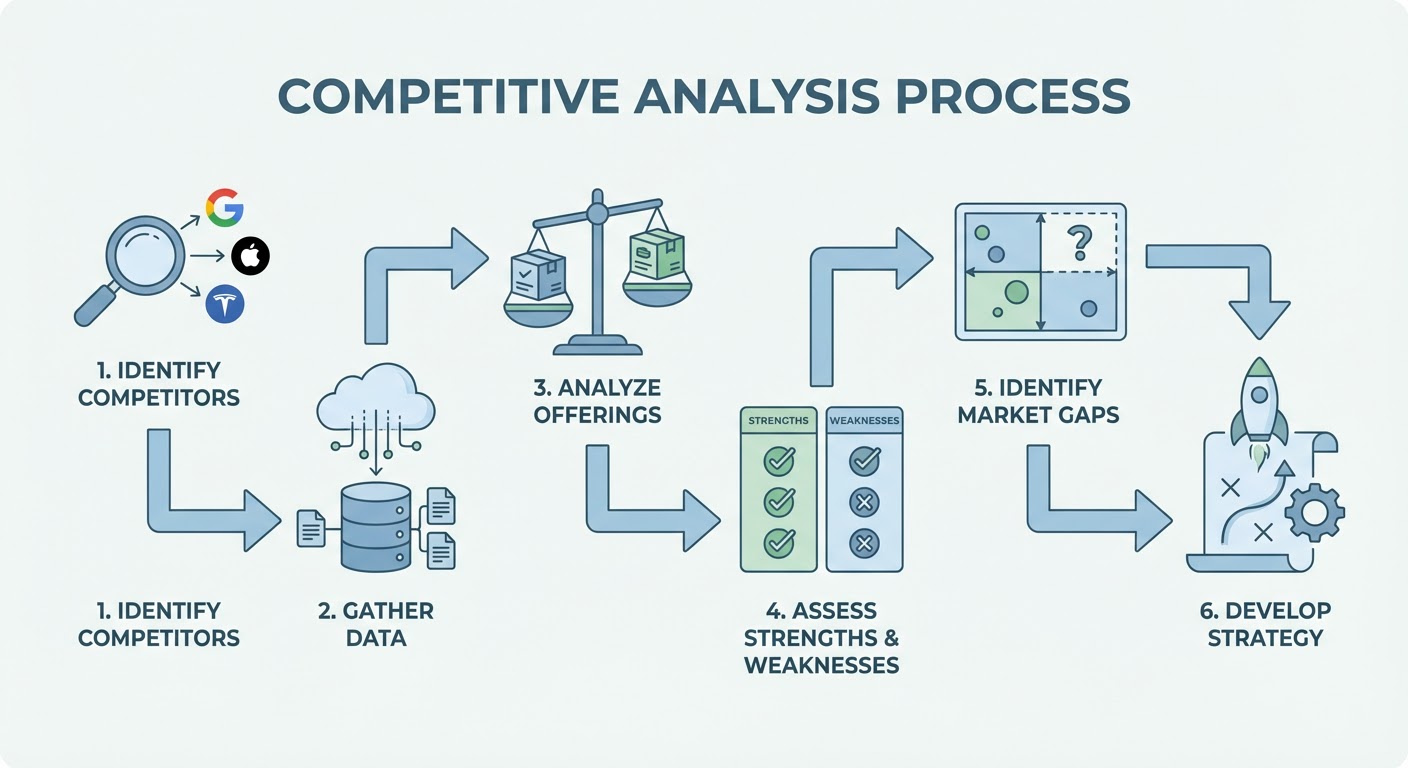
I'll be honest. The first time I ran a competitor SWOT analysis, I opened a Google Doc, drew the four-quadrant box, and started typing whatever came to mind. "Strength: strong brand." "Weakness: complex pricing." "Opportunity: they don't have mobile." "Threat: they might acquire someone."
I presented it to my VP. She looked at it for about ten seconds and asked, "How do you know their pricing is complex?" I said I'd heard it from a prospect once. Once. One person. She told me to come back when I had evidence, not anecdotes. It was embarrassing but she was right. I'd been filling in boxes with feelings instead of facts.
Here's what I do now. It's less fun, more spreadsheet-y, and it actually works.
Step 1: Pick One Competitor
Resist the urge to SWOT three competitors at once. You'll half-ass all three and produce nothing useful. Pick the one you lose to most — that's where the analysis pays off fastest because it directly connects to deals you're bleeding.
Open your CRM. Sort closed-lost deals by competitor. The name that comes up most? That's your target. If you're not tracking this (fix that, by the way), walk over to your reps and ask. They'll tell you who they're sick of losing to before you finish the question.
Step 2: Gather the Evidence (Before You Write Anything)
This is where most people skip ahead to filling in boxes. Don't. Spend the time gathering raw material first. You need four types of data.
Customer review data. Pull up G2, Capterra, and TrustRadius for the competitor. Read at minimum 30 reviews — 15 positive, 15 negative. Don't skim. Actually read them. Write down every specific praise and complaint in a running list. "Great API documentation" goes on one list. "Reporting is basic" goes on another. You'll sort these into quadrants later. Right now you're collecting raw material without trying to categorize it.
Traffic and distribution data. Check SimilarWeb for their traffic volume, growth trend, and channel breakdown. Which channels drive the most visits? Is their traffic growing or shrinking? This tells you about their go-to-market strength. A competitor growing organic traffic at 20% per month has a content machine working. A competitor where 60% of traffic is paid has a checkbook working.
Product and company signals. Check their changelog or product blog for what they shipped recently. Check their careers page for what they're hiring. Check Crunchbase for funding history. Check LinkedIn for executive changes. Each of these tells you something specific: shipping velocity, investment focus, financial runway, leadership stability.
Your own internal data. Win/loss data from CRM. Call recordings or notes from deals you lost to them. Feedback from prospects who evaluated both of you. This is the richest source of competitive intelligence you have and most teams barely touch it. Your reps know things about competitors that no public data source can tell you.
Step 3: Sort Into Quadrants (Now You Can Fill In Boxes)
Take your raw notes and sort them. But here's the rule: every item needs evidence attached.
Strengths should come primarily from their positive reviews and your loss reasons. If customers love their onboarding and your reps keep saying "they won because the prospect liked their implementation process," that's a confirmed strength with two independent sources. If you can only find one mention of something, it's probably noise, not a pattern.
Weaknesses come from negative reviews, your win reasons, and observable gaps. If G2 reviewers consistently flag "limited integrations" and your reps say "we won because they couldn't integrate with Salesforce," you've triangulated a real weakness. The triangulation matters. A single data point is an anecdote. Three data points from different sources is a pattern.
Opportunities come from gaps you've identified in their strategy. Where are they not showing up? What channels are they ignoring? What customer segments are they underserving? What pain points do their customers express that they haven't addressed? Cross-reference negative reviews with your product capabilities — every complaint about them that your product solves is an opportunity.
Threats come from their recent actions. New product launches, funding rounds, executive hires, partnership announcements, aggressive pricing changes. These aren't hypothetical scenarios. They're things that already happened and will affect you in the next 6-12 months.
Step 4: Cut Ruthlessly
You probably ended up with 10-15 items per quadrant. That's too many. Nobody acts on 60 competitive insights. Cut to three per quadrant. Twelve total. That's your working SWOT.
How to decide what stays? For strengths, keep the ones that actually cost you deals. Not their most impressive capability in the abstract — the thing that makes your prospects say "we're going with them." For weaknesses, keep the ones you can actually use in a sales conversation next week. A theoretical weakness you can't exploit is academic trivia.
Opportunities get ranked by effort-to-payoff. A three-month project that could flip 20% of competitive deals beats a year-long initiative that might affect 5%. And for threats — urgency wins. Something they shipped last week outranks something they might build eventually.
Step 5: Make It Actionable (Or Why Bother)
Here's where most SWOT exercises die. People nod thoughtfully, say "good insights," and go back to whatever they were doing before. If the SWOT doesn't produce specific tasks for specific people, delete the document and save everyone the pretense.
Your top competitor strength needs a response plan. Maybe you can match it. Maybe you position around it entirely. If they have great onboarding and yours is a mess, you've got two choices: fix yours or change the sales conversation so onboarding never comes up. Both are valid. Ignoring it isn't.
Their biggest weakness? Write a talk track for your reps. Literally script it. "When they mention [competitor], ask about [weakness area]." Then train the team. I've watched too many sales teams discover a competitor weakness in a strategy meeting and then never mention it in a single deal. That's not intelligence — that's trivia night.
Opportunities become projects with owners. Threats get monitoring set up — a market intelligence agent watching for announcements saves you from being the last to know when a competitor makes a move.
Step 6: Review and Update Quarterly
Mark your calendar. Every quarter, pull the SWOT back up. Go through each item: still true? Changed? No longer relevant? Update the evidence sources and refresh the rankings.
The most valuable moment in a SWOT review is when something moves from "Opportunity" to "Threat" — meaning a gap you identified is now being closed by the competitor. That's the signal to move fast. The second most valuable moment is when a strength disappears — a competitor who was untouchable on pricing suddenly raises rates 40%. Windows like that don't stay open long.
Why Use an Agent for This
Step 2 (gathering evidence) is where people quit. Reading 30 reviews, pulling traffic data, checking hiring pages, scanning news — it's a couple hours of pure grunt work per competitor. And if you're doing quarterly refreshes, that time compounds.
The G2 review win/loss analyzer handles the review data at scale. Feed it a competitor and it reads through hundreds of reviews, categorizes praise and complaints, identifies patterns, and gives you the raw material for your strengths and weaknesses quadrants. Instead of 45 minutes of reading reviews, you spend 5 minutes reading a summary.
The competitor pain points agent goes a layer deeper — it identifies the specific frustrations that competitors' customers express and maps them against your product's capabilities. That output plugs directly into the opportunities quadrant.
For the broad competitive picture, the market intelligence agent monitors strategic moves, positioning changes, and market trends. That's your threats quadrant populated without daily competitor website checking.
You still do the thinking. You decide what matters, how to rank it, and what actions to take. But the three hours of data gathering compresses to about 20 minutes of reviewing pre-built summaries. Which means your SWOT actually gets updated quarterly instead of collecting dust after month one.
Try These Agents
- G2 Review Win/Loss Analyzer — Analyze competitor reviews for strengths, weaknesses, and win/loss patterns
- Competitor Pain Points — Identify frustrations from competitor customers mapped to your advantages
- Market Intelligence Agent — Monitor competitive moves, positioning changes, and market trends
- Competitor Review Analysis — Deep analysis of competitor review sentiment and themes