
How to Monitor Competitor Keyword Changes
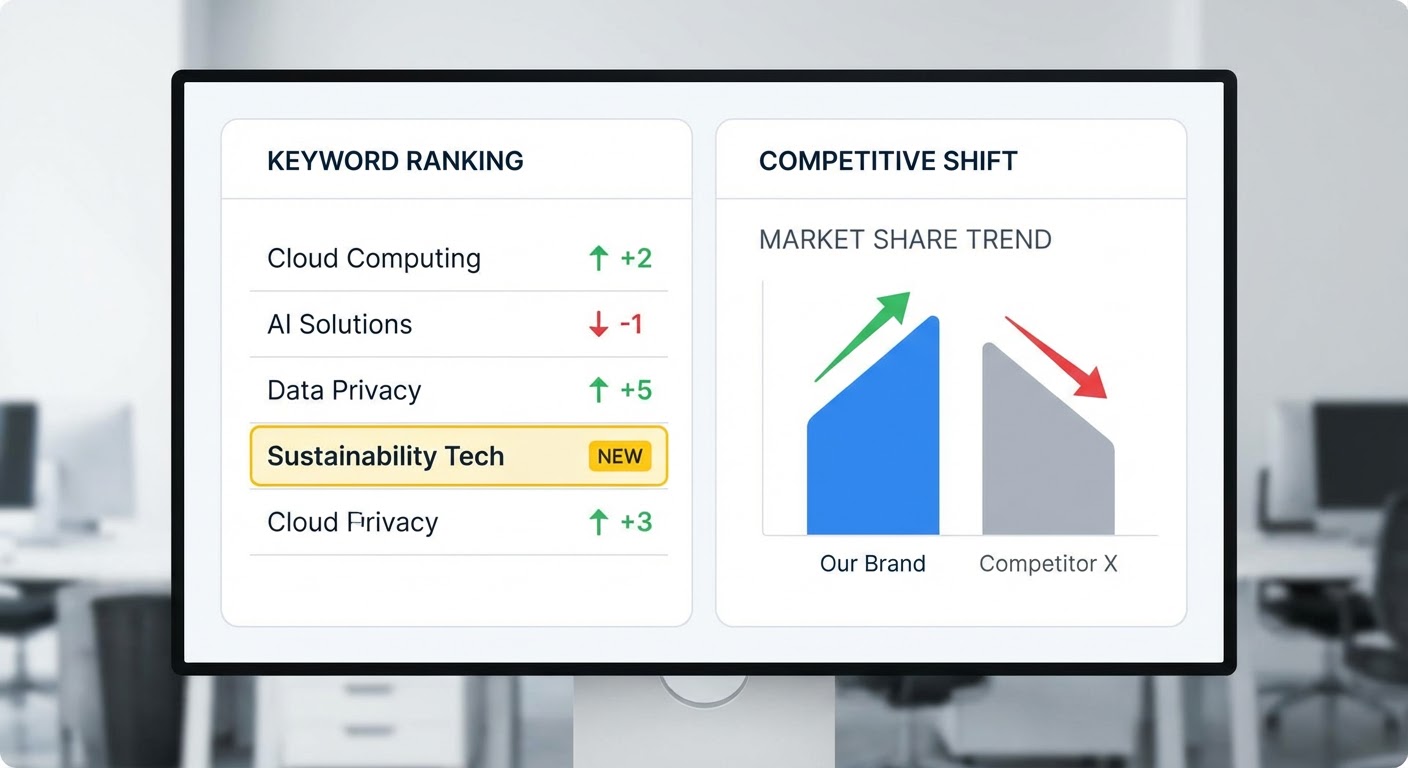
One of our competitors published 18 blog posts about "revenue operations" in a single quarter. They'd never written about RevOps before. We didn't notice until they started outranking us on three keywords that had been reliably ours for a year.
By the time we caught it, they were entrenched. Their content was fresh and extensive. Ours was a single blog post from 2023. We spent six months playing catch-up on a topic cluster that we could have defended if we'd noticed the incursion when it started.
That was the wake-up call. We started monitoring not just competitor rankings (where they are now) but competitor keyword changes (where they're heading). The difference between those two is the difference between seeing a punch and seeing the windup.
What "Keyword Changes" Actually Means
There are three kinds of keyword changes worth tracking.
New keyword entries. Your competitor starts ranking for keywords they've never appeared for before. This usually means they published new content targeting those terms. When Competitor A goes from zero presence on "AI sales automation" to ranking for 15 related keywords in two months, they're making a deliberate content investment in that topic. You should assume they'll keep investing.
Keyword exits. Your competitor drops off the first few pages for keywords they used to rank for. This can mean they deleted or redirected content, got hit by an algorithm update, or just stopped maintaining older pages. Their loss is your potential gain. If they were ranking for "sales prospecting tools" and suddenly aren't, there's a vacuum on that SERP that you might be able to fill.
Keyword position changes on terms you both target. They move from position 8 to position 3 on a keyword you rank #4 for. That's a direct competitive threat on a shared keyword. Or they drop from #3 to #12 while you stay at #4 — now you're the next company poised to move up.
The most valuable of these three is new keyword entries. Exits and position changes tell you what's happening now. New entries tell you what's about to happen. When a competitor starts investing in a new keyword cluster, the full impact takes months to materialize. If you catch it early, you can respond before they've built an insurmountable content advantage.
How to Catch Keyword Changes
The simplest method: run a monthly keyword gap analysis. Most SEO tools (Ahrefs, SEMrush, SE Ranking) have a "competing domains" report that shows keywords your competitor ranks for. Export this list monthly. Compare this month to last month. New entries in the list = new keywords they're targeting. Disappeared entries = keywords they've lost.
This comparison is tedious to do manually in spreadsheets. A VLOOKUP comparing two keyword exports works but it's the kind of task that makes you question your career choices. Better to use the tool's built-in change reports if they have them, or set up a comparison that runs automatically.
What to look for in the comparison:
Topic clusters appearing. Not just individual keywords — groups of related keywords. If a competitor shows up for "revenue operations," "revops tools," "revenue operations vs sales ops," and "revops platform" all in the same month, that's a coordinated content play, not random fluctuation.
Keywords overlapping with your money terms. Not every keyword your competitor targets matters to you. If they start ranking for "best CRM for real estate agents" and you sell project management software, who cares? Focus on keyword changes that affect your business specifically.
Volume and intent signals. A competitor entering a keyword with 5,000 monthly searches and commercial intent ("best sales intelligence platform") is more threatening than one appearing for a keyword with 50 searches and informational intent ("what does sales intelligence mean"). Weight your attention accordingly.
Building a Monthly Monitoring Process
The process takes about 20 minutes per competitor once you've done it a few times.
Pull the current keyword report for each competitor from your SEO tool. Compare to last month's export. Flag new keyword entries, lost keywords, and significant position changes on shared terms.
For new entries, answer two questions: what content did they publish that caused this? And does it target keywords we care about? If the answer to the second question is yes, add a response item to your content calendar.
For lost keywords, look at whether you can capitalize. If a competitor dropped off "sales prospecting automation" and you rank #8 for it, investing in that content could push you up with less resistance.
For shared-keyword position changes, check if the movement is a one-month blip or a three-month trend. One-month changes are often noise. Three consecutive months of them losing ground on your keywords (or gaining on theirs) is a pattern worth responding to.
Keep a running log. Month, competitor, keyword cluster, change type (new, lost, moved), your response. After six months, the log tells you which competitors are most actively investing in SEO and which topic areas are getting crowded.
Why Use an Agent for This
The monthly keyword comparison is exactly the kind of work that kills manual processes. Export CSV, download last month's CSV, run VLOOKUP, scan for patterns, categorize changes, decide what matters. It's 45 minutes of spreadsheet work per competitor, and nobody enjoys it enough to do it consistently.
The competitor keyword research agent handles the gap analysis automatically. It identifies new keywords competitors are targeting, keywords they've lost, and changes in shared-keyword rankings. Instead of downloading CSVs and running comparisons, you review a pre-built change report.
The SEO competitor analyzer adds the broader context: traffic trends, content velocity, and backlink changes. Keyword movements don't happen in isolation. A competitor gaining keywords while also increasing their backlink profile is on a sustained upswing. One gaining keywords temporarily without link support might be riding a Google experiment that reverses next month.
The NewsAPI competitor news tracker catches the announcements that often precede keyword pushes. When a competitor announces a new product category or market expansion, their content team usually follows with a keyword blitz. Catching the announcement gives you days or weeks of lead time before the keyword changes show up in SERP data.
The monitoring runs in the background. Your job is the 10-minute monthly review: what changed, does it matter, and what are we doing about it?
Try These Agents
- Competitor Keyword Research — Automated keyword gap analysis and change detection
- SEO Competitor Analyzer — Comprehensive SEO monitoring including keyword movements
- NewsAPI Competitor News Tracker — Early warning on competitor announcements that precede keyword pushes
- Website Traffic Checker — Traffic impact from competitor keyword changes