
How to See Your Competitor's Google Ads (and What They Reveal About Their Strategy)
Every Google ad your competitor runs is a tiny public confession. Which keywords they think are worth $14 a click. Which value prop survived their last round of A/B tests. Which landing page their growth team trusts enough to keep sending paid traffic to. All of it, right there, free to look at.
Most people don't know you can do this. And the ones who do mostly squander it by screenshotting a few ads and calling it "competitive research."
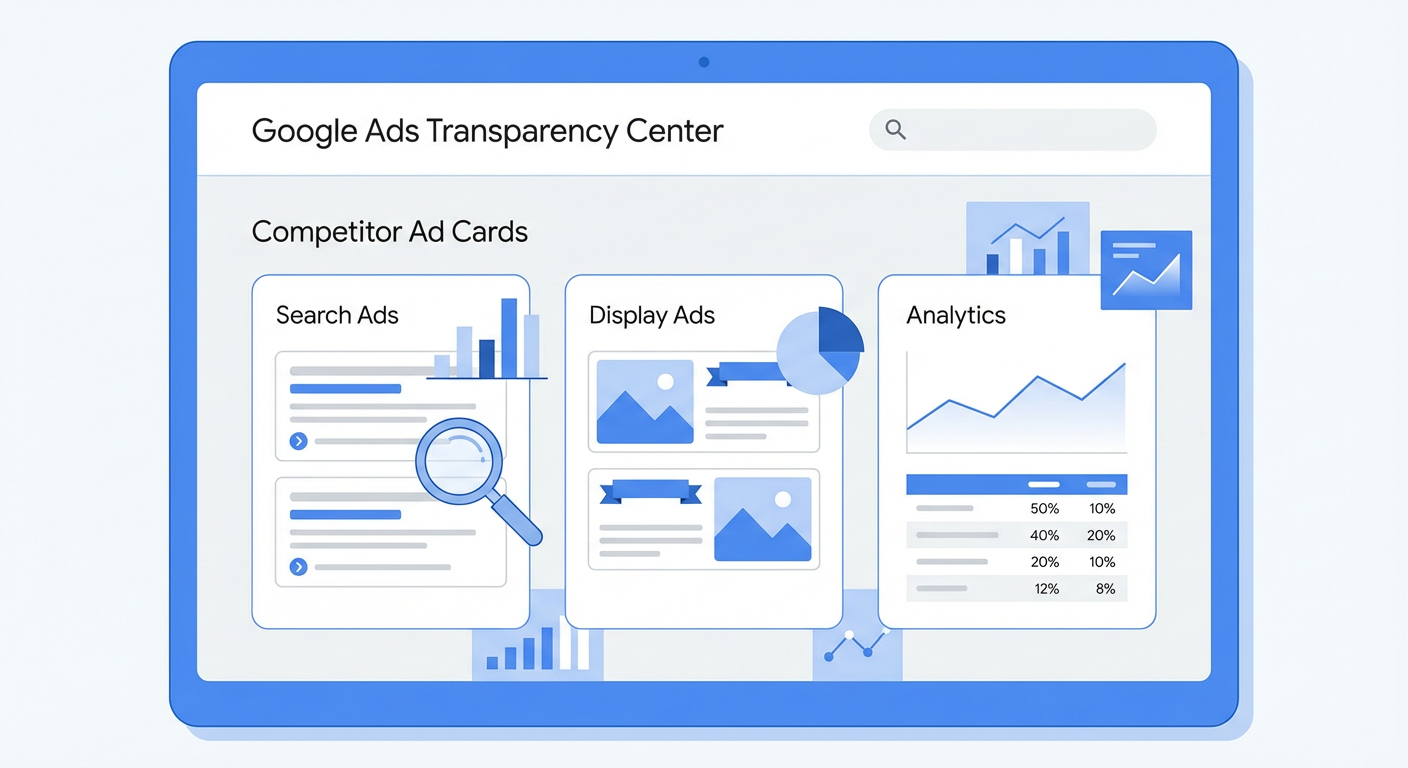
The Google Ads Transparency Center
Google shipped the Ads Transparency Center back in 2023, and somehow it's still the most underused free tool in paid search. No cost, no login. It shows every ad a verified advertiser has run across Search, Display, and YouTube.
Here's the walkthrough:
- Go to adstransparency.google.com
- Type your competitor's brand name or website domain
- Pick the right advertiser from the results
- Filter by region, time window, and ad type
That's it. You're looking at every Google ad that competitor has served recently.
Two things most people blow right past. The time filter is secretly the best control on the page. Last 30 days shows what's live. Last 90 days reveals what they tested and killed, and the dead ads are often more interesting because they're hypotheses that flopped. Also, filter to Search ads specifically. That's where keyword intelligence lives.
Reading Keywords From Ad Copy
Google won't hand you a competitor's keyword list. But you can reverse-engineer most of it by reading their headlines.
Why? Quality Score. Google's auction system rewards ad-keyword relevance. If you're bidding on "best project management software," your headline had better mention project management software or you're paying a premium for irrelevance. Smart advertisers know this. Their headlines ARE their keyword targets, barely disguised.
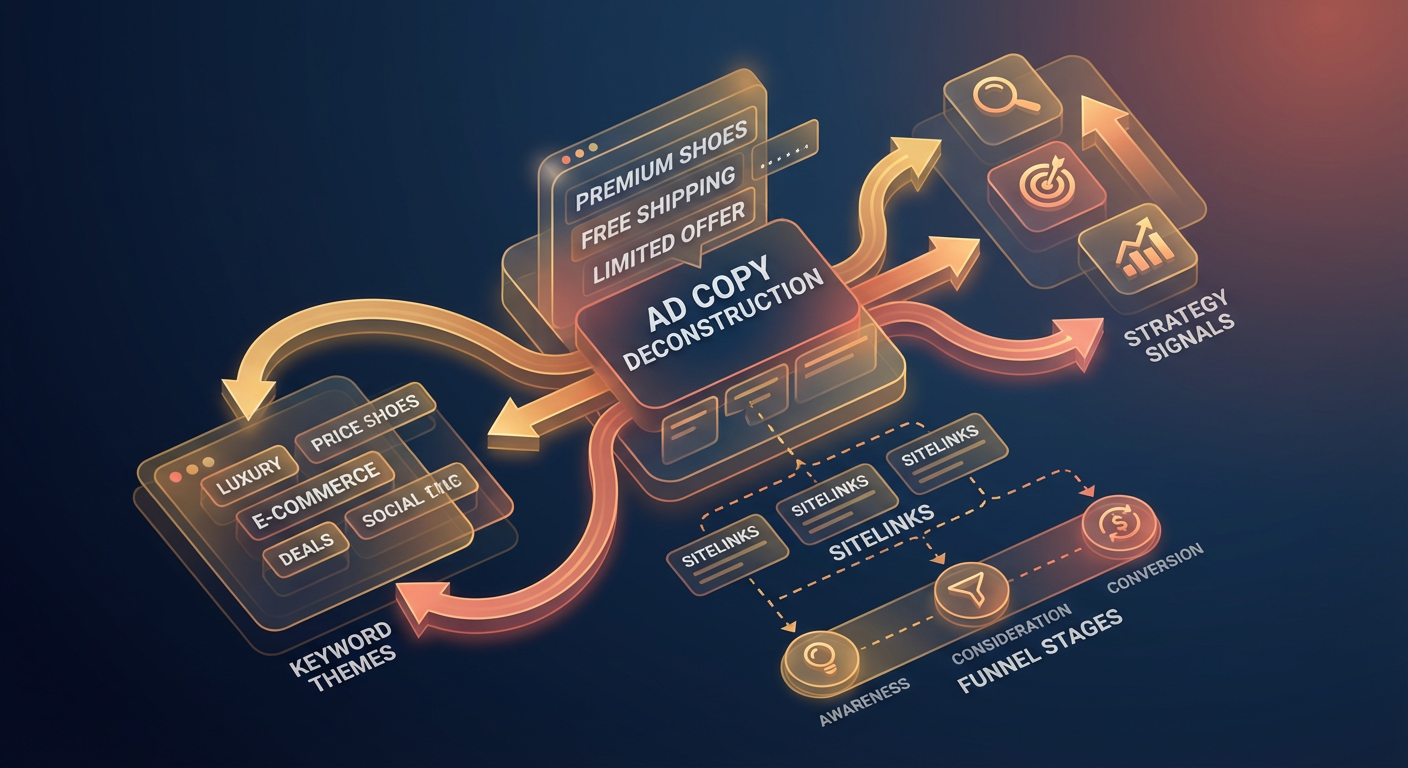
So when you spot a headline like "Best Project Management Software for Remote Teams," they're almost certainly bidding on "project management software," "remote team tools," and probably the exact-match version too.
The process:
- Pull up all their search ads in the Transparency Center
- Read each headline across every variation
- Group the recurring themes (not individual words, the repeating concepts)
- Pay attention to frequency. If "free CRM" shows up in eight of fifteen ads, that's their core bet
Here's where it gets interesting. If those same ads said "enterprise CRM" three months ago and now they all scream "free CRM," you just watched a positioning pivot happen in real time. That one observation is worth more than most competitive intelligence decks.
What Ad Extensions Tell You
Headlines get all the attention, but extensions are where competitors accidentally overshare. Sitelinks, callouts, structured snippets, price extensions. Every one is a choice about what deserves scarce ad real estate.
Sitelinks are basically a minimap of their conversion funnel. "Pricing," "Free Trial," "Demo," "Case Studies"? Self-serve motion. "Request Demo," "Talk to Sales," "Enterprise Solutions"? They're selling to committees and procurement teams. That distinction alone tells you whether you're up against a PLG company or a traditional sales org.
Callout extensions are their elevator pitch under space constraints. When they burn characters on "No Credit Card Required" or "SOC 2 Certified," those are the differentiators that tested best. When three competitors all run the same "No Credit Card Required" callout, it's table stakes now, not a differentiator.
Price extensions are the boldest signal. A competitor showing pricing in ads has either a price advantage they want to flex, or transparent pricing that builds trust. A competitor hiding pricing? Complex deals, high ACVs, or they know their price needs a conversation.
Tearing Down Their Landing Pages
Every search ad points somewhere. Click through on the longest-running ads, since those landing pages actually convert.
Things to watch for:
- Message match. Does the landing page headline echo the ad? "Free CRM for Small Teams" in the ad but "Welcome to Our Platform" on the page? That mismatch bleeds conversions, and you can beat them just by being more consistent.
- The CTA. "Start Free Trial" = self-serve. "Book a Demo" = sales-assisted. "Get a Quote" = custom pricing, probably enterprise. One button tells you their go-to-market approach.
- Proof placement. Enterprise logos above the fold means they need credibility first. G2 badges mean they know buyers comparison-shop.
- Form fields. Name, email, phone, company, company size, role? Qualifying aggressively (high ACV, sales-led). Just email? Volume play.
Run these landing page teardowns across three or four competitors and you've got a conversion playbook assembled from other people's testing budgets.
Track Changes Over Time
A single snapshot of competitor Google ads is mildly interesting. A tracking habit is where this gets genuinely useful.
Block out 20 minutes on the first Monday of every month. Pull up your top three competitors. Keep a running doc. Competitor name, this month's dominant themes, what changed since last time.
Three months in, the patterns smack you in the face. One competitor abandons feature messaging for outcome messaging. Another starts bidding on YOUR brand name (which means someone sees you as a real threat). A third drops keywords they've bid on for a year. The mutations matter more than the snapshots, because they represent decisions somebody made.
Why Use an Agent for Google Ads Competitor Analysis
You can absolutely do all of this manually. The problem is that manual competitive analysis gets stale the moment you finish it. Your competitors launch new ads, kill underperformers, and iterate on winners constantly.
A PPC competitor analysis agent can pull competitor ad data across Google, Meta, TikTok, LinkedIn, and Reddit in one pass. Instead of opening five different transparency tools, you describe the competitors you care about and get a structured breakdown of their ad copy patterns, keyword bids, and creative strategy. It does the categorization work (hook types, value props, CTA patterns) that takes an hour by hand. You can also pair it with SEO competitive analysis to see both the paid and organic picture at once.
Google's Transparency Center cracked open what used to be a total black box. Every competitor's paid search strategy is now public record. The only question is whether you'll bother reading it.
Try These Agents
- PPC Competitor Analysis Tool — Spy on competitor ads across Google, Meta, TikTok, LinkedIn, and Reddit in minutes
- SEO Competitor Analyzer — Uncover what keywords competitors rank for and where the content gaps live
- Landing Page Teardown — Rip apart competitor landing pages for conversion and messaging patterns
- Market Intelligence Agent — Full-spectrum competitor research covering hiring, reviews, keywords, and news