
How to Track Competitor App Store Rankings and Reviews
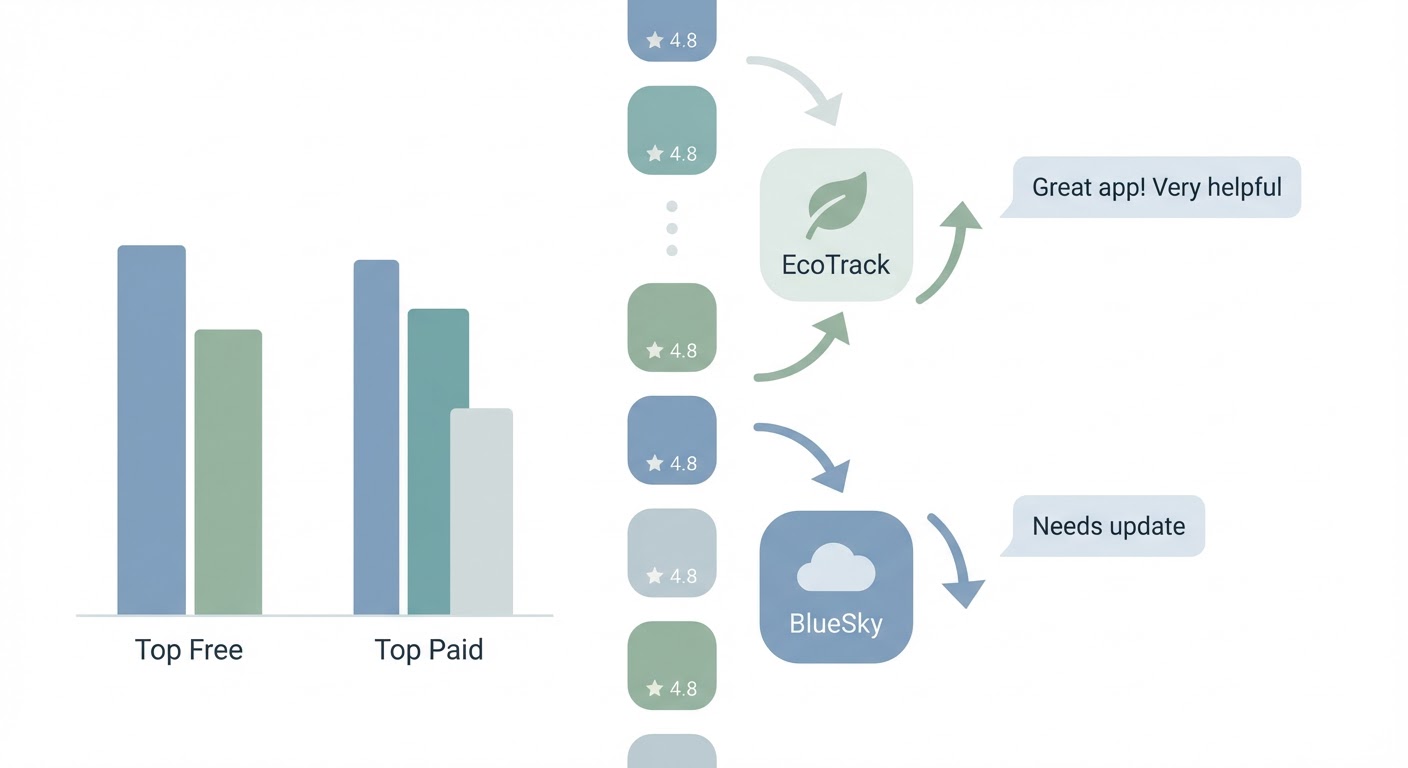
Our mobile app sat at #47 in the Productivity category for months. I didn't think much of it until I noticed a competitor suddenly jump from #120 to #15 in two weeks. Turns out they'd launched a massive referral campaign. By the time I figured out what happened, they'd acquired tens of thousands of users who might have found us instead. I didn't lose because their app was better. I lost because I wasn't paying attention to the scoreboard.
App store rankings are one of the few places where competitive position is publicly visible and updated in real time. Unlike website traffic estimates or revenue guesses, app store rankings are actual data. The number is what the number is.
Free Monitoring Methods
Both the Apple App Store and Google Play let you search for competitors and see their current ranking, rating, review count, and recent reviews. The data is right there. The challenge is tracking it over time, because neither app store gives you historical data natively.
My low-tech approach: every Monday, I open the App Store and Google Play, search for our category keywords, and screenshot the top 20 results. I drop the screenshots into a Google Drive folder organized by date. After a few months, I can flip through and see ranking movements. Not elegant, but it works and costs nothing.
For something more structured, App Annie (now data.ai) has a free tier that shows basic ranking history and download estimates. Sensor Tower's free features are more limited but still useful for a quick competitor lookup. Both tools give you a better historical view than manual screenshots.
The update history on each app's store page is worth reading too. Every time a competitor ships an update, the "What's New" notes tell you what they've been building. I check this monthly for my top three competitors. One competitor's update notes shifted from bug fixes to new feature announcements over a quarter, which told me they'd finished their platform stabilization phase and were back to building.
Reviews Are Better Than Rankings
Rankings tell you relative position. Reviews tell you why. And honestly, competitor app reviews are some of the most honest user feedback available anywhere online. People leave one-star reviews at 2 AM after a frustrating experience. That anger produces really specific, actionable intelligence.
Sort competitor reviews by "most recent" and read the last 30. What do people complain about most? What features do they request? What makes them threaten to switch? One-star reviews are complaints. Two-star reviews are more nuanced — people who like parts of the product but are frustrated with specific things. Those two-star reviews are your best competitive intelligence source.
A review monitoring agent systematically tracks new reviews across app stores and review platforms. Instead of manually checking every week, the agent alerts you when a competitor gets a cluster of negative reviews (potential product issue) or a sudden spike in positive reviews (potential rating manipulation or genuine product improvement).
Five-star reviews matter too, but differently. They tell you what's working. If a competitor's five-star reviews consistently mention "the easiest onboarding I've ever seen," their onboarding is a competitive strength you need to match or beat.
What Rankings and Reviews Actually Tell You
A sudden ranking jump means one of three things: a successful marketing campaign, a viral moment, or an app store feature. Check if Apple or Google featured them on their editorial pages. Being featured creates a temporary ranking spike that fades unless the underlying product retains users.
A slow, steady ranking decline is more interesting than a sudden drop. Gradual decline means the product is losing relevance or the market is moving in a direction they're not following. I watched a competitor's ranking slide from top 10 to top 50 over six months. Their reviews during that period told the story — users kept asking for features that competing apps already had.
A sentiment analysis agent can process hundreds of competitor reviews and give you a structured breakdown of sentiment by feature, by time period, and by rating. It answers "what do their users feel about X" at a scale that manual reading can't match.
Rating changes over time reflect product quality trends. A competitor whose average rating dropped from 4.5 to 4.1 over a year has a product quality problem. One whose rating climbed from 3.8 to 4.3 just shipped their way to customer satisfaction. Both are competitive signals you can act on.
The Release Cadence Signal
How often a competitor updates their app tells you about their engineering investment. Weekly updates mean they have a dedicated mobile team shipping fast. Monthly updates mean mobile is one of several priorities. Quarterly updates or less mean their app is in maintenance mode.
Compare the release cadence to the content of updates. Frequent updates with only bug fixes means technical debt cleanup. Frequent updates with new features means active product development. The combination of cadence and content maps their mobile product strategy.
Brand monitoring can catch app store mentions and discussions across the broader internet — Reddit threads about competitor apps, tweets from frustrated users, blog posts comparing mobile tools in your category. The app store itself is one data source. The conversations about apps happen everywhere.
Try These Agents
- Review Monitoring — Track competitor app reviews across platforms
- Sentiment Analysis — Process review sentiment at scale
- Brand Monitoring — Catch app discussions beyond the app stores
- Competitor Review Analysis — Deep review intelligence and trend analysis