
AI Win Loss Analysis: What It Can (and Can't) Do
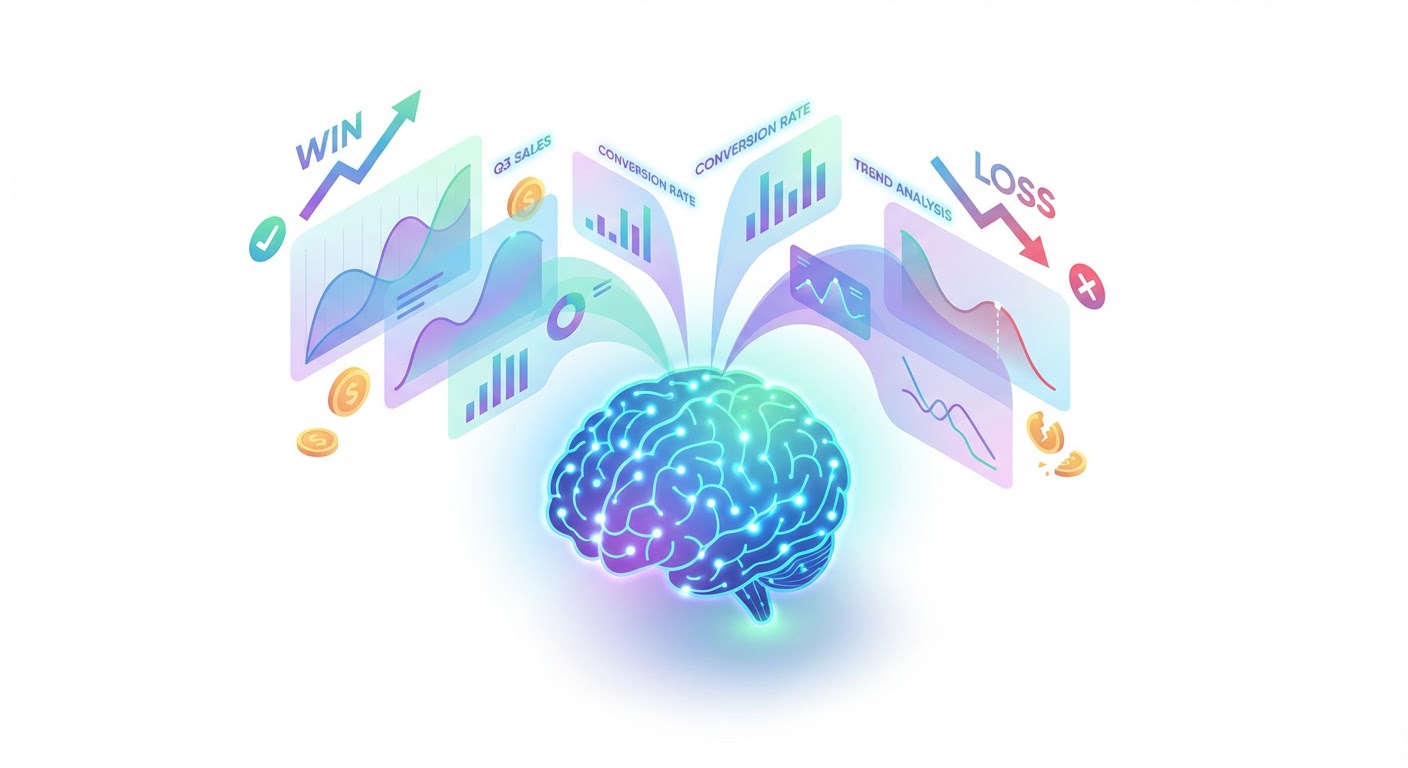
Traditional win loss analysis has a math problem. The good version requires buyer interviews. Buyer interviews take time. Time is expensive. So most companies either skip win loss entirely or do a watered-down version that relies on rep self-reporting, which is about as reliable as asking students to grade their own exams.
AI changes the math by tackling the parts of win loss analysis that don't require human judgment. Mining reviews for competitive patterns. Scanning call transcripts for competitive mentions. Aggregating signals across hundreds of data points that no human analyst could process manually. The analysis gets cheaper and faster, which means more companies can actually do it.
But — and this matters — AI handles the data processing. The interpretation is still yours.
What AI Does Well in Win Loss
Pattern detection across large datasets is the obvious strength. A human analyst can read 20 G2 reviews and identify themes. An AI agent can process 2,000 reviews and quantify exactly how often specific concerns appear, which competitor comparisons are most common, and how sentiment shifts over time.
The G2 review win loss analyzer does this in minutes. Feed it your product and your top competitors, and it returns structured data: "Competitor A is mentioned in 34% of your negative reviews," "customers switching from Competitor B cite integration depth 3x more often than pricing," "'implementation speed' appears in 67% of 5-star reviews and 12% of 2-star reviews." That quantitative layer takes weeks to build manually. AI does it before lunch.
Call transcript analysis is the second big win. Sales teams record thousands of calls. Nobody listens to all of them. AI can scan every transcript for competitive mentions, objections, feature requests, and decision criteria. The Gong competitive intel tracker pulls this data automatically — every time a competitor name comes up in a call, it logs the context, the stage of the deal, and the outcome.
This produces insights that manual analysis misses entirely. "Deals where Competitor C is mentioned in discovery calls close at 22% versus our overall 35% win rate." No human analyst is doing that math across 500 calls. An AI agent does it as a standard output.
Trend detection over time is the third strength. Win loss patterns shift as markets change. A product gap that cost you deals six months ago might be fixed now. A competitor that was weak on pricing might have adjusted. AI can track these shifts across months and flag when patterns change direction, so you're not solving last quarter's problems with next quarter's resources.
What AI Can't Do (Yet)
AI can't read between the lines the way a skilled interviewer can. When a buyer says "pricing was a concern" in a win loss interview, a human knows to probe further. Was it the absolute price? The pricing model? The discount structure? The perception of value? AI takes the statement at face value.
AI can't navigate the political dynamics of B2B buying decisions. Sometimes the real reason a deal was lost is that the VP of Engineering hated the founder's pitch style, or the champion left the company mid-evaluation, or the CFO had a golf buddy at the competing vendor. These factors don't show up in reviews or transcripts. They show up in candid, off-the-record conversations between humans.
AI also can't judge context. When a review mentions "poor customer support," AI doesn't know if that reviewer contacted support once during a unique outage or if they've been frustrated for months. A human interviewer would ask follow-up questions. AI processes what's written and moves on.
The takeaway: use AI for breadth and humans for depth. AI scans everything and finds the patterns. Humans investigate the patterns that matter and figure out the "why behind the why."
Building the Hybrid System
The most effective win loss program combines AI processing with selective human interviews. Here's how I'd structure it.
Layer one: continuous AI monitoring. Set up the G2 review win loss analyzer to track review patterns monthly. Set up the Gong competitive intel tracker to scan call transcripts for competitive mentions. These run in the background and produce a monthly data dump: which competitors are coming up, what's being said about them, and how win rates correlate with competitive mentions.
Layer two: targeted human interviews. Use the AI data to decide who to interview. If the data shows you're losing more deals to Competitor B and the transcripts mention "implementation timeline" frequently, interview three recent Competitor B losses and dig into the implementation concern. You're not doing random interviews. You're investigating specific hypotheses that the data generated.
Layer three: synthesis. Once a quarter, combine the AI data with interview findings into a competitive update. "AI data shows Competitor B mentioned in 40% of lost deals, up from 25% last quarter. Interview findings suggest their new self-serve deployment is the primary factor. Recommendation: prioritize our deployment automation roadmap and update battlecards with our professional services advantage in complex environments."
That synthesis is the human layer. AI generates the inputs. You produce the insight.
The Competitor Pain Points Angle
One underused application of AI win loss analysis is flipping the lens. Instead of only analyzing why you win and lose, analyze why your competitors' customers are unhappy.
The competitor pain points agent scans competitor reviews for recurring complaints. Not your win/loss data — their customer data. If Competitor A's customers consistently complain about data export limitations, that's a selling point for you, whether or not it's showing up in your own deal data yet.
This works because buyers don't always articulate their concerns during your sales process. They might not know about Competitor A's export limitations until they've been a customer for six months. But the information is public in reviews. AI finds it. You use it.
Why Use an Agent for This
The G2 review win loss analyzer turns thousands of reviews into structured competitive intelligence in minutes. It's the quantitative foundation that tells you where to focus your human analysis. Without it, you're picking interview targets based on gut feel. With it, you're investigating data-driven hypotheses.
The Gong competitive intel tracker makes your recorded calls a competitive intelligence asset instead of a storage cost. Every competitive mention in every call gets logged and analyzed. The patterns it finds across hundreds of calls are invisible to manual review.
The competitor pain points agent gives you the offensive angle. While win loss analysis tells you where you're weak, pain point analysis tells you where competitors are weak. Use both and you have a complete picture of the competitive landscape from the buyer's perspective.
Let AI handle the data. You handle the decisions.
Try These Agents
- G2 Review Win Loss Analyzer — Quantitative win/loss intelligence from reviews
- Gong Competitive Intel Tracker — Competitive signals from sales call transcripts
- Competitor Pain Points — Competitor weakness mining from customer reviews
- Call Insights Analyzer — Deal pattern analysis from recorded conversations