
Best AI Recruiting Tools in 2026: 10 Worth Your Budget
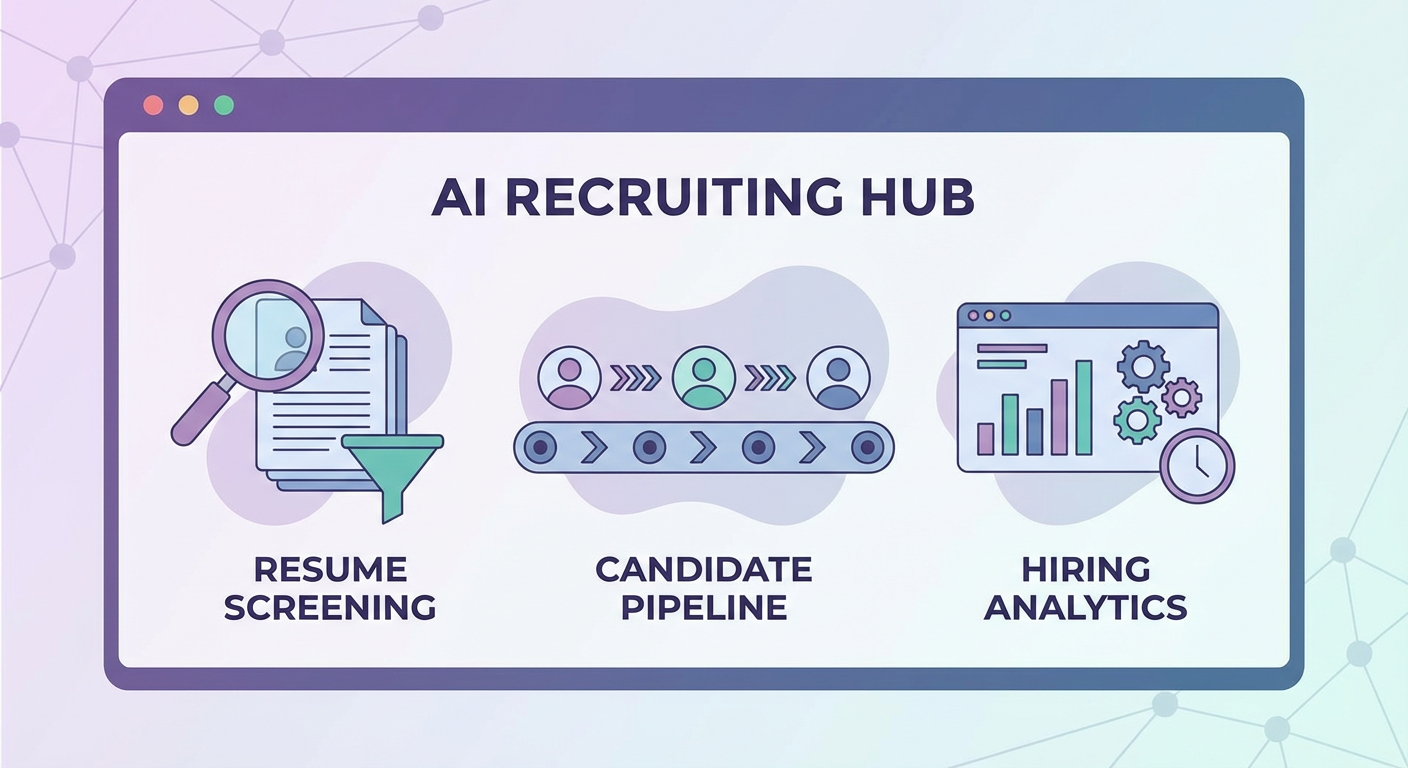
Last fall I helped a 90-person startup hire four engineers in six weeks. The recruiting team was two people. The job postings pulled in about 1,400 applications across the four roles. I sat next to the head of talent one morning while she tabbed between LinkedIn Recruiter, their ATS, a shared Google Sheet tracking outreach status, and a separate spreadsheet where the hiring managers ranked "must-have" vs. "nice-to-have" skills — which, naturally, contradicted each other across tabs. She had been at it since 7 AM. By noon she'd screened maybe 110 resumes and moved nine people to phone screens. Three of those nine had already accepted other offers. One ghosted. So: five hours of focused work, five viable candidates, and a backlog of 1,290 unread applications slowly going stale.
That experience broke something in my brain. Not because the recruiter was bad — she was excellent. But because the entire process was designed to waste her time on the wrong things. She was spending 80% of her hours on screening and sourcing, and maybe 20% on the part she was actually great at: closing candidates. When we plugged an AI Candidate Sourcer into the workflow and let it pre-screen inbound applications against the actual job requirements, that ratio flipped within two weeks. She went from reading 1,400 resumes to reviewing 35 pre-qualified shortlists. Same quality bar. Fraction of the time.
So here's my list. Ten tools, all ones I've either used directly or watched recruiting teams deploy up close. Some are full ATS platforms with AI bolted on. A few are AI-native from day one. And the prices range from "free" to "you need a VP to approve this purchase order."
| # | Tool | Best For | Pricing |
|---|---|---|---|
| 1 | Cotera | AI-powered candidate sourcing and screening agents | Free tier available |
| 2 | Greenhouse | Structured hiring at scale | From ~$6,000/yr |
| 3 | Lever | Combined ATS + CRM | From ~$6,000/yr |
| 4 | Ashby | Modern ATS with built-in analytics | From $300/mo |
| 5 | HireVue | AI video interviews and assessments | Custom pricing |
| 6 | SeekOut | Deep passive candidate sourcing | From $833/mo |
| 7 | Eightfold AI | Talent intelligence and matching | From ~$650/mo |
| 8 | Phenom | Enterprise talent experience | From ~$10,000/mo |
| 9 | Gem | Sourcing CRM with outreach automation | From $270/mo |
| 10 | hireEZ | AI sourcing across 800M+ profiles | From $169/user/mo |
1. Cotera
Free tier available
- AI agents for candidate sourcing, screening, and pipeline building
- Resume screening against actual job requirements, not just keywords
- LinkedIn talent search with ranked shortlists and outreach angles
- Custom agent builder for repeatable recruiting workflows
- Free tier covers most recruiting research needs
Most recruiting tools give you a database and a search bar and say "go find people." Cotera does the finding for you. The AI Candidate Sourcer agent takes a job description and a set of target companies, breaks the JD into the actual requirements that matter — not just keyword matches, but experience patterns, skill depth, and career trajectories — then searches across LinkedIn and Apollo to build a ranked shortlist. Each candidate comes back with a match score, a summary of strengths and gaps against the role, contact info, and a personalized outreach angle. What used to be a full day of profile-clicking becomes a 10-minute review of pre-qualified candidates.
The AI Resume Screener is the other half of the equation. Feed it a stack of applications and the job description, and it evaluates each resume against the actual requirements — not surface-level keyword scanning, but real analysis of whether someone's experience maps to what the role needs. I watched it correctly flag a candidate whose resume listed "machine learning" prominently but whose actual experience was running pre-built models in a Jupyter notebook, not building production ML systems. A keyword scanner would have ranked them highly. The AI screener caught the gap.
The LinkedIn Talent Search agent and the Recruiting Pipeline Builder round things out. The talent search runs targeted queries and gives you structured results instead of endless scrolling. The pipeline builder helps you map out your full funnel — from sourced candidates to scheduled screens to offers — with AI doing the grunt work at each stage.
Where Cotera won't help: it's not an ATS. You still need something to manage your interview scheduling, offer letters, and compliance workflows. Think of it as the intelligence layer that sits on top of your existing recruiting stack. The free tier handles most sourcing and screening needs for teams hiring fewer than ten roles at a time.
2. Greenhouse
From ~$6,000/yr
- Structured interview kits and scorecards
- AI-generated candidate summaries and interview plans
- DEI measurement tools built into the hiring workflow
- Integration ecosystem with 500+ HR tools
Greenhouse basically wrote the playbook on structured hiring. Interview kits with pre-loaded questions, scorecards that force interviewers to evaluate against defined criteria, and debrief workflows that prevent the loudest voice in the room from dominating hiring decisions. If you have ever sat through a hiring debrief where someone said "I just didn't get a good vibe" and that killed a candidacy, Greenhouse is designed to prevent exactly that.
The AI features arrived more recently. Candidate summaries that distill an application into the information that actually matters for evaluation. Auto-generated interview plans based on the role requirements. Job posting suggestions optimized for inclusivity and reach. These are useful time-savers, though I'd describe them as "thoughtful additions" rather than "transformation of the product." The core of Greenhouse is still the structured process, not the AI.
The pricing deserves a frank conversation. Starting around $6,000/year sounds reasonable, but that's for small teams on the Essential tier. A mid-market company with 200 employees and a real recruiting operation will land somewhere between $15,000 and $35,000 annually. Enterprise deployments with custom integrations, dedicated support, and advanced analytics can hit $120,000+. Implementation fees add another $2,000 to $15,000 on top. If you're a 30-person startup, Greenhouse is probably more platform than you need. If you're past 150 employees and plan to grow aggressively, the structured approach pays for itself by reducing bad hires — which, at an average cost of $17,000 per mis-hire (conservative estimate), doesn't take many prevented mistakes to break even.
3. Lever
From ~$6,000/yr
- Unified ATS and CRM in a single platform
- AI Interview Companion with structured scoring
- AI-powered candidate matching and screening
- Built-in DEI dashboards and EEO reporting
Lever's pitch has always been "ATS and CRM in one." Most recruiting tools handle either applicant tracking (people who apply to you) or candidate relationship management (people you source and nurture). Lever does both, and the unified data model means you can see every touchpoint with a candidate — inbound application, sourced outreach, referral, rehire — in one timeline. For teams that source heavily and also get decent inbound volume, not having to switch between two systems is a real workflow win.
The AI additions are more ambitious than Greenhouse's. AI Interview Companion (they acquired Pillar for this) provides real-time structured interview guidance and generates post-interview summaries. Talent Fit matching scores candidates against role requirements using IBM watsonx.governance for bias mitigation. The DEI dashboards track diversity metrics through each funnel stage, which matters both ethically and practically — a pipeline that's homogeneous at the top of the funnel can't produce diverse hires at the bottom, and Lever surfaces that problem early enough to fix it.
The pricing model is the part that trips people up. Lever charges based on total company headcount, not recruiting users. A 500-person company pays for all 500 employees even if five recruiters actually use the platform. That math gets painful fast. Small teams (under 50 people) start around $6,000/yr, which is fine. But a 500-person mid-market company could be looking at $37,000/yr, and enterprise deployments push past $144,000. The per-headcount model means your recruiting software bill grows every time you make a hire, which is an odd incentive structure.
4. Ashby
From $300/mo
- All-in-one ATS, CRM, sourcing, scheduling, and analytics
- AI built into every hiring stage
- Recruiting analytics that surface real bottlenecks
- Customizable workflows for different role types
Ashby is what happens when you build a recruiting platform in 2020 instead of 2012. There's no legacy architecture to work around, no bolted-on features, no "we acquired three companies and stitched them together" feel. ATS, CRM, sourcing, scheduling, and analytics all live in one system, designed as one system, and it shows. The interface is fast. Workflows are configurable without needing an admin to update settings in some buried menu. And the analytics — this is where Ashby earns its fans — actually tell you where your hiring process is broken, not just that it is broken.
The analytics alone would justify a look. Time-to-hire by stage, source effectiveness by role type, interviewer calibration scores, offer acceptance rates sliced by compensation band. I've seen recruiting leaders switch to Ashby specifically because their old ATS treated reporting as an afterthought. When you can see that your technical phone screen is where 40% of candidates drop out, and that one interviewer's rejection rate is triple the team average, you can actually fix things.
AI features are woven throughout: sourcing assistance, candidate evaluation, scheduling automation. Ashby treats AI as part of the workflow rather than a separate tab you navigate to. The downside is that Ashby is still building market share, which means fewer third-party integrations than Greenhouse or Lever, and their support resources are thinner. Starting at $300/mo for the Foundations tier is accessible for smaller companies, but pricing scales up with usage and the enterprise tier requires custom quotes.
5. HireVue
Custom pricing (est. $35,000+/yr)
- On-demand video interviews with AI-powered evaluation
- Skills-based assessments for technical and soft skills
- Game-based cognitive ability assessments
- ATS integrations with automated scheduling
HireVue is the tool people have the strongest opinions about, and honestly, both sides have a point. The product: candidates record video responses to interview questions on their own time, and HireVue's AI evaluates their answers — not facial expressions (they dropped that after the backlash), but the substance and structure of their responses. They also offer game-based cognitive assessments and technical skills tests.
For high-volume hiring — think retail, hospitality, contact centers, roles where you're screening thousands of applicants per quarter — HireVue genuinely solves a math problem that no number of recruiters can solve manually. You physically cannot phone-screen 3,000 applicants for seasonal retail positions. HireVue lets every candidate "interview" on their own schedule, and the AI surfaces the top performers for human review. Companies using it for these use cases consistently report 27-50% reductions in time-to-hire, and the candidate experience is arguably better than playing phone tag with a recruiter for a week.
The controversy is real, though. Candidates routinely report finding video interviews awkward and impersonal. There are legitimate concerns about AI bias in evaluation, even without facial analysis. And the pricing is steep — most estimates put the average contract around $50,000/yr, with enterprise bundles exceeding $145,000. This is an enterprise tool for enterprise hiring volumes. If you're hiring 20 people a year, HireVue will cost more per hire than having your recruiter do phone screens. If you're hiring 2,000, the math flips entirely.
6. SeekOut
From $833/mo per seat
- AI-powered search across 800M+ candidate profiles
- Diversity sourcing with representation goal tracking
- Technical talent filters for 290+ programming languages
- Candidate rediscovery from your existing ATS data
SeekOut goes deeper than LinkedIn Recruiter for one specific job: finding passive candidates who aren't actively looking. Their database of 800M+ profiles aggregates data from across the open web — GitHub, Stack Overflow, patents, publications, professional associations — and enriches it with AI-inferred skills and career trajectories. For technical recruiting especially, the difference is tangible. LinkedIn will show you someone's self-reported skills. SeekOut will show you their actual GitHub contributions, the languages they commit in, and the complexity of their open-source work.
The diversity sourcing features are genuinely useful, not performative. You can set representation goals for a pipeline, and SeekOut surfaces candidate pools that meet those goals while maintaining qualification standards. I've watched a recruiting team use this to build a shortlist for a VP of Engineering search that was 50% underrepresented candidates — all of whom were genuinely qualified for the role. That's not something LinkedIn Recruiter makes easy.
The price point filters out smaller teams. Starting at $833/mo per seat (billed annually), you're paying roughly $10,000 per recruiter per year. Enterprise plans with candidate rediscovery and predictive matching run $1,200 to $2,000/mo per seat. If you have a three-person sourcing team, that's $30,000-$72,000/yr just for SeekOut. Worth it for companies hiring 100+ roles per year, especially in competitive technical markets. Overkill for a startup making five hires this quarter.
7. Eightfold AI
From ~$650/mo
- AI matching across 1.6 billion career profiles
- Skills-based candidate evaluation beyond job titles
- Internal mobility and career pathing for employees
- Recruiter AI Copilot for scheduling and screening
Eightfold does something that most recruiting tools don't even attempt: it thinks about skills instead of titles. Feed it a job description and it doesn't just match against "Senior Product Manager with 5+ years experience." It identifies the underlying skills that predict success in the role — stakeholder communication, data-driven prioritization, cross-functional team leadership — and finds people who have demonstrated those skills regardless of what their job title happened to be. This matters more than it might sound. A "Program Manager" at one company does the same work as a "Product Manager" at another. Title-based matching misses those candidates. Skills-based matching catches them.
The platform indexes 1.6 billion career profiles, which is in the same ballpark as LinkedIn's total membership. The Recruiter AI Copilot handles scheduling, screening, and shortlisting, and there's an Employee AI Copilot that handles internal mobility — helping existing employees find new roles inside the company, which is both a retention play and a recruiting cost reduction. Companies with 1,000+ employees who are bleeding institutional knowledge to attrition should pay attention to that feature specifically.
The honest limitation: Eightfold is built for organizations with 500+ employees. The entry price of roughly $650/mo sounds accessible, but that's for mid-market companies, and enterprise deployments are six-figure annual contracts. The platform is also complex to implement — expect a multi-month rollout with professional services, not a "sign up and start sourcing tomorrow" experience. For the right-sized organization, it's transformative. For a team under 200 people, it's more machine than you need.
8. Phenom
From ~$10,000/mo
- Personalized career sites with AI-powered job matching
- Recruiting CRM with AI-enhanced candidate pipelines
- Internal talent marketplace for mobility and gigs
- Chatbot for candidate engagement and screening
Phenom calls itself a "Talent Experience Management" platform, which sounds like marketing speak until you see what it actually does. It manages every touchpoint a person has with your company as a potential, current, or past employee. The career site personalizes job recommendations for each visitor based on their browsing behavior and profile. The CRM lets recruiters build and nurture pipelines with AI-driven segmentation. The internal talent marketplace helps employees find new roles, gigs, and mentors inside the company. And a chatbot handles initial candidate questions and qualification 24/7.
The career site personalization is the feature that wins deals. Instead of a static jobs page with a search bar, Phenom builds candidate-specific experiences. A software engineer visiting your careers page sees engineering roles matched to their skill level and location, content about your engineering culture, and employee testimonials from people in similar roles. Phenom claims this approach increases application completion rates by 2-3x compared to standard career sites, and the data I've seen from companies using it supports that range.
But the price tag is unmistakable: starting around $10,000/mo. This is unambiguously an enterprise product. The implementation takes months, requires dedicated resources, and involves professional services fees on top of the subscription. If you're a company with 5,000+ employees, dozens of open roles at any given time, and a recruiting team that's already stretched thin, Phenom's automation can genuinely transform your hiring operation. For companies under 1,000 employees, the cost and complexity are almost impossible to justify.
9. Gem
From $270/mo
- AI sourcing across 800M+ candidate profiles
- Automated personalized outreach with drip campaigns
- Pipeline analytics with diversity tracking
- ATS integration that syncs all candidate activity
Gem started as a Chrome extension that tracked your recruiting outreach, and it's grown into a full AI-first recruiting platform. The sourcing capability searches across 800M+ profiles and — this is what recruiters love — also rediscovers candidates already sitting in your ATS. That "rediscovery" feature alone has saved teams I've worked with from re-sourcing candidates they'd already talked to six months ago. One recruiter told me she found her best hire of the year through Gem's rediscovery, a candidate who'd applied for a different role eight months earlier and been passed over, but was a perfect fit for a new opening.
The outreach automation is polished. Personalized drip sequences, follow-up scheduling, open and reply tracking, A/B testing on email templates. Gem integrates directly with Gmail and Outlook, so recruiters stay in their inbox instead of switching to a separate outreach tool. The reporting dashboard (they call it Talent Compass) gives you pipeline health, recruiter productivity, and diversity metrics in one view.
Pricing is reasonable compared to the enterprise behemoths on this list. Starting at $270/mo billed annually ($300/mo monthly), with startups under 30 employees eligible for a free tier. There's also a startup program offering six months free followed by 50% off the first paid year. The limitation is that Gem works best as a sourcing and outreach CRM layered on top of an existing ATS. If you don't already have Greenhouse, Lever, or similar for the core ATS workflows, Gem alone won't cover everything.
10. hireEZ
From $169/user/mo
- AI sourcing from 800M+ profiles across the web
- Automated email sequences with scheduling integration
- Resume screening with fraud detection
- Talent market analytics and salary benchmarks
hireEZ (formerly Hiretual) is the scrappy alternative to SeekOut for AI-powered sourcing. Same basic promise — search across a massive database of professional profiles using AI-driven matching — at roughly one-fifth the price per seat. The Starter plan at $169/user/mo gives you access to the 800M+ profile database, automated email sequences, and the EZ Agent that handles sourcing, screening, and scheduling automation. The Professional plan at $199/user/mo adds more advanced features.
The Applicant Match feature handles inbound screening: it ranks and verifies incoming applications, surfacing the best matches and flagging suspicious or fraudulent resumes. That fraud detection is increasingly relevant — with AI making it trivially easy to generate polished resumes, the ability to spot inflated or fabricated credentials is becoming table stakes. hireEZ claims their clients see 15 hours saved per recruiter per week, which is a big number, but even half that would make the tool worth the subscription cost.
Where hireEZ falls short compared to SeekOut: the data enrichment isn't as deep for technical roles, the diversity sourcing features are less sophisticated, and the AI matching algorithms aren't as refined. You get 80% of the capability at 20% of the cost, which is a tradeoff most small and mid-size recruiting teams should make happily. hireEZ is the right tool for companies hiring 20-100 roles per year that need AI sourcing without enterprise pricing. It's also the best option if you want to test whether AI sourcing actually improves your recruiting outcomes before committing to a $10,000+/yr seat license elsewhere.
How to Choose
Different hiring challenges call for different tools.
Need to find qualified candidates faster without manual profile-browsing? Start with Cotera's AI Candidate Sourcer. It gives you ranked, pre-qualified shortlists in minutes instead of days. The free tier handles most sourcing needs for teams with fewer than ten open roles.
Need a full ATS with structured hiring? Greenhouse for process rigor, Lever for combined ATS and CRM, or Ashby if you want a modern platform with built-in analytics. Greenhouse is most proven at scale, Ashby is the best-designed, Lever is the best if you source heavily and need CRM alongside applicant tracking.
Need to source passive technical talent? SeekOut for maximum depth (especially for engineering, scientific, and diversity-focused searches), hireEZ for 80% of the capability at 20% of the price. If budget is the primary constraint, hireEZ is the obvious choice.
Need AI-powered screening for high-volume roles? HireVue for video interviews and assessments, Cotera's AI Resume Screener for resume evaluation, or hireEZ's Applicant Match for inbound screening with fraud detection.
Need enterprise-scale talent intelligence? Eightfold AI for skills-based matching and internal mobility, Phenom for the full talent experience across career sites, CRM, and internal marketplace. Both require significant investment and implementation time.
Need sourcing outreach that actually gets replies? Gem for CRM-first sourcing with drip campaigns and candidate rediscovery. The startup pricing makes it accessible for smaller teams.
Most effective recruiting stacks combine two to three tools: an ATS (Greenhouse, Lever, or Ashby) for process management, a sourcing layer (Cotera, SeekOut, Gem, or hireEZ) for finding candidates, and optionally an intelligence platform (Eightfold or Phenom) for companies operating at enterprise scale.
Try These Agents
- AI Candidate Sourcer — Find and rank candidates with AI-powered sourcing across LinkedIn and Apollo
- AI Resume Screener — Screen resumes against real job requirements, not just keywords
- LinkedIn Talent Search — Run targeted talent searches with structured, ranked results
- Recruiting Pipeline Builder — Build and manage your full recruiting pipeline with AI automation