
Competitor SWOT Analysis: How to Do It Without Making Things Up
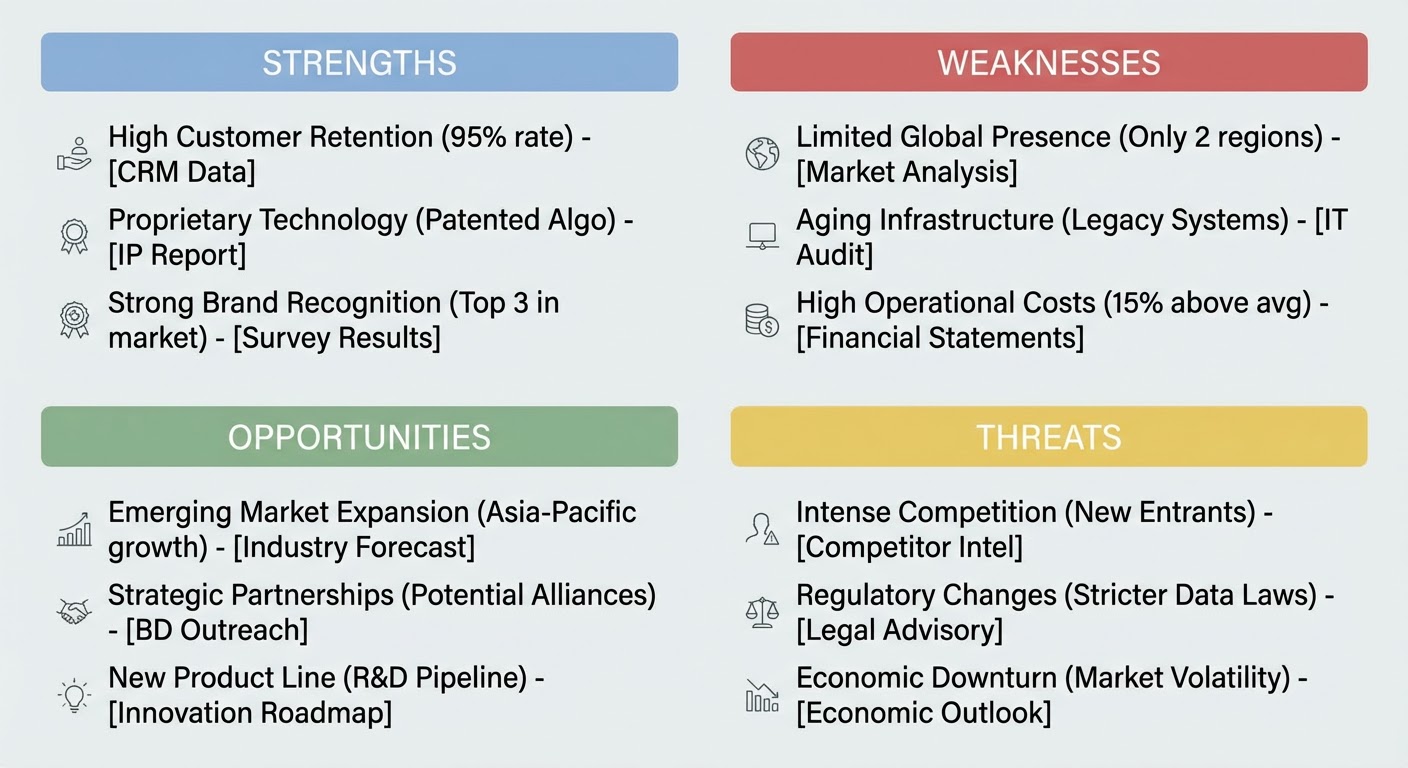
I sat through a strategy meeting last year where our marketing director presented a competitor SWOT analysis. Under "Weaknesses" for our biggest competitor, she'd written "lack of brand awareness." This company had 10x our traffic, a Super Bowl ad, and name recognition that made us look like a garage startup. She'd filled in the weakness quadrant with what she wished were true, not what was actually true.
That's the problem with 90% of competitor SWOT analyses. They're aspirational fiction. The strengths quadrant is grudgingly accurate because nobody can deny a competitor's obvious wins. The weaknesses quadrant is wishful thinking. Opportunities are whatever the team already wants to do. Threats are whatever the team is already worried about. The whole exercise becomes a way to confirm existing biases instead of discovering new information.
A competitor SWOT analysis that actually works is grounded in data you can point to. Not opinions. Not hunches. Data.
Why Most SWOT Analyses Are Useless
The traditional SWOT format invites speculation. You stare at four empty quadrants and ask people to fill them in. What happens? The loudest person in the room writes their opinions on the whiteboard and everyone else nods. Nobody says "how do we know that?" because it feels confrontational.
I've done this exercise at four different companies and the output was always more revealing about the team doing the analysis than the competitor being analyzed. Teams that felt insecure about their product invented competitor weaknesses that didn't exist. Teams that felt confident about their product underestimated competitor strengths. The SWOT became a Rorschach test for team psychology.
The fix is embarrassingly simple. Every single item in every single quadrant needs a source. "Weakness: slow customer support" is an opinion. "Weakness: G2 reviews show 34% of negative reviews mention response time, average sentiment score for support is 2.1 out of 5" is evidence. One of those belongs in a SWOT analysis. The other belongs in a bar conversation.
Building Each Quadrant With Real Data
Strengths — what the data says they're good at. Start with their G2 and Capterra reviews. Filter for 4-5 star reviews and read what customers actually praise. If 60% of positive reviews mention "easy onboarding," that's a confirmed strength. Cross-reference with traffic data: if their organic traffic is growing 15% month over month while the market average is 5%, that's a distribution strength. Check their win rate against you (from your CRM data) — if they beat you 70% of the time in a particular segment, acknowledge it.
Weaknesses — what their own customers complain about. This is where most people get lazy or dishonest. Go back to the reviews. Filter for 1-2 star reviews. What comes up repeatedly? If 40% of negative reviews mention "reporting limitations," that's a confirmed weakness. Check Glassdoor too — if employees consistently mention high turnover or management issues, that affects product velocity and customer experience. The weakness has to come from their customers or employees, not your imagination.
Opportunities — gaps in their strategy that you can exploit. This is where competitive traffic data gets interesting. Use SimilarWeb or a traffic analysis tool to see their channel mix. If they get 70% of traffic from paid search, that's a dependency you can exploit because paid traffic disappears when budgets get cut. If they have zero presence on a channel where your audience lives, that's whitespace you can own. Check what keywords they don't rank for that they should — those are content gaps you can fill.
Threats — real moves they're making that affect you. Not hypothetical threats. Actual ones. Did they just raise $100M? That's a threat — they're about to outspend you. Did they hire 15 engineers in the last quarter? They're about to ship faster. Did they launch a free tier? They're going after your entry-level customers. Every threat should link to an observable action, not a fear.
The One-Page Format That Works
Forget the four-quadrant box. It's a presentation format, not a working format. I use a ranked list instead.
Top three strengths, ranked by impact on your business. Top three weaknesses, ranked by exploitability. Top three opportunities, ranked by effort required. Top three threats, ranked by urgency. Twelve items total. Each one has a source citation and a recommended action.
The recommended action is what makes the SWOT useful instead of decorative. "Strength: strong onboarding experience (source: G2 reviews). Action: audit our own onboarding funnel, identify specific drop-off points, run competitive comparison study." Now the SWOT produces work, not just awareness.
I've seen teams do SWOT analyses that end with everyone saying "interesting" and going back to their desks. That's what happens when there's no action column. The SWOT should leave you with 12 tasks, not 12 observations.
Running SWOT for Multiple Competitors
Don't try to do this for more than three competitors at once. Seriously. I tried running a SWOT for seven competitors last year and the document became so sprawling that nobody could find anything useful in it. Three is the magic number: your primary competitor (the one you lose to most), your aspirational competitor (the market leader), and your emerging competitor (the one growing fastest).
If you need to cover more ground, stagger them. Run SWOT on three competitors this quarter. Pick three different ones next quarter. Over a year you'll have covered the landscape without drowning in any single analysis.
Compare across the three — do they share any weaknesses? If all three have poor customer support ratings, that's a market-wide opportunity for you to differentiate, not just a company-specific weakness. If all three are investing in AI features, that's a market trend you can't afford to ignore. The cross-competitor patterns are often more valuable than any individual analysis.
Keeping the SWOT Alive
A SWOT analysis has a shelf life of about three months. Competitors ship features, raise money, hire people, change pricing. The SWOT you built in January is fiction by April if you haven't updated it.
Quarterly refresh works for most teams. Block two hours, pull fresh data, update the 12 items. Don't start from scratch — review each item and ask "is this still true?" Most items won't change. The ones that do are the most interesting ones.
Keep old versions. The changelog of your SWOT is fascinating over time. Watching a competitor's weakness list shift from "limited integrations" to "confusing pricing" to "high churn" tells you a story about their company trajectory that no press release will ever tell you.
Why Use an Agent for This
The data collection for a proper SWOT eats time in a way that makes people cut corners. Reading 50 G2 reviews, pulling traffic data, checking hiring pages, monitoring pricing — that's hours of work per competitor, and you need to do it quarterly.
The market intelligence agent handles the broad research: competitive positioning, market trends, and strategic moves. It gives you the raw material for the opportunities and threats quadrants without spending a morning with 30 browser tabs open.
For the strengths and weaknesses quadrants, the competitor review analysis agent reads through G2 and Capterra reviews at scale. Instead of manually reading 100 reviews per competitor, you get a synthesized breakdown of what customers praise and complain about, with specific percentages and themes. That's the evidence-based SWOT data that makes your analysis credible instead of speculative.
The competitor traffic analysis agent fills in the distribution piece — where competitors get their traffic, how fast they're growing, and which channels they're betting on. That data feeds directly into both the strengths quadrant (channels they dominate) and the opportunities quadrant (channels they're ignoring).
The analysis is still yours. Nobody's automating the judgment of "what does this mean for us." But the six hours of data collection? That part runs in the background while you do work that actually requires a human brain.
Try These Agents
- Market Intelligence Agent — Broad competitive research across positioning, strategy, and market trends
- Competitor Review Analysis — Synthesize competitor strengths and weaknesses from review data
- Competitor Traffic Analysis — Traffic trends, channel mix, and growth signals for competitors
- G2 Competitive Battlecard Generator — Generate positioning battlecards from G2 review data