
How to Benchmark Against Competitors Without Drowning in Data
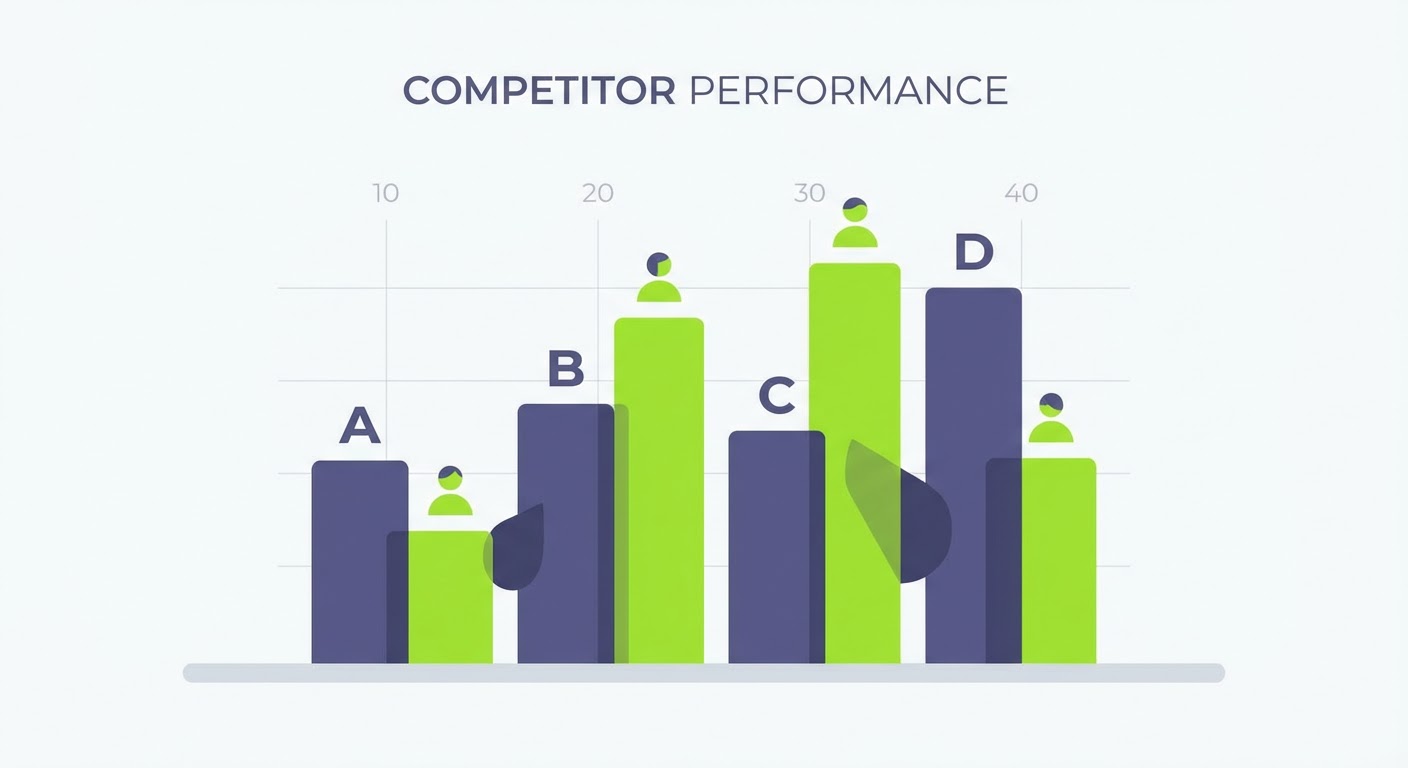
I once spent an entire quarter building a competitive benchmark. Traffic analysis, pricing teardowns, feature matrices, review sentiment scores. All of it. The final report was 30 pages with charts I color-coded by hand. I was proud of the thing.
My CEO flipped to the executive summary, said "cool," and closed the tab. Sales asked if we were cheaper than Competitor X. (We were. It was on their pricing page.) Product said the feature comparison was "interesting" — which is corporate for "I'm not going to do anything with this."
Thirty pages. One quarter. Zero decisions. I don't do comprehensive benchmarks anymore. Here's what works instead.
Start With the Question, Not the Data
I've seen the same pattern kill benchmarking projects at every company I've worked at. Someone says "let's see how we stack up against competitors." That sounds productive. It's not. It's a fishing expedition disguised as a strategy exercise.
Real benchmarks start with a specific business question. "Why did we lose the last three enterprise deals?" is a question. "Should we raise our pricing?" is a question. "Are we underinvesting in SEO compared to competitors who are growing faster?" is a question.
The question determines what you measure. If you're losing deals, benchmark pricing and feature gaps. If your organic traffic is stagnating, benchmark competitor SEO strategy. If customer churn is rising, benchmark competitor customer satisfaction.
I've found that one question per quarter is plenty. You don't need to benchmark everything. You need to benchmark the thing that, if you had an answer, would change what you're doing tomorrow. One question per quarter. That's it. Ignore everything else until you've acted on that one answer.
The Five Benchmarks That Actually Matter
After running competitive benchmarks at three different companies, I've narrowed it down to five that consistently lead to decisions. Everything else is noise that fills reports.
Price-to-value ratio. Not just what competitors charge, but what customers think they get for the money. Check G2 reviews for mentions of value, overpriced, or worth it. If competitor reviews say "expensive but worth it" and yours say "cheap but limited," you have a positioning problem, not a pricing one.
Website traffic trajectory. Not the absolute number — the trend. Is a competitor growing 15% month-over-month while you're flat? That trajectory tells you more than knowing their exact visitor count. Are they winning in channels you've ignored? A competitor getting 40% of traffic from YouTube while you have zero video presence is a gap worth investigating.
Review sentiment by category. Don't read reviews generically. Tag them by what people are talking about: onboarding, support, features, pricing, reliability. Then compare your sentiment breakdown to competitors. If your support scores are 3.2/5 and theirs are 4.6/5, that's a concrete problem you can fix. Way more useful than an overall rating comparison.
Content velocity. How fast are competitors publishing? What topics are they covering? If a competitor who publishes 4 blog posts per month suddenly starts publishing 20, something changed. They either hired a content team, shifted strategy, or are about to launch in a new vertical. The volume shift is the signal. The topic mix tells you where they're headed.
Win rate by competitor. This one requires internal data. When you go head-to-head with each competitor, what's your win rate? If you win 70% against Competitor A but only 30% against Competitor B, that's your most actionable benchmark. Figure out why B beats you and either fix the gap or stop competing in their space.
Getting the Data Without Paying $50K for Tools
Here's a secret the enterprise tool vendors don't want you to know: most competitive benchmarking data is free or cheap. You don't need a $50K Klue or Crayon contract to benchmark effectively.
Traffic data comes from SimilarWeb's free tier, or Ahrefs if you already have it. It's estimated data — not exact — but the trends are directionally correct and trends are what matter.
Review data is sitting right there on G2, Trustpilot, and Capterra. Free. Reading 20 reviews per competitor takes an hour. That hour gives you more actionable insight than any automated sentiment tool I've tried.
Pricing data is on their website. If it's not, check G2 reviews (users mention pricing constantly), look at archived pricing pages on the Wayback Machine, or just ask your sales team — they hear competitor pricing in every deal.
Content velocity is public. Go to their blog, sort by date, count posts. Check their YouTube channel. Search for their name on LinkedIn. Takes ten minutes per competitor.
The expensive tools are worth it when you need to monitor continuously at scale. But for a quarterly benchmark? Save your budget.
Why Use an Agent for This
The manual process I described works. I've used it for years. But it does take a full afternoon of tab-switching and note-taking, and that's for just 5 competitors. If you're monitoring 10-15 competitors across a broader market, the manual approach starts breaking.
That's where an agent earns its keep. A website traffic checker pulls traffic estimates, source breakdowns, and growth trends for any competitor in minutes. Run it for all five competitors and you have your traffic benchmark in the time it takes to make coffee.
The competitor keyword research agent handles the SEO benchmarking. Which keywords are your competitors ranking for that you're not? Where are they winning organic traffic that you could compete for? This used to require an afternoon in Ahrefs. Now it's a prompt.
For the review analysis, the SimilarWeb channel mix benchmarker breaks down where each competitor's traffic comes from. Organic, paid, social, referral, direct. When you see that a competitor gets 35% from social while you get 3%, that's a channel gap you might want to close. Or ignore deliberately — but at least now it's a conscious choice.
The biggest win is consistency. Manual benchmarks happen when someone has time, which means they don't happen consistently. Agent-based benchmarks run on schedule. Monthly traffic checks, quarterly review analysis, weekly content velocity scans. The data stays current without anyone remembering to do it.
Make It Small and Make It Frequent
The best competitive benchmark is a one-pager your team updates monthly. Not a 30-page report that comes out once a year. Five metrics, five competitors, updated regularly. If anything changes significantly, it triggers a conversation. If nothing changes, the update takes five minutes and everyone moves on.
Benchmarking against competitors isn't about knowing everything about everyone. It's about noticing when something changes and deciding whether to respond. Keep it tight, keep it current, and for the love of everything, keep it under two pages.
Try These Agents
- Website Traffic Checker — Pull traffic estimates and growth trends for any competitor site
- Competitor Keyword Research — Discover which keywords competitors rank for that you don't
- SimilarWeb Channel Mix Benchmarker — Break down competitor traffic by channel source
- Trustpilot Competitor Benchmark — Compare review scores and sentiment across competitors