
Competitive Benchmarking Metrics: The Only 7 That Matter
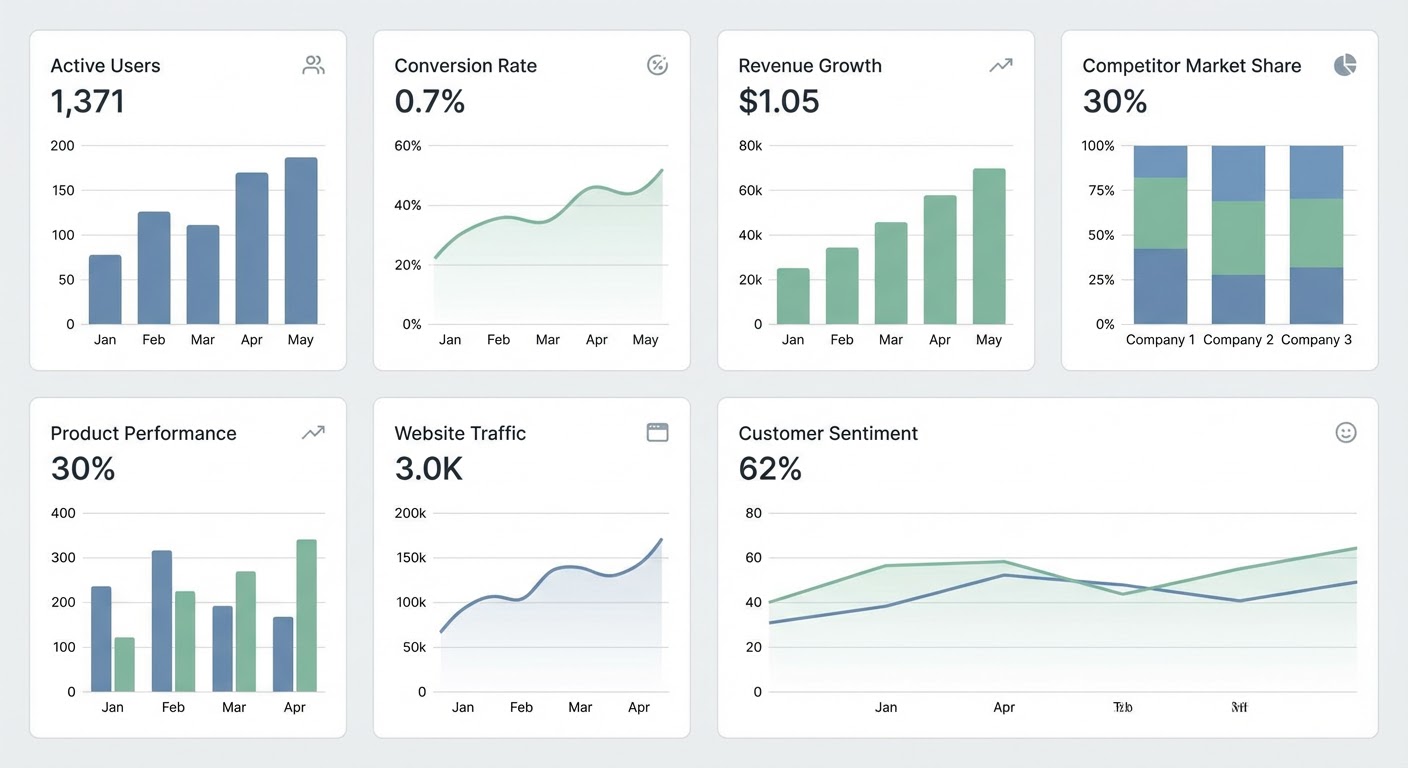
Last year I inherited a competitive dashboard that tracked 43 metrics across six competitors. Website traffic, social followers, blog post count, Glassdoor rating, number of integrations, App Store rating, page load speed, Domain Authority, Alexa rank (which doesn't even exist anymore), email newsletter frequency, and about 30 others I'm forgetting.
Forty-three metrics. Nobody looked at the dashboard. I asked the team why. Someone said "it's too much information to know what to focus on." Another person said "half of those numbers haven't updated in months." The marketing ops person who built it had left the company and nobody knew how to update the Ahrefs and SimilarWeb API connections.
I deleted the dashboard and started over with seven metrics. The team actually uses the new one. Here's what made the cut and why.
Metric 1: Traffic Growth Rate (Not Total Traffic)
I don't care if Competitor X gets 500,000 monthly visits and we get 50,000. That ratio tells me they've been around longer or invested more in SEO. Not useful.
What I care about is the growth rate. Are they growing at 12% per month while we're growing at 3%? That's a trend that tells me something actionable: they're doing something right in their acquisition strategy and we should figure out what it is.
Traffic growth rate also tells you when a competitor is stumbling. A sudden 20% drop in traffic usually means they got hit by a Google algorithm update, lost a major backlink source, or discontinued a paid acquisition channel. That's a window of opportunity you'd miss if you only looked at absolute numbers.
Where to get it: SimilarWeb's free tier gives you directional traffic trends. Not exact, but close enough for benchmarking. What matters is whether competitors are trending up or down relative to you.
Metric 2: Channel Mix
Where does their traffic come from? Organic, paid, social, referral, direct? This is the single most revealing competitive metric I've found, and almost nobody tracks it.
If a competitor gets 60% of traffic from paid search, their growth is buying traffic. That's expensive and it stops the moment the budget dries up. If they get 60% from organic search, they've built a content moat that compounds over time. If they get 40% from referral traffic, they have a partnership or integration network driving distribution.
Knowing the channel mix tells you where to invest. When I saw a competitor getting 35% of traffic from organic and growing 15% per month in that channel, we doubled our SEO investment. Within eight months we started eating into their keyword rankings.
Where to get it: SimilarWeb, or have a channel mix benchmarking agent pull it automatically.
Metric 3: Review Sentiment Breakdown
Not the overall star rating. The breakdown. What percentage of reviews mention positive things about support? About onboarding? About pricing? About the product itself?
Overall rating is almost useless for benchmarking. A 4.3 versus a 4.5 on G2 tells you nothing actionable. But when you dig into the reviews and find that your competitor's negative reviews consistently mention "poor reporting capabilities" while your reporting gets praised? That's a feature you should be selling harder against them.
I tag competitor reviews into five categories: product quality, support, pricing/value, onboarding, reliability. Then I compare the sentiment distribution. If their support is weak and ours is strong, that becomes a sales talking point. If their pricing perception is "fair" and ours is "expensive," we have a positioning problem.
Where to get it: Read the reviews manually (it takes an hour per competitor) or use a competitive battlecard agent to categorize them automatically.
Metric 4: Feature Velocity
Not "how many features do they have" but "how fast are they shipping new ones." Check their changelog, release notes, or product blog. Count the number of new features or updates per month. Track this over time.
A competitor that was shipping twice a month and suddenly starts shipping weekly just hired a bunch of engineers or changed their development process. They're accelerating. If they were shipping weekly and dropped to monthly, something went wrong internally — maybe technical debt, maybe team turnover.
Feature velocity tells you how aggressive a competitor is. A fast-shipping competitor will close feature gaps quickly. A slow-shipping competitor will leave gaps open for you to exploit. Adjust your sales positioning accordingly.
Where to get it: Check their changelog or blog monthly. Takes 10 minutes.
Metric 5: Content Strategy Signals
What topics are competitors publishing about? Not the volume — the topics. If a competitor that's traditionally written about "CRM management" starts publishing heavily about "AI sales automation," they're either launching an AI feature or entering a new market. The content tells you where they're going before they announce it.
I track the last 20 blog posts per competitor by topic cluster. When a cluster appears that wasn't there three months ago, that's a strategic signal. When a cluster disappears, they've either given up on that positioning or the person writing about it left.
Where to get it: Visit their blog. Categorize the last 20 posts. Do this quarterly.
Metric 6: Pricing Position
Not just the dollar amount. Where do they sit in the market? Are they the premium option? The value option? The mid-market option? Has their positioning changed?
A competitor raising prices by 30% is telling you they're moving upmarket. A competitor introducing a free tier is telling you they're competing on volume. A competitor bundling features that used to be add-ons is telling you those features aren't differentiators anymore.
Track pricing quarterly. Screenshot the pricing page. Compare it to the last screenshot. What changed? Why?
Where to get it: Their pricing page, quarterly. Use a pricing analysis agent to monitor changes automatically if you don't want to remember to check.
Metric 7: Win Rate by Competitor
This is internal data, not public data, and it's the most actionable metric on this list. When you compete head-to-head against each competitor, what's your win rate?
If you win 75% against Competitor A and 25% against Competitor B, those aren't just numbers. They're strategy guides. Study why you beat A consistently. Study why B beats you. Interview the lost deals. Read the CRM notes. Talk to the reps.
Maybe B has a feature you don't. Maybe B is cheaper. Maybe B has a reference customer in the prospect's industry and you don't. Whatever the reason, it's the most actionable competitive intelligence you'll ever get, and it comes from your own data.
Where to get it: Your CRM. Tag deals by primary competitor and track the outcome.
Why These Seven (And Not Forty-Three)
Each of these metrics answers a question that leads to an action.
Traffic growth rate → Should we change our acquisition strategy? Channel mix → Where should we invest? Review sentiment → What should sales emphasize? Feature velocity → How fast is the gap closing or opening? Content signals → Where are competitors headed? Pricing position → Should we adjust our pricing? Win rate → Where are we losing and why?
Seven questions. Seven actions. If you can't connect a metric to a decision you'd make differently, drop it from the dashboard. Your team will actually look at a dashboard with seven metrics. Nobody looks at one with forty-three.
Why Use an Agent for This
Collecting these seven metrics manually takes about four hours per quarter for five competitors. Not terrible. But keeping them updated monthly? That's where consistency breaks down. Someone forgets to pull the traffic data. Nobody checks the pricing pages. The review analysis gets pushed to next month forever.
A competitor traffic analysis agent handles metrics 1 and 2 automatically. Monthly traffic trends and channel breakdowns, updated without anyone remembering to do it. The Google Sheets competitor traffic report drops the data into a spreadsheet that the whole team can access.
For metrics 3 and 6, the Trustpilot competitor benchmark and competitor pricing analyzer keep sentiment and pricing data current. When a competitor changes their pricing, you know within days instead of discovering it during a sales call.
The system runs on autopilot. You review the dashboard at the beginning of each month, see what changed, and decide whether any of the seven metrics warrant a strategy conversation. Most months, nothing significant changes and the review takes five minutes. But the month something does change? You catch it immediately instead of three months late.
Try These Agents
- Competitor Traffic Analysis — Automated traffic growth and channel mix tracking for competitors
- Google Sheets Competitor Traffic Report — Drop competitor traffic data into a shared spreadsheet automatically
- Trustpilot Competitor Benchmark — Compare review sentiment across competitors
- Competitor Pricing Analyzer — Monitor competitor pricing page changes over time