
SWOT Analysis vs Competitive Analysis: They're Not the Same Thing
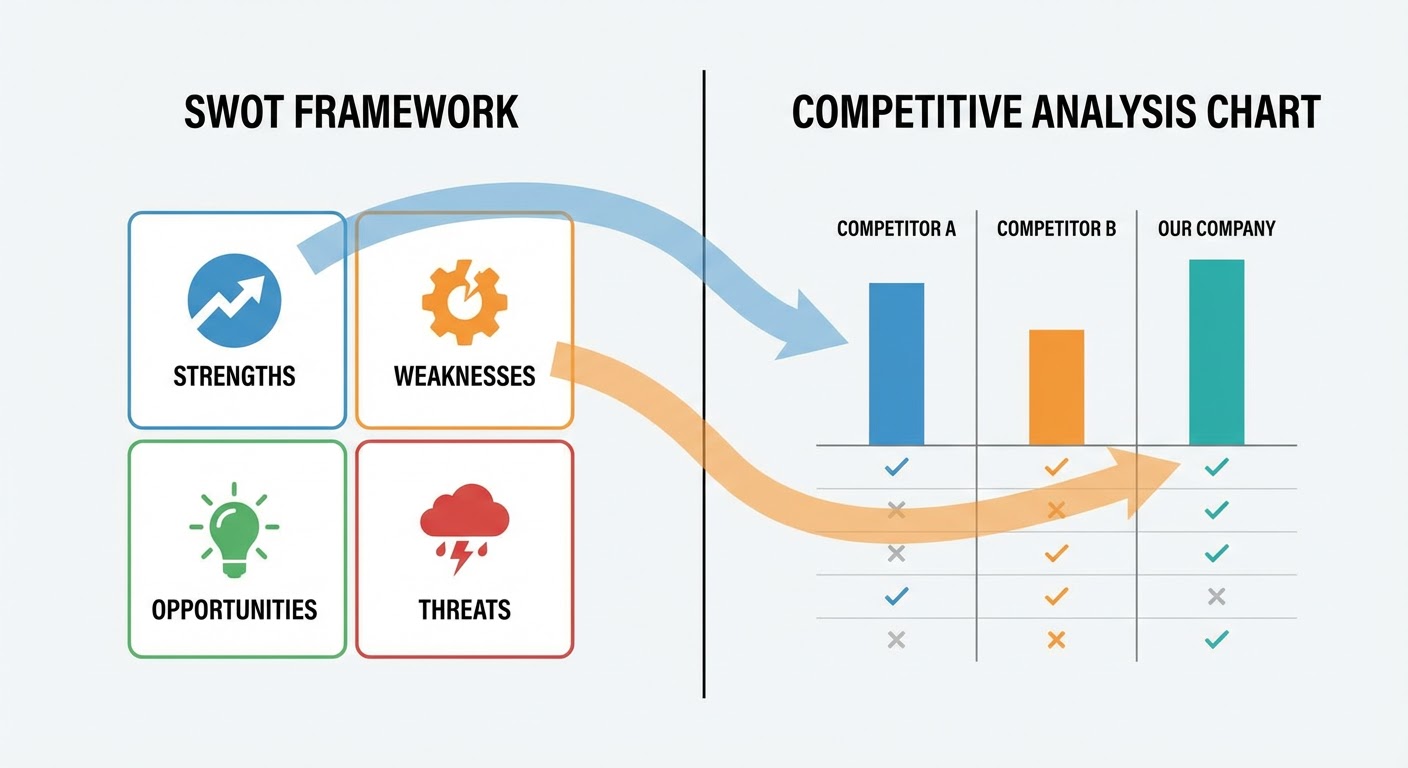
I mixed these up for an embarrassing amount of time. My first marketing role, the VP asked me to "do a competitive analysis." I built a SWOT matrix for each of our three competitors. Four quadrants, strengths, weaknesses, opportunities, threats. Presented it on Friday. She said, "This is a SWOT analysis. I asked for a competitive analysis. These are different things."
I genuinely did not know the difference. And based on the number of blog posts that use these terms interchangeably, I wasn't alone. So let me save you the awkward meeting.
What Each One Actually Is
A SWOT analysis looks inward and outward simultaneously. Strengths and weaknesses are internal — things about your own company. Opportunities and threats are external — things happening in the market. A SWOT analysis is fundamentally about you. Competitors show up in the threats quadrant sometimes, but they're not the focus.
A competitive analysis looks outward only. It's about them. What are competitors doing? How are they positioned? Where do they win? What are their customers saying? How does their pricing compare? A competitive analysis might mention your company for context, but the subject is the competitor, not you.
The confusion happens because a "competitor SWOT analysis" is a thing people do — and it's a hybrid. You apply the SWOT framework to a competitor instead of yourself. That's valid and useful (I wrote a whole guide about how to do it), but it's a specific application of the SWOT framework, not the same as a broad competitive analysis.
When to Use a SWOT
Use SWOT when you're making a strategic decision about your own company. Should we enter a new market? Should we raise prices? Should we sunset a product line? SWOT forces you to look at internal capabilities (can we actually do this?) alongside external conditions (does the market want this?).
I use SWOT at the beginning of annual planning. It's a reality check. Here's what we're good at, here's where we're weak, here's what's happening in the market that we could take advantage of, and here's what's coming that could hurt us. The output is a set of strategic priorities for the year.
Where SWOT falls short: specificity about competitors. A SWOT might tell you "Threat: new entrant with VC funding targeting our segment." That's useful for strategic awareness. It tells you nothing about how to position against them in a sales call next Tuesday. For that, you need competitive analysis.
When to Use Competitive Analysis
Use competitive analysis when you need to answer operational questions about specific competitors. How do we beat Competitor X in this deal? What should our SDRs say when a prospect mentions Competitor Y? Where should we invest to close the gap against Competitor Z?
Competitive analysis is granular. It includes things like pricing comparisons, feature matrices, win/loss data broken down by competitor, traffic and distribution analysis, customer review sentiment. The output isn't "be aware of this threat" — it's "here's exactly how to position against this company in these specific situations."
I use competitive analysis continuously. Monthly updates to competitive battlecards. Weekly win/loss reviews where we dissect specific deals against specific competitors. Quarterly pricing position checks. This is operational intelligence that drives daily decisions.
Where competitive analysis falls short: it doesn't tell you what to do about yourself. You can know everything about every competitor and still not have a strategic direction. That's where SWOT fills the gap.
The Real Answer: You Need Both
Any strategy leader who tells you to pick one is wrong. They answer different questions.
SWOT answers: "What should we focus on this year?" It's a planning tool. You do it once or twice a year, and it shapes priorities and resource allocation.
Competitive analysis answers: "How do we win against these specific companies today?" It's an operational tool. You maintain it continuously, and it shapes positioning, messaging, and sales tactics.
The ideal workflow is this: run a SWOT annually to set strategic direction. Run competitive analysis monthly to stay tactically sharp. When the SWOT identifies a threat, the competitive analysis tells you exactly what that threat looks like and how to respond. When competitive analysis reveals a consistent pattern of losses against one competitor, the SWOT helps you decide whether to invest in closing the gap or pivoting away.
Where They Overlap (And Where People Get Confused)
The overlap happens in the external quadrants of SWOT — opportunities and threats. Both frameworks look at the competitive landscape. A competitive analysis that reveals a competitor's major weakness (from review data, win/loss data, etc.) becomes an opportunity in your SWOT. A competitive analysis that reveals a competitor just raised $200M becomes a threat in your SWOT.
People get confused because they try to do everything in one document. They start a competitive analysis and accidentally turn it into a SWOT by including internal strengths and weaknesses. Or they build a SWOT and go so deep on competitors that it becomes a competitive analysis wearing a SWOT costume.
Keep them separate. Two documents, two purposes, two cadences. The SWOT is your strategic lens. The competitive analysis is your tactical lens. They reference each other but they're not the same deliverable.
The Fastest Path to Both
If you're starting from zero, do the competitive analysis first. It's easier to fill out because it's all external data — you don't need to have the hard internal conversations about your own weaknesses yet. Pull traffic data, read competitor reviews, check pricing, look at feature comparisons. You can do a solid competitive analysis for three competitors in about four hours.
Then use that competitive analysis to feed your SWOT. The competitor strengths you identified? Those are potential threats. The competitor weaknesses? Those are potential opportunities. You've already done the external research — now add the internal assessment (your own strengths and weaknesses) and you have a complete SWOT.
Going the other direction — SWOT first — tends to produce vague external quadrants because you haven't done the competitive homework yet. "Opportunity: market demand for AI" is something you'd write in a SWOT without competitive research. "Opportunity: Competitor X has no AI features and their customers are asking for them in 45% of recent reviews" is something you'd write after doing competitive analysis first. The second one is actionable. The first one is a platitude.
Why Use an Agent for This
Both exercises bottleneck on data collection. SWOT needs market data and internal data. Competitive analysis needs competitor data from multiple sources — reviews, traffic, pricing, product updates, hiring signals.
The market intelligence agent feeds both frameworks. It monitors competitive moves, market trends, and industry shifts — data that populates the external quadrants of your SWOT and the strategic sections of your competitive analysis. One data feed, two outputs.
For the operational side of competitive analysis, the competitor traffic analysis gives you the distribution picture and the competitor review analysis gives you the customer sentiment picture. Together, they answer "how is this competitor doing and what are their customers saying?" — which is 80% of a competitive analysis.
You still have to do the internal assessment for SWOT. No agent can tell you your own weaknesses (though your Glassdoor reviews might). And you still need to write the positioning and battlecard content that makes competitive analysis useful for sales. But the research foundation — the hours of reading and clicking — runs in the background while you do the work that requires human judgment.
Try These Agents
- Market Intelligence Agent — Monitor competitive moves, market trends, and industry shifts for strategic planning
- Competitor Traffic Analysis — Distribution, channel mix, and traffic trend data for competitor analysis
- Competitor Review Analysis — Customer sentiment and review themes from G2, Capterra, TrustRadius
- G2 Competitive Battlecard Generator — Turn competitive intelligence into usable sales battlecards