
Best Clearbit Alternatives in 2026: 9 Tools Compared
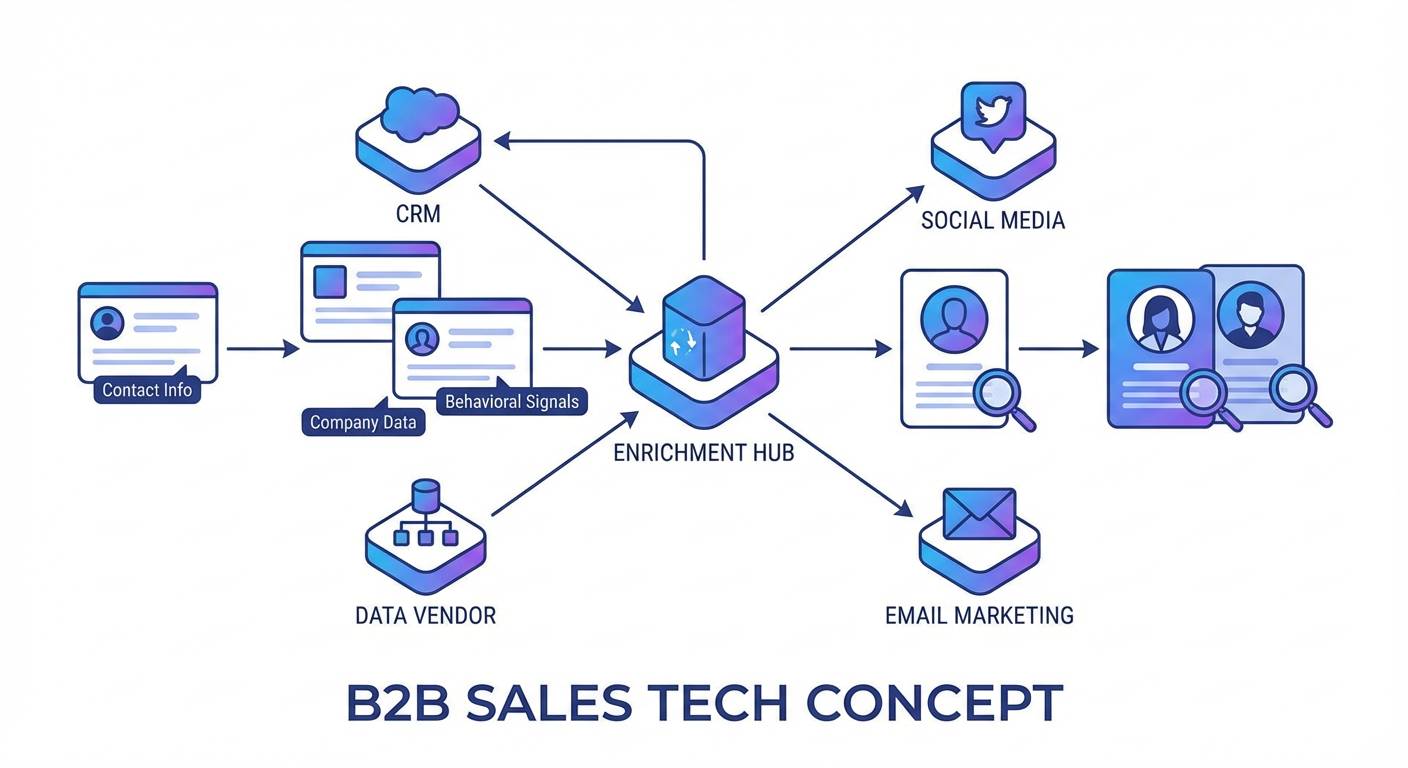
Clearbit used to be the tool I recommended to every sales team that asked about data enrichment. Clean API, accurate firmographics, real-time enrichment on form fills. Then HubSpot bought them in late 2023, rebranded the product to Breeze Intelligence, and started gating features behind HubSpot subscription tiers. Credits now expire monthly. Pricing jumped 30-60% for teams migrating from the standalone product. And if you're on Salesforce or Pipedrive? The roadmap isn't built for you anymore.
I spent two weeks testing clearbit alternatives after our own Breeze credits doubled in cost at renewal. We ran a 500-contact enrichment test across nine platforms, comparing match rates, data accuracy, and what you actually get per dollar. I also looked at how tools like Cotera's Lead Enrichment agent change the equation entirely by going beyond static data fields and doing actual research on each lead.
Here's how the nine best options stack up.
| # | Tool | Best For | Pricing |
|---|---|---|---|
| 1 | Cotera | AI agent platform for lead research | Free tier available |
| 2 | ZoomInfo | Enterprise-grade contact database | Custom pricing ($15K+/yr) |
| 3 | Apollo.io | All-in-one prospecting and outreach | Free tier, paid from $49/mo |
| 4 | Lusha | Fast contact lookups from LinkedIn | Free tier, paid from $49/mo |
| 5 | Clay | Waterfall enrichment across 150+ sources | From $185/mo |
| 6 | 6sense | Predictive ABM and intent signals | Custom pricing ($60K+/yr) |
| 7 | Cognism | GDPR-compliant European data | Custom pricing |
| 8 | LeadIQ | LinkedIn prospecting with CRM push | Free tier, paid from $36/mo |
| 9 | FullContact | Privacy-safe identity resolution | From $99/mo |
1. Cotera
Free tier available
- AI agents that research leads and write qualification briefs
- Enriches contacts from 50+ data sources automatically
- Scores leads against your ICP with written rationale
- No per-seat pricing or expiring credits
- Works with Salesforce, HubSpot, Pipedrive, Attio
Clearbit gave you 30 data fields per contact. Cotera gives you an AI agent that does what a junior analyst would do with those fields and an hour of free time. The difference matters when your reps are drowning in enriched records but still can't tell which leads are worth calling first.
The Lead Enrichment agent takes a name or email and pulls firmographic data, checks recent funding rounds, looks at hiring patterns, scans the tech stack, and writes a brief your rep can read in 60 seconds. The Company Growth Analyzer goes deeper on account-level signals, tracking headcount changes and expansion indicators that static databases miss because they only update quarterly. For teams doing bulk enrichment through Apollo or ZoomInfo data, the Apollo Bulk Enrichment agent layers Cotera's research on top of your existing contact lists. And the HubSpot Contact Enrichment agent plugs directly into your CRM to enrich records without exporting CSVs.
What separates Cotera from ZoomInfo or Clay is the output format. Those tools hand you rows in a spreadsheet. Cotera hands you a written analysis that explains why a lead fits your ICP, not just whether they match a filter. The free tier is genuinely usable for small teams. The limitation is that Cotera isn't a self-serve database where you search by title and industry across 200 million records. If bulk list-building is your primary workflow, pair it with Apollo or ZoomInfo for discovery and let Cotera handle the research layer.
2. ZoomInfo
Custom pricing ($15K+/yr)
- 321M+ contacts with verified emails and direct dials
- Org charts and buying committee mapping
- Intent data and technographic filters
- Built-in engagement tools (Engage, Chat)
- Deep firmographic and hierarchical data
ZoomInfo is the tool Clearbit users look at when they need a bigger database with phone numbers. Clearbit was always stronger on company-level data. ZoomInfo's strength is person-level: direct dials, org charts, buying committees. If your team sells by phone, ZoomInfo's database is still the deepest in B2B.
The 321 million contact database with verified direct dials is hard to match. In our testing, ZoomInfo's phone numbers connected 72% of the time, which was the highest of any tool we tested. Email accuracy was 94%. The intent data helps prioritize accounts showing buying signals, and the technographic filters let you find companies running specific tools in their stack. For enterprise sales teams doing account-based outreach, ZoomInfo gives you everything in one platform.
The problem is cost. Contracts start at $15K per year and climb past $30K for most teams once you add intent data, Engage, and extra seats. That's 10x what Apollo charges for a comparable database. And the annual price hikes are real. I've talked to teams whose ZoomInfo bill went up 25-35% at renewal with no new features added. If your budget can absorb it, the data quality justifies the price. If it can't, Apollo or Lusha gets you 80% of the value at a fraction of the cost.
3. Apollo.io
Free tier, paid from $49/mo
- 275M+ contact database with email and phone
- Built-in email sequencing and dialer
- Chrome extension for LinkedIn prospecting
- API access on paid plans
- Intent data and job change alerts
Apollo is where most teams land when they leave Clearbit and don't want to pay ZoomInfo prices. The math is simple: Clearbit's Breeze Intelligence costs thousands per year for enrichment credits that expire monthly. Apollo gives you a 275 million contact database with sequencing, a dialer, and a Chrome extension for $49-$99 per month per user.
We ran parallel enrichment tests on the same 500 contacts. Clearbit matched 71% with firmographic data. Apollo matched 67%. The 4-point gap existed mostly in smaller companies under 50 employees where Clearbit's company data has historically been stronger. For contacts at mid-market and enterprise companies, the coverage was almost identical. Apollo also returns person-level data (email, phone, title) that Clearbit never specialized in.
Where Apollo falls short compared to Clearbit is real-time enrichment. Clearbit could enrich a form submission in milliseconds before the lead hit your CRM. Apollo doesn't have that kind of inline enrichment. You search their database, export, or use the API. The data freshness can also lag. We found contacts listed at companies they'd left months ago. But for the price difference, most teams accept that trade-off.
4. Lusha
Free tier, paid from $49/mo
- One-click contact reveal from LinkedIn profiles
- Direct dial phone numbers with high accuracy
- Bulk enrichment for contact lists
- CRM integration with auto-push
- GDPR and CCPA compliant data sourcing
Lusha replaces the part of Clearbit that people actually used the most: quick lookups. You're on a LinkedIn profile, you need the person's email and phone number, and you need it pushed into your CRM without tab-switching. Lusha's Chrome extension does that in about 10 seconds.
Phone number accuracy is the real selling point. In our testing, Lusha's direct dials connected 68% of the time. That's close to ZoomInfo's 72% and well above Apollo's 58%. For teams where cold calling is a core part of the outbound motion, that 10-point gap versus Apollo means more conversations per day. The $49/mo entry price makes Lusha one of the cheapest ways to get high-quality phone data.
The limitation is company-level enrichment. Clearbit was famous for its firmographic depth: revenue estimates, tech stack, employee count by department, industry classifications. Lusha gives you the basics (headcount, industry, location) but nothing close to Clearbit's company profile. If you used Clearbit primarily for lead routing based on firmographic data, Lusha won't fill that gap. It fills the "find me this person's direct line" gap, and it does that really well.
5. Clay
From $185/mo
- Waterfall enrichment across 150+ data providers
- AI research agent (Claygent) for web scraping
- Customizable enrichment workflows
- AI formula generator for data transformation
- Integrations with CRMs and outreach tools
Clay is what you pick when one data provider isn't enough. The waterfall enrichment feature queries multiple providers in sequence. If provider A can't find an email, it tries provider B, then C. In practice, this means higher match rates than any single tool. Our 500-contact test got an 82% email match rate through Clay's waterfall, compared to 71% from Clearbit alone and 67% from Apollo alone.
The platform is basically a spreadsheet that connects to 150+ data sources. You build enrichment workflows by chaining lookups together. Claygent, their AI research agent, can scrape public web data and pull information that structured databases miss, like whether a company just launched a new product or opened a new office. For ops teams that think in workflows, Clay is the most flexible tool on this list.
The downside is complexity and cost. Clay charges credits for every lookup, including failed ones. If you query three providers searching for an email and none return a result, you pay for all three attempts. The $185/mo plan supports roughly 200-400 fully enriched prospects per month, which means per-contact costs can hit $0.50-$1.00. For high-volume teams, that's expensive. And the learning curve is real. Clay rewards people who build custom workflows. If you just want to search a database and export a list, Apollo is simpler and cheaper.
6. 6sense
Custom pricing ($60K+/yr)
- AI-powered predictive account scoring
- Anonymous website visitor identification
- Buyer journey stage tracking
- Intent data across multiple signal sources
- Account-based advertising orchestration
6sense is a different animal than Clearbit. Where Clearbit enriched known contacts with company data, 6sense identifies anonymous buying signals and predicts which accounts are in-market before they fill out a form. It's an ABM platform that happens to include enrichment, not an enrichment tool that happens to do ABM.
The predictive scoring is the core feature. 6sense tracks buyer behavior across the web, assigns accounts to buying stages (awareness, consideration, decision), and tells your sales team which accounts to prioritize. For enterprise teams running account-based motions, this kind of signal data is worth more than firmographic enrichment. You're not just knowing who a company is. You're knowing when they're ready to buy.
The cost is serious. Contracts start at $60K per year and often run $100K+ for mid-market teams. Implementation takes 4-8 weeks. You need a dedicated admin to manage the platform. And the intent scores feel opaque. Users regularly ask "why does this account show Decision stage?" without getting a clear answer. If you're running a large ABM program with 50+ sellers and the budget to match, 6sense can drive measurable pipeline. If you're a 10-person sales team, this is overkill by a wide margin.
7. Cognism
Custom pricing
- Diamond Data: phone-verified mobile numbers
- GDPR-compliant by design for European data
- Bombora intent data included
- Chrome extension for LinkedIn and Sales Navigator
- Strong coverage in UK, DACH, and Nordics
Clearbit's European data was always thin. If you sell into the UK, Germany, or Nordics, you noticed the gap in coverage and accuracy. Cognism was built for European markets from the start, with GDPR compliance baked into how they collect and store data.
The Diamond Data feature is the differentiator. These are mobile numbers verified by Cognism's team within the last 90 days by actually calling them. We tested 50 Diamond Data numbers and got a 71% connect rate. Standard database phone numbers average 35-40% in Europe. For teams that sell by phone into European accounts, that connect rate alone justifies the cost. Cognism also bundles Bombora intent data at no extra charge, which ZoomInfo and most other providers treat as a paid add-on.
The catch is that Cognism's US data is noticeably weaker than ZoomInfo's or Apollo's. If you prospect primarily in North America, this isn't the right tool. Pricing is enterprise-level at $20K-$35K per year, so it's not a budget alternative. It's the right choice for a specific use case: European prospecting with verified phone numbers. If that's your use case, nothing else on this list comes close.
8. LeadIQ
Free tier, paid from $36/mo
- One-click contact capture from LinkedIn
- Champion tracking for job changes
- AI email writer (Scribe) for outreach
- Direct push to Salesforce, Outreach, Salesloft
- Prospecting intelligence and buying signals
LeadIQ is built specifically for SDRs who prospect from LinkedIn. The Chrome extension captures contact data and pushes it directly to your CRM and sequencer in one click. Where Clearbit required API integration and developer time to set up, LeadIQ works out of the box for reps who live in Sales Navigator.
The champion tracking feature is genuinely useful. When a contact who previously bought your product changes jobs, LeadIQ flags it. Those "warm" outreach opportunities convert at 3-5x the rate of cold outreach because the person already knows your product. Clearbit never had anything like this. The AI email writer, Scribe, generates personalized outreach based on the prospect's profile, which saves reps 5-10 minutes per email on research and drafting.
LeadIQ's weakness is data depth. The company-level data is basic compared to what Clearbit provided. Revenue estimates, technographic data, and departmental headcount aren't there. LeadIQ is a prospecting tool for individual reps, not a data infrastructure layer for your GTM stack. The free plan gives you 50 verified emails and 5 phone numbers per month, which is enough to test but not enough to run outbound at scale. Paid plans start at $36/mo, making it one of the most affordable options here.
9. FullContact
From $99/mo
- Patented identity graph with 1B+ profiles
- 900+ data attributes per contact
- Privacy-safe enrichment (CCPA, GDPR compliant)
- Real-time Enrich API with clean documentation
- Matches across email, phone, social, and MAIDs
FullContact is the closest architectural replacement for Clearbit's API. Both were built API-first for developers who want to embed enrichment into their product or workflow. FullContact's Enrich API takes an email address and returns up to 900 data attributes: name, location, job title, company info, social profiles, and behavioral signals. The identity graph covers over one billion person profiles.
Where FullContact stands apart is identity resolution. If you have fragmented customer data across multiple systems (one record with an email, another with a phone number, a third with a social handle), FullContact stitches them together into a unified profile. Clearbit didn't do this well. For marketing teams running cross-channel campaigns, that identity resolution capability is worth more than raw data volume.
The downside is that FullContact's data accuracy is inconsistent. Users report outdated information, especially for job titles and company affiliations. The match rate for emails is solid (around 80% in our testing), but the depth of company data doesn't match Clearbit's best-in-class firmographics. The pricing starts at $99/mo for basic API access, but comprehensive enterprise plans run into the thousands. If you need an API-first enrichment tool with identity resolution, FullContact is the logical pick. If you need a sales prospecting database, look elsewhere on this list.
How to Choose
It depends on why you left Clearbit in the first place.
Tired of HubSpot lock-in? Apollo gives you comparable contact data with built-in outreach tools for a fraction of the cost. No CRM dependency. If you just want your enrichment back without the Breeze Intelligence pricing headaches, start there.
Need better company-level data than Clearbit provided? ZoomInfo has the deepest firmographic and technographic database in B2B, plus org charts and buying committees that Clearbit never offered. The price is steep, but the data is best-in-class.
Want enrichment across multiple sources instead of just one? Clay's waterfall approach queries 150+ providers and consistently hits higher match rates than any single tool. It takes more setup, but ops teams love the flexibility.
Selling into European markets? Cognism is the only tool here with verified European mobile numbers and built-in GDPR compliance. Nothing else comes close for UK, DACH, and Nordic prospecting.
Need to predict which accounts are buying, not just enrich them? 6sense turns anonymous intent signals into prioritized account lists. It's an ABM platform, not an enrichment tool, but for enterprise teams it replaces both.
And if you want the enrichment data to actually mean something to your reps, that's what Cotera was built for. An AI agent that reads the data, analyzes the signals, and writes a brief that tells your rep exactly why this lead matters and what to say. Static fields in a spreadsheet are table stakes now. The question is what you do with those fields after they're filled in.
Most teams end up with two tools: a database for discovery and something smarter on top for research. That combination costs less than Clearbit's new pricing and does more.
Try These Agents
- Lead Enrichment — Enrich leads with firmographics, technographics, and company data from 50+ sources
- Company Growth Analyzer — Track headcount changes, funding rounds, and expansion signals for target accounts
- Apollo Bulk Enrichment — Layer AI research on top of Apollo contact exports for deeper lead context
- HubSpot Contact Enrichment — Enrich HubSpot CRM records with verified data without manual exports