
Best Klue Alternatives in 2026: 9 Tools Worth Trying
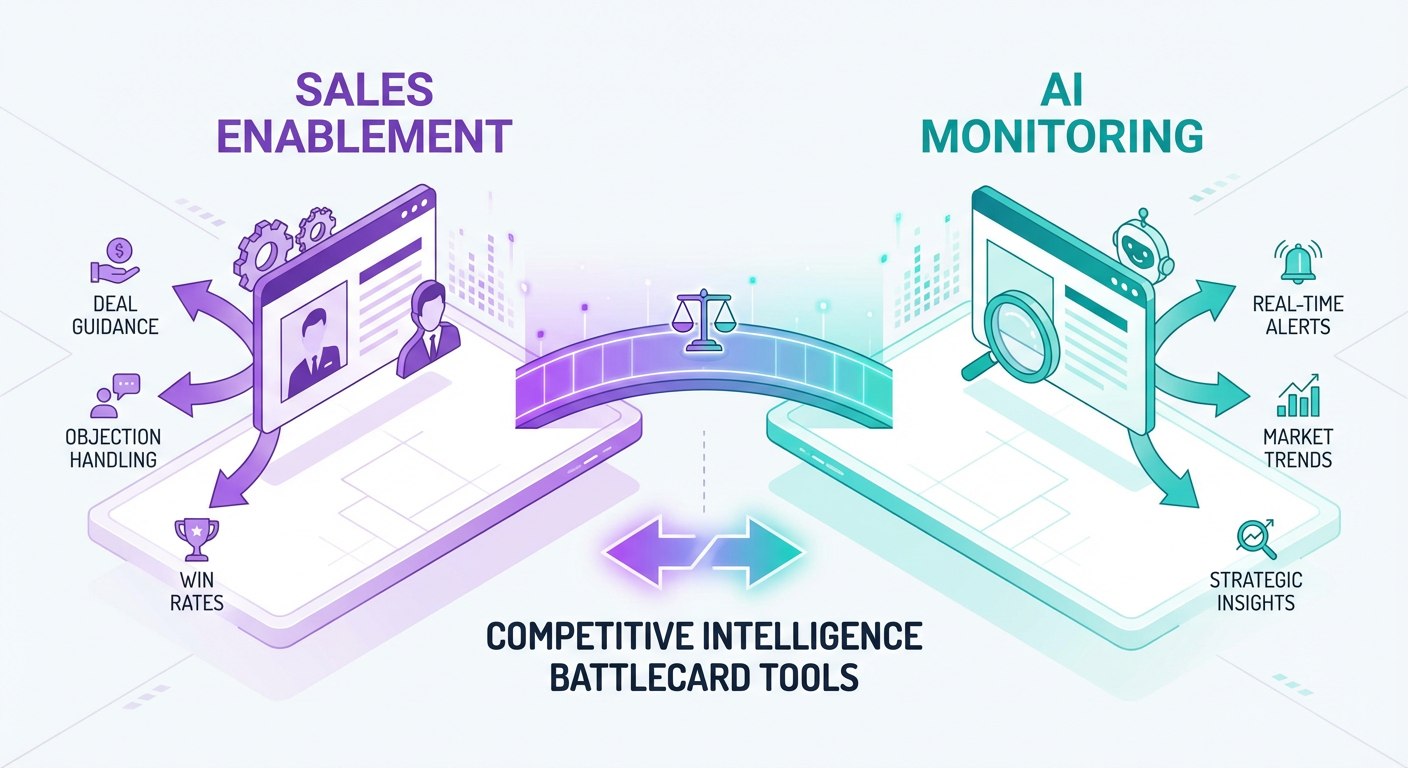
Klue is good at what it does. If your main job is creating and distributing sales battlecards, the platform works. But I kept running into three problems: the competitive monitoring felt shallow compared to what I needed, pricing conversations with their sales team went nowhere fast, and I wanted intelligence that went beyond "here's a card your rep can pull up during a call." I wanted to actually understand what competitors were doing — their pricing changes, their traffic shifts, their hiring patterns — not just have a document that summarized it once a quarter.
So I tested alternatives. A lot of them. Some were built for the same sales enablement use case as Klue but did it differently. Others approached competitive intelligence from entirely different angles — SEO data, social listening, AI-powered research agents. The Competitor Pricing Analyzer on Cotera was the tool that changed how I thought about the whole category, because it treated competitive intelligence as something that should happen automatically rather than something I had to remember to do.
Here are nine alternatives worth looking at, depending on what you actually need from a competitive intelligence tool.
| # | Tool | Best For | Pricing |
|---|---|---|---|
| 1 | Cotera | AI agents for automated competitor monitoring | Free tier available |
| 2 | Crayon | Enterprise competitive enablement | Custom pricing (~$25K+/yr) |
| 3 | Kompyte | Automated website change tracking | Custom pricing |
| 4 | Semrush | SEO & paid search intelligence | From $130/mo |
| 5 | G2 | B2B review & buyer intent data | Custom pricing |
| 6 | Contify | Market & competitive intelligence feeds | Custom pricing |
| 7 | Brandwatch | Social media & sentiment monitoring | Custom pricing |
| 8 | Cipher | Strategic competitive intelligence | Custom pricing |
| 9 | Similarweb | Website traffic & audience intelligence | Custom pricing |
1. Cotera
Free tier available
- AI agents that monitor competitor pricing, traffic, reviews, and more
- Runs automatically — no manual research or dashboard checking
- Pulls from live web data instead of a static database
- Custom agents for any competitive question you can define
- Free tier covers most competitive monitoring needs
Klue expects you to feed it data and then packages it into battlecards. Cotera flips that model. You tell it what you want to know about a competitor, and an AI agent goes and finds the answer. The Competitor Pricing Analyzer watches how competitors price and position their products, then flags changes as they happen. No more finding out about a price drop from a prospect who forwarded you a competitor's quote.
The Competitor Review Analysis agent pulls reviews from across the web and identifies patterns in what customers love and hate about your competitors. That's the kind of intelligence that makes battlecards actually useful — not just "here's what they offer" but "here's what their customers complain about, backed by data." The G2 Competitive Battlecard Generator takes this further and builds battlecard content directly from structured review data.
Where Klue gives you a static enablement platform, Cotera gives you a research engine. The Competitor Traffic Analysis agent monitors where competitors get their web traffic and how their channel mix is shifting. I set up four agents against our top competitors and had more useful intelligence in a week than months of manually checking Klue dashboards had produced.
The trade-off is that Cotera doesn't hand you a pre-built competitive dashboard. You build agents that answer your specific questions. If you know what you need to track, that flexibility is a clear advantage over Klue's more rigid battlecard structure. If you want a turnkey solution where everything is organized for you on day one, you'll need to spend some time configuring agents upfront.
2. Crayon
Custom pricing (typically $25K+/year)
- Monitors competitor websites, pricing pages, and messaging
- Curated weekly competitive digests for stakeholders
- Battlecard creation and CRM distribution
- Slack, Salesforce, and email integrations
If your problem with Klue is that the monitoring isn't deep enough, Crayon is the most direct upgrade. Both tools do battlecards and sales enablement, but Crayon's monitoring engine is more comprehensive. It watches competitor websites constantly, catching pricing page revisions, new feature announcements, and messaging changes that Klue's lighter monitoring often misses.
The curated digest is where Crayon earns its budget. Every Monday you get a summary of what moved across your competitive set — not raw alerts, but edited highlights that you can forward to leadership or paste into a Slack channel. Klue has competitive updates too, but Crayon's curation layer feels more polished.
The problem is price. At $25K+ per year, Crayon costs more than Klue for most configurations, and it's really built for teams that have a dedicated competitive intelligence function. If you're a product marketer who handles competitive work as 20% of your job, Crayon is probably more tool than you need. Expect to spend the first few weeks filtering out noisy alerts before the signal-to-noise ratio improves.
3. Kompyte
Custom pricing
- Automated website and content change detection
- SEO, social media, and ad monitoring
- AI-summarized competitive updates
- Battlecard builder from tracked changes
Kompyte, now owned by Semrush, does the same core job as Klue — monitor competitors and create battlecards — but with a lighter footprint. Where Klue wraps a lot of workflow around the battlecard (win/loss analysis, revenue impact measurement, CRM integrations), Kompyte focuses on the monitoring-to-battlecard pipeline and does it with less setup overhead.
The AI summarization is what separates Kompyte from raw alerting tools. Instead of getting "this page changed" notifications, you get summaries: "Competitor X updated their enterprise pricing tier, removing the 50-seat minimum and adding a usage-based option." That saves you from clicking through to every change alert to figure out if it matters.
Compared to Klue, Kompyte is generally less expensive and faster to set up. The trade-off is that it lacks Klue's win/loss analysis features and its CRM integrations aren't as deep. If you're choosing between the two, it comes down to whether you need a full competitive enablement platform (Klue) or a focused monitoring-and-battlecard tool (Kompyte). The Semrush integration is a nice bonus if you're already in that ecosystem.
4. Semrush
From $130/mo
- Competitor traffic estimates with channel breakdown
- Keyword gap analysis across multiple competitors
- PPC ad copy and spend intelligence
- Backlink comparison and content gap analysis
Klue doesn't really do SEO competitive intelligence. If you want to know which search terms your competitors rank for, how much traffic their blog drives, or what they're spending on Google Ads, you need a different tool. Semrush is the standard here and it covers that entire lane with depth that no general competitive intelligence platform matches.
The keyword gap analysis is what I come back to most. Plug in your domain and three competitors, and Semrush shows you every search term where they rank and you don't. That feeds directly into content strategy. The PPC research feature shows you competitor ad copy, landing pages, and estimated budgets — useful intelligence that Klue doesn't even attempt to collect.
Semrush won't replace Klue for sales enablement. It's not going to build you a battlecard or integrate with Salesforce. But it fills a blind spot that Klue leaves wide open. Many teams use Semrush alongside their competitive enablement tool, pulling SEO and traffic data into Semrush while using something else for battlecards and sales content.
5. G2
Custom pricing
- Largest B2B software review database
- Competitive comparison grids and category reports
- Buyer intent signals from active researchers
- Structured review data on competitor strengths and weaknesses
Klue can import G2 data, but using G2 directly for competitive intelligence gives you a level of detail that the import doesn't capture. Every review on G2 contains structured data: what the buyer liked, what frustrated them, what they switched from, what they'd change. Read enough reviews about a competitor and you start seeing patterns that no battlecard captures.
I found that 40% of negative reviews for one competitor mentioned onboarding difficulty. That became a positioning angle our sales team used for three months. You can't get that kind of insight from Klue's battlecard — you get it from reading reviews systematically and extracting the patterns.
The G2 Grid reports show where you stand relative to competitors in customer satisfaction and market presence. Tracking your grid position over time tells you whether your competitive investments are working. The buyer intent data — which companies are actively researching your category — is a separate product, but for competitive intelligence purposes the review data and grid positioning are the real value.
The downside: G2 reviews are backward-looking. They tell you what already happened. A competitor can launch a new product and G2 won't reflect it for months until reviews come in. Use G2 for deep competitive positioning insights, but pair it with something that tracks real-time changes.
6. Contify
Custom pricing
- AI-curated news and market intelligence feeds
- Competitor, customer, and industry monitoring
- Custom taxonomies for organizing intelligence
- API and newsletter distribution options
Contify takes a different approach than Klue. Instead of focusing on sales enablement and battlecards, it's a market intelligence platform that monitors news, press releases, regulatory filings, job postings, and web content across your competitive set. The output is curated intelligence feeds rather than battlecards — think of it as a smarter, automated version of the Google Alerts you set up for competitors and then forgot about.
The custom taxonomy system lets you tag and organize intelligence by competitor, topic, product line, or any category that makes sense for your business. That's useful for larger teams where different stakeholders care about different competitors or different aspects of the same competitor. The newsletter feature packages intelligence into automated email digests that go out to the people who need them.
Compared to Klue, Contify is broader but shallower on the sales enablement side. It monitors more sources and organizes intelligence more flexibly, but it doesn't build battlecards or integrate into your CRM the way Klue does. It's a better fit for strategy teams and market research functions than for product marketing teams arming sales reps.
7. Brandwatch
Custom pricing
- Social media monitoring across all platforms
- AI-powered sentiment analysis and trend detection
- Crisis alerting and conversation spike tracking
- Historical social data with years of archives
Klue monitors competitor websites and news. Brandwatch monitors what people are saying about competitors on social media, forums, Reddit, news sites, and blogs. These are two completely different data sources, and for many companies the social conversation tells you more about competitive positioning than the competitor's own website does.
The sentiment analysis tracks whether people talk about a competitor positively or negatively over time. If a competitor pushes a product update and the social reaction is overwhelmingly bad, you'll see it in Brandwatch days before it shows up in review scores or churn data. That early signal gives your sales team ammunition while the conversation is still fresh.
Brandwatch is enterprise software. The platform is powerful but it takes real setup time to configure the right queries and filters. For small teams, tools like Mention or even free social monitoring cover the basics. Brandwatch is for organizations that treat social intelligence as a strategic input, not a side project. If your competitive battle is fought partly on social media — SaaS, consumer tech, D2C brands — Brandwatch fills a gap that Klue doesn't touch.
8. Cipher
Custom pricing
- AI-driven competitive intelligence platform
- Automated collection from thousands of sources
- Strategic analysis frameworks and dashboards
- Analyst support for custom research projects
Cipher sits at the strategic end of competitive intelligence — less about arming individual sales reps (Klue's strength) and more about informing executive decision-making and long-term strategy. The platform collects intelligence from thousands of sources automatically, then applies analytical frameworks to surface trends, threats, and opportunities.
What differentiates Cipher from Klue is the depth of analysis. Klue gives you data organized for sales consumption. Cipher gives you data organized for strategic planning — market landscape views, competitive positioning maps, threat assessments. The analyst support option means you can commission custom research projects when the automated monitoring isn't enough.
The catch is that Cipher is built for large organizations with dedicated competitive intelligence teams. The platform is complex, the onboarding takes time, and the pricing reflects enterprise expectations. For most mid-market companies, Cipher is more tool than they need. But if your competitive intelligence function reports to the C-suite and influences product roadmap decisions, Cipher handles that level of analysis better than Klue does.
9. Similarweb
Custom pricing (free tier available)
- Most accurate website traffic estimation available
- Audience overlap and referral source analysis
- Industry benchmarking with market share data
- App intelligence for mobile competitive analysis
Similarweb gives you the most accurate third-party traffic estimates on the market. When someone in a meeting asks "how much traffic does Competitor X get?" the number usually comes from Similarweb. The free tier shows basic traffic numbers and top sources. The paid product breaks it down by geography, device, referral source, and audience demographics — none of which Klue offers.
The audience overlap feature is genuinely useful for competitive strategy. It shows which websites share visitors with your competitors, which tells you where your target audience actually spends time online. If 30% of a competitor's visitors also read a specific industry publication, that's an advertising opportunity you wouldn't have found from Klue's battlecard.
The limitation is that Similarweb is narrow. It's traffic data, and it does traffic data well. It doesn't build battlecards, it doesn't monitor messaging changes, and it doesn't integrate with your CRM. Like Semrush, it fills a specific gap in your competitive intelligence stack rather than replacing Klue entirely. The free tier is worth using for occasional competitor traffic checks even if you don't invest in the full platform.
How to Choose
The right Klue alternative depends on which of Klue's limitations bothers you most.
Frustrated by shallow monitoring? Cotera's AI agents monitor pricing, traffic, reviews, and hiring automatically. Crayon offers deeper website monitoring with curated digests. Both go well beyond what Klue tracks.
Want battlecards without the Klue price tag? Kompyte does monitoring-to-battlecard workflows with less overhead and usually at a lower cost.
Need SEO and paid search competitive data? Semrush is the standard. Klue doesn't cover search intelligence at all.
Want to understand competitor sentiment and perception? G2 for structured review data. Brandwatch for social media conversations. Both reveal competitive angles that Klue's monitoring misses.
Need broader market intelligence? Contify monitors news, filings, and industry trends across your competitive set. Cipher adds strategic analysis frameworks for executive-level competitive planning.
Need accurate competitor traffic data? Similarweb is the most reliable source for traffic estimates, audience data, and channel breakdowns.
Most teams that outgrow Klue don't replace it with a single tool. They build a stack: Cotera for automated monitoring and analysis, Semrush or Similarweb for traffic and SEO data, and G2 for review intelligence. Start with the blind spot that's costing you the most deals and expand from there.
Try These Agents
- Competitor Pricing Analyzer — Track competitor pricing changes and positioning shifts automatically
- Competitor Review Analysis — Analyze competitor reviews for product gaps and positioning opportunities
- G2 Competitive Battlecard Generator — Build data-backed battlecards from structured G2 review data
- Competitor Traffic Analysis — Monitor competitor website traffic and channel mix over time